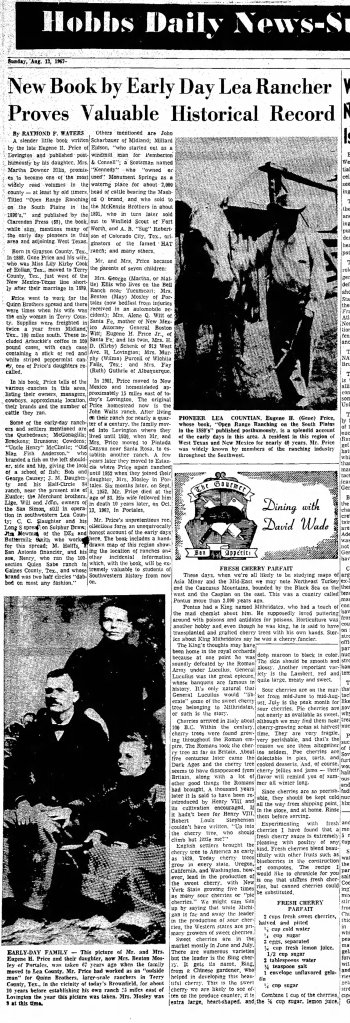
Gene Price (full name Eugene Hubbert Price) was born on November 19, 1868, in Grayson County, Texas to Theodore Martin Price (1836 – 1927) and Martha Ann Virginia Drisella Hubbert Price (1842 – 1905). Theodore Martin Price was a farmer/rancher/merchant and also a circuit riding Methodist preacher. From his early years, Gene was keenly interested in ranching, beginning in the era of the open range.
As a young man, he worked on several ranches in the southwest. He named the Quinn Brothers, the Hat Ranch, Pemberton Brothers and the E Ranch in his comments. In 1889, he married the former Lily Kirby Harris Cook in Eolian, Texas. Around 1901, the family homesteaded in New Mexico, at the corner where Yoakum, Gaines, Eddy, and Chaves counties met – roughly 15 miles east of the future site of Lovington.
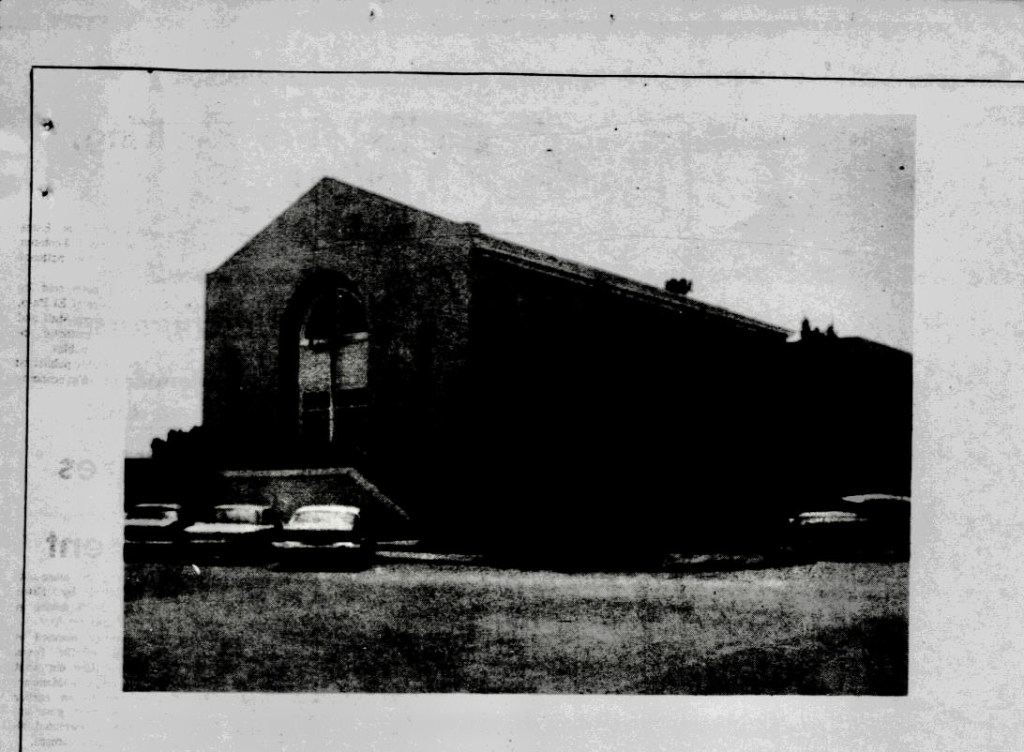
Mr. Price built up one of the area’s earliest high-quality registered Hereford herds. For a while, he leased the Highlonesome Ranch, and the family resided in its old headquarters house. As their children reached school age, the family bought a home in Lovington while still working the ranch. Gene served on the Lovington School Board and participated actively in community matters; he generously donated land for a second, larger school building, which served as the town’s only school for many years. He was a long time member of the Methodist Church in Lovington.
In his later years, he authored “Open Range Ranching on the South Plains in the 1890’s,” a memoir of his early experiences that has become a valuable resource for those interested in the region’s history. Long out of print, the original publication included a reproduction of Gene’s informative hand drawn map of Lea County and the surrounding area.
Mr. Price passed away on September 5, 1952. Mrs. Price died on October 16. 1962. Both are buried in Lovington Cemetery. In 1988, he was posthumously honored with a Bronze Cowboy award for his numerous contributions to the early traditions and settlement of Lea County.
Image credit – Hobbs Daily News-Sun, August 13, 1967
Chances are, many readers have been to Carlsbad Caverns numerous times. Below is is an excerpt from reporter Alvin Rucker’s column “Across the Trail of Billy the Kid” in the July 6, 1929 issue of the McCurtain Gazette published in Idabel, Oklahoma:
Tourists from Oklahoma who plan to drive over the Oklahoma City – Carlsbad Cavern route this vacation season should arrange travel schedule so as to reach Lubbock, Texas, at the end of the first day’s drive, and Carlsbad the second night. It is necessary to be at the cavern entrance at 10 o’clock a.m. in order to get through, for at that hour the “donters” start. The cavern is operated by the federal government. One daily trip is made through the cavern, about five hours being required. All go in a big mob, and for every 20 visitors there is one “donter.” It is the “donters’” business to go along and tell you to quit whatever you happen to be doing. It’s “don’t walk so fast;” “don’t walk so slow;” “don’t go in there;” “don’t touch the rocks;” “don’t carry away any of the formations.” When I got out of that cavern I was as obedient as a private in the Army. It is necessary for the guides continually to admonish the visitors in order to prevent accidents and to preserve the cavern in its pristine condition for succeeding generations. Much of the original beauty of Mammoth cave, Kentucky, been lost through wantonness on the part of visitors, and the government is wisely trying to preserve Carlsbad cavern. A portable typewriter ean not give even a hint of the awe-inspiring grandeur of the interior of Carlsbad cavern, and the best that I can do is to send you some pictures, but even photography is pitifully inadequate. The cavern is electrically lighted and trails are absolutely fool-proof. The great dining room where hot dinners are cooked and served is 650 feet under ground. It was the farthest I had ever been from heaven. The head guide pointed out a formation which, he said, had required 60,000,000 years to complete, after the cave was formed. A man from New York demanded a recount, but got no second. Sixty million years may a long time when compared with man’s allotment of three score and ten years on earth, but after all, 60,000,000 years is not even a sun-up in eternity. If Billy the Kid had known of that cave they wouldn’t have had him yet.
Literature issued in connection with the cavern states that the ascent is so gradual and slow that even the aged need not fear becoming fatigued in making the trip. I noticed, however, that a white-haired old gentleman from Maryland who was making the trip the day I was in the cavern panted like a prize fighter in the last round he got half way through, and he gave up. Next day I saw him in Roswell and he was all right. He said that he wouldn’t have become tired but for the fact that he had asthma and heart trouble. He sorry that he was not able to go clear through the cavern. I told him that in a few more years they would be running ambulances through the cavern for invalids and that he could make the trip then. That cheered him up.
Those who want to turn back before the journey is completed are permitted to do so with an escort at dining room, and the others go on. I stayed until the finish, but I had rather change four flat tires in a downpour of rain or beneath the burning sun of the Carrizozo desert than climb that last flight of 200 steps, after tramping for hours in the cavern. In coming out it is the last 1,000 miles that seems the hardest on old folks. Five hours is a long time to be out of God’s sunlight, during daylight hours. It seems like eternity. When I got out, I hurried to Carlsbad, 30 miles distant, and bought all the newspapers I could find, in order to see what had happened on earth while I was underground – it seemed so long. The dining room is operated as a private concession. The meals are cooked down there and there is a telephone in the dining room. The meals cost 75 cents and are worth the money. The cavern is probably the nearest bone-dry spot between the Rio Grande and the Canadian border.
Carlsbad cavern is winter resort for to the millions of Oklahoma bats that make the caves of Major county their homes during the summer. Bats are great tourists, according to batologists, who say they are exceeded in prodigious flights only by wild geese and flivver owners.
It is needless for Oklahomans to hasten to Juarez after visiting Carlsbad cavern, for they will be making and selling it in Juarez long after the vacation season is over. In Carlsbad, Juarez-bound tourists, pending the completion of the scenic cutoff, are directed to drive south to Pecos and then west to El Paso and Juarez, but if you take my advice you will do as Carlsbad citizens themselves do when they start to El Paso and Juarez – drive north to Roswell and then west over the highway scenic route. Stay in New Mexico as long as possible, not only because of the places of historical and topographical interest, but because of the wonderful highways. In New Mexico you pay 25 cents a gallon for gasoline, but the extra price goes on the highways, the tourist obtains more miles per gallon, and if time is an element he can drive 100 miles an hour, if his car will go that fast.
Southern New Mexico is a tourist’s paradise. The serpent-like Rio Pecos, the noisy Ruidoso, the Bonito, the Hondo and Tularosa flow through it; the Capitans, the Guadalupe, Sacramento and the Sierra Blanca rise above it; white desert sands glisten in it and over all is the sunny mantle and atmosphere of Mexico and Spain.
From Carlsbad drive 15 miles north on Highway No. 2 and stop at a lone filling station on the right side of the road. It is run by Frank Head of Konowa, Okla. Get Head to introduce you to John McKenzie, a cattle herder on the surrounding plains. McKenzie will be glad to take you up the road a few miles and show you the site of a forgotten adobe town and its abandoned cemetery – old Seven Rivers. Long before there was a railroad in New Mexico Seven Rivers was a boisterous cow town, and the hang-out for the Seven Rivers Warriors and L G. Murphy’s cowboys. Stage and freighters made old Seven Rivers a stopping place during the 15 years following the Civil war. Nothing remains now except the ruins of old adobe buildings, thousands of pieces of whiskey bottles, poker chips and revolver shells. John Dowe transported lumber on burros to old Seven Rivers and erected a frame saloon building. Among the adobe saloon buildings and other adobe houses the frame structure was so outstanding the knights and knaves of the plains literally shot it to pieces. McKenzie can tell you that there not a space that could be covered by the hand that was not perforated by revolver and rifle bullets. Have him take you to the old Seven Rivers cemetery, nearby, and you will see that the whooping, whiskey drinking, revolver shooting cowboys did not spare even the few tombstones when they were looking for targets.
The Pecos valley was to the cattle covered plains, what the Nile valley is to Egypt – the most fertile and desired section, and hundreds of thousands of longhorns once grazed in the valley. The herds were owned by kings who paid no tribute; they were guarded by men who acknowledged no master and who knew no home except the saddle. Drive on north to Roswell, 60 miles, but when five miles south of Roswell turn to the right in a grove of cottonwood trees that leads to several brick houses. That is the the old South Spring ranch headquarters where old John Chisum, cattle king of the Pecos valley, once lived in medieval splendor. On burro backs he brought trees from distant states and set out a great grove, nearly all of which is now gone. He built a great adobe castle with 20 rooms the remains of which can still be seen in the jungle of underbrush to the right. The great spring which gave name to the place has been so depleted by the drilling of irrigation wells that only a remnant remains. Following the Lincoln county war the ranch passed into the hands of the Hagerman family, pioneer railroad builders in New Mexico, and has since remained.
At Roswell, drive a few miles east to the Pecos river bridge and you will be in the area that comprised Pat Garrett’s ranch at the time he was sheriff of old Lincoln county and killed Billy the Kid. From Roswell drive 40 miles west on highway No. 366 across a mountain desert to the Hondo Trading Co.’s store, but instead of turning to the left, keep straight on 10 miles into the historic town of Lincoln, once the county seat of an area 200 miles square – old Lincoln county. Stop over night at the Boniot Inn. While you are listening to the phonograph playing the saga of Billy the Kid, look directly across the street at the old McSween-Tunstall store around which the cattlemen’s war raged. Adjacent on the west stood McSween’s great adobe of 15 rooms which the Murphy faction stormed and burned during a battle with McSween defenders led by Billy the Kid, 50 years ago. The heavy wooden shutters on the windows are still metal-lined to resist bullets, just as they were then. The McSween home and store were converted into forts during the five-day battle between the rival factions of cattlemen and their cowboys. Three of the men were either from or returned to Oklahoma at the end of the war. Some of the relatives of the three are very prominent in Oklahoma today. Employ Luna to walk with you from the east end of the mile-long old road that still serves as a street, and point out the old buildings and the rock fort that played such important parts of the Lincoln county war. The old Ellis house on the north side of the road, at the east end ot the street, is where Governor Lew Wallace, of Ben Hur fame, wrote the letter and kept the clandestine appointment with Billy the Kid and induced him to surrender. Have Luna point out to you the door jam in the Montana house where Billy the Kid carved his name. The letters are still there, after a lapse of a half century. Have Luna point out the mountain top, three quarters of a mile from the McSween store, from which Billy the Kid shot an enemy during the famous battle, the body rolling clear down the mountain side, where it is buried in an old cemetery, filled with the the bodies of men who died with their boots on. The two-story adobe building on the south side, at the west end of the street, was the old Murphy store, in the upper east of which Billy the Kid, while waiting to hanged, killed one of his guards, and then from of the east window of the room killed the other and escaped. The building is now the Lincoln public school building. Luna, your guide, witnessed the killing of one of the guards. Four miles west of Lincoln there still lives an aged Mexican, Ygnio Salazar, who was one of the fifteen defenders of the McSween home and store when the two buildings were stormed, one burned and the other looted, by the Murphy faction.
Drive back to the Hondo Trading Co.’s store and follow the south prong of Highway 366 through the beautiful Ruidoso and Tularosa canyons. On the left side of the road a few miles after passing Bonnell’s ranch you will see an old gentleman selling cider. He is George Coe. He owns 360 acres of irrigated land and has a lease on several thousand acres of adjacent mountain land on which he grazes cattle. Notice that the first finger of his right hand is gone and the hand shattered. He was a participant in the Lincoln county war and was shot by Buckshot Roberts at Blazer’s Mill, which you will pass as you drive down the road. At Blazer’s mill talk with the storekeeper, J. H. McNatt. He used to be a cowhand around Ryan and other southern Oklahoma towns. He knows everybody in Oklahoma – whom they married and whom they killed. Just before reaching the Mescalero Indian reservation there is a spring on the south side of the road. Stop and drink out of it. Fifty years ago, Fred Waite, Jim French, John Middleton of Oklahoma and Henry Brown, with a dozen members of a posse, headed by Billy the Kid, stopped there to drink, with a fatal result. At Tularosa turn south to Alamogordo and there be certain to fill the gasoline tank. Instead of following highway No. 366 as the bus does, follow state highway No. 3 across the Alamogordo desert, sixty-two miles between filling stations or other signs of habitation. The road is fine and mountains on the distant desert rim soon come into view. When you reach the White sands, park the ear and climb to the top of the seemingly endless dunes that stretch a hundred miles away. You are not apt to get lost unless you become snow-blinded, as you can follow your tracks back to the car. Stop all night at Las Cruces, an American city populated by Mexicans, and next morning drive out to Pat Garrett’s grave, and then five miles south of Mesilla Park, a collection of filling stations. At Mesilla Park turn west on a good dirt road and go another five miles to Old Mesilla, a dreamy Mexican adobe town with ruins that resemble pueblos.That building the big elephant painted on the side is the old court house in which Billy the Kid was tried and sentenced to be hanged for killing Sheriff Brady at Lincoln, during the cattlemen’s war. It was later the Elephant Saloon and is now a Mexican pool room. After you tire of old Mesilla, return to the highway and drive forty-five miles south through El Paso and to the American end of the International Bridge.
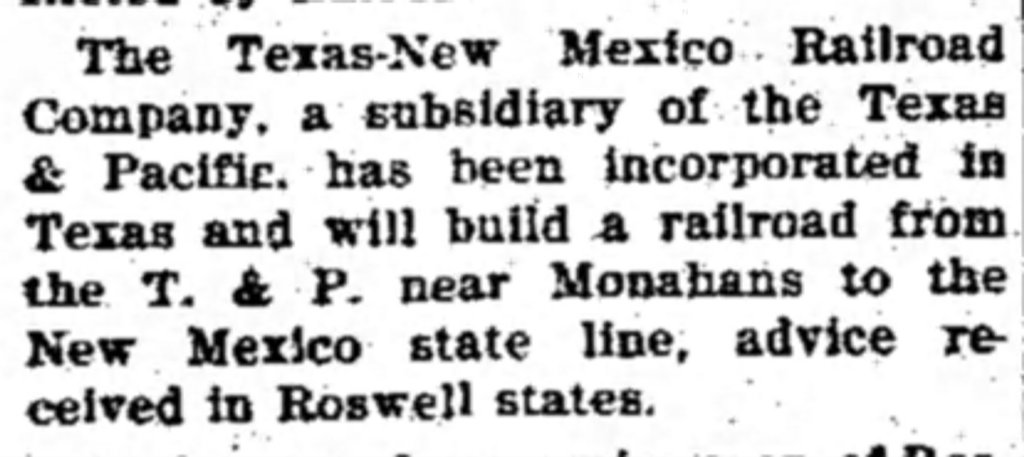
The Texas and New Mexico Railway has been in business for close to 100 years. The line runs from Monahans, Texas to Lovington, New Mexico covering a distance of over 110 miles. The railway has been beneficial to Lea County in transporting oilfield products and other materials for the oil and gas, ranching and wind electricity generation industries and general business freight.
Prior to the discovery of oil in the Permian Basin, there were proposals to extend freight rail lines to Lea County from West Texas, but the plans were not realized. Once oil was discovered in the area in the late 1920s, rail service became more economical and appealing. The railway was incorporated on November 19, 1927 as a subsidiary of the Texas & Pacific Railway. The first train rolled into Lovington, the end of the line, on June 7, 1930. No copies of it can be found online, but the Lovington Leader issued a special “Railroad Edition” for the occasion.
Image credit – Casa Grande (AZ) Dispatch, December 18, 1927.
Over the years, the ownership has changed several times with the longest single duration of ownership being Texas and Pacific Railway (T&P). T&P was merged into the Missouri Pacific Railroad (Mo-Pac) in 1976. Mo-Pac merged with Union Pacific to become the Union Pacific System (UP) in 1982. UP sold the line to RailTex in 1989. In 2000 Railtex was taken over by RailAmerica, Inc. Two years later, the line was sold to Permian Basin Railways, a subsidiary of Iowa Pacific Holdings. Watco, a privately held company, acquired the line in 2015.
To view Watco’s description of the line, a map of its rail stops and other information, please see this page on Texas & New Mexico Railway.
Robert Lincoln “Bob” Causey was born in Illinois on February 12, 1868 to George Washington Causey and Mary Adeline Crowder Causey. February 12, 1809 was the birth date of the late United States President, Abraham Lincoln. This was likely the source of Robert’s middle name. Concerning his place of birth, articles usually say that he was born in Missouri, but both the 1870 and 1880 census pages list his place of birth as Illinois. He was one of ten children born to the couple, many of whom were also born in Illinois. George W. (the father) had been born in Tennessee and in the 1870 census, his occupation was listed as farmer. He was still shown as being a farmer in the 1900 census before his death in 1907 at around 80 years of age. He died in Guthrie, Logan County, Oklahoma Territory. Mary Adeline had predeceased him, also in Oklahoma, in 1895.
In the 1880 federal census, Bob was twelve years old, still living with his parents and two of his sisters in Adams County, Iowa. The other siblings had left the family home over time. Several of the brothers including John and Thomas (known as George), had been making their living since the 1870s as buffalo hunters and had moved west following the herds. They had begun to hunt the big animals in Kansas and as the herds worked their way south, they followed them, eventually crossing the Arkansas River and venturing into areas that had been set aside by treaty as hunting lands for the native tribes which roamed the area. George continued this until he reached the Panhandle of Texas. Still in close proximity to the roaming tribes, George was not involved in either of the two battles of Adobe Walls, but he was camped near enough to hear the shooting during one of the events, at the time assuming that it was his fellow buffalo hunters at work.
However, by about 1882, the herds had been depleted to the point that the brothers realized that they needed to find other livelihoods. So, they headed further west to the New Mexico Territory with a plan to round up, raise and sell wild mustangs, which they did with little early success. Bob must have been drawn to the west himself, as later in 1880 he is said to have left the family home with $5 in his pocket. He made his way as far as Indian Territory where he managed to stop in an unnamed town and find a job as an apprentice in a blacksmith shop. He worked there for about four years earning a tiny wage plus room and board before moving on to join his brothers around 1884.
In the meantime, his brother George settled for a while in the Yellow House area of West Texas before moving on. George found a seepage spring and dammed it up to provide a water supply. There he built a sod house as his home base. The area took its name from nearby geological formation of limestone bluffs that were pockmarked with caves. The name in Spanish was las casas amarillas which in English was translated “yellow houses.” The general area was to later become part of both the XIT and Yellow House (owned by Littlefield) ranches at various times. George was aware of the enormous transaction had taken place between the State of Texas and a syndicate to create the XIT and decided it was time to move on. When the XIT began to be dissolved after around 1910, the Littlefield operation acquired some 236,000 acres of the former XIT.
George and John Causey left West Texas and resettled in southeastern New Mexico, near a place called Monument Spring before building their ranch house a bit north of there. They built their ranch headquarters about five miles south of what became the town of Lovington and roughly fifteen or so miles northwest of what became the town of Hobbs. Bob appears to have joined them at their ranch a few years later. He stayed in southeastern New Mexico until in the latter part of the 1880s, when he branched out to set up his first blacksmith shop in Odessa, then basically just a water stop for the Texas and Pacific Railroad. He was soon joined some time later by his recently widowed sister Nellie Causey Whitlock and her young son, Vivian Whitlock. As Netties’ son grew up, Bob took him under his wing at the blacksmith shop. However, Whitlock did not follow in Bob’s footsteps as a blacksmith. Instead, he became a writer. He published one book, “Cowboy Life on the Llano Estacado” and numerous stories and articles in magazines and newspapers over thirty plus years. Some knew him by his pen-name, “Ol’ Waddy” and others under his given name.
Being one of the earliest Anglo settlers to arrive in the area and an early blacksmith, Bob is called the “first blacksmith of the Llano Estacado.” In addition to his day to day blacksmithing duties, Bob began to make spurs and bits for the local cowboys. One of his designs was called the “gal-leg” spurs. They were so labeled because the neck or shank of the spur (the part that extends behind the boot) was fashioned to resemble a woman’s leg, with the foot or toe holding the rowel pin. (Parts of a spur.) Bob is sometimes credited for coming up with the gal-leg design, but even if he was not the inventor of the design, he was at the least one of the first to make them.
Bob remained in the Odessa area for about ten years, also serving as constable as the town grew. He moved to Eddy, now known as Carlsbad, New Mexico about 1895. There he set up a blacksmith shop on Main Street. He operated the shop for many years before partnering with Robert Osborn. Bob married Martha Agnes Bogle in 1903 and the couple had one daughter. His reputation spread and Bob became well known for his spurs and bits. He would make them up ahead of time and also make them to order. When he signed his work, he stamped the articles with his initials, “R. L. C”. In addition to the gal-leg design, he was known for fashioning the neck or shank in the shape of a horse head. He would often adorn them with Mexican coins that he would collect on his travels and save for just this purpose.
After a few other moves, he was finally drawn to move to Safford, Arizona in 1924. He remained there until his death in 1937. He is buried in Safford City Cemetery. His wife Martha Bogle Causey survived him by twenty-four years and is also buried in Safford City Cemetery.
Source: “Then and Now – Lea County Families,” Lea County Genealogical Society, Walsworth Publishing Company, 1979.
Tom Conway interviewed Robert L. “Preacher” Jones for an article in the above mentioned book. In the interview, Rev. Jones was said to be the first person of African American descent to move to Lovington, arriving in 1931 and staying a short time. He had previously lived in Hobbs, moving there from North Texas where he said he had grown up on the “Wagner” (probably a reference to the Waggoner) Ranch near Vernon, Texas.
The interview stated that he had moved to Hobbs, attracted by the oil boom, where he did some carpentry work. After that, he left the area for a while, returning in 1933 to Lovington where he bought property on a high place to the east of town.
The article stated that one David Martin was the second person of African American descent to come to Lovington around 1935. Mr. Martin bought some of Rev. Jones’ land where he built a home and lived until the 1950s. While in Lovington, Mr. Martin, reportedly disabled, worked shining shoes at Simpson’s barber shop. He is said to have later moved to Hobbs where he worked for the Postal Service.
Rev. Jones was a pentecostal minister and a carpenter and remained in Lovington the rest of his life. The article stated that he had built some seventeen churches and many homes. Rev. Jones is said to have named the neighborhood Rock Hill. Rev. Jones also was the first garbage collector for the neighborhood. He would drive around and pick up garbage in his pickup truck.
In addition to Jones and Martin, the article also mentions other early residents: the Cottons, Andover Williams, Olene Fillmore. The article also mentions B. W. “Overcoat” Williams as being an early resident.
Rev. Robert L. Jones died in 1986 and is buried in Lovington Cemetery along with his wife, Annie.
[This is a transcription of an article that appeared in the Lovington Daily Leader on July 6, 1962.]
Though there were other churches in the eastern portion of Eddy and Chavez Counties, there were seven determined Baptists in the Caprock vicinity of Lovington in 1910 who wanted their own place of worship.
These seven people met on a cold evening in January 30, (1910) and established the First Baptist Church.
Gathered that evening with Reverend Parrock of Garden City, Texas were W. D. O’Kelly, Rollin Wright and Mrs. Wright, Miss Clara Creighton, Mrs. M. S. Allen, James M. Rodin Jr. and Mrs. Roden.
The group called as its pastor, Reverend J. M. Roden, Sr. who took the call at the handsome salary of $150 annually.
The church had its first revival in October of that year, which resulted in an increase of membership of over 500%.
East of this small village a group, in 1912, selected a small rise in the prairie to erect their first building, a white structure which was referred to as the “Silo.”
The second pastor, Reverend J. H. Clouse, from Texline, Texas, served at the salary of $1200, to be paid, $600 by the Board, and $600 to be raised in the field, comprising, Lovington, Monument, High Lonesome and Midway.
The friendly white “Silo” building, continued to provide a meeting place for more than a decade, even though it was damaged by fire on one occasion, and later a “blue norther” damaged the framework.
In November 1916, Reverend O. L. Vermillion assumed the pastorship, he was followed within two years by Reverend E. J. Barb, who served two years, and was in turn succeeded by Reverend W. F. Dillard.
The church had no pastor from 1922 to July 1925; however, the members provided enthusiasm and continued their worship and in 1925 a new building was erected at the present location.
During the time the small white church served as their place of worship many memories are recalled by the older members that served only to strengthen the faith of the small group. One remembers the arrival of the Reverend Vermillion with his six children, and with no parsonage to move into they remained as guests of the John D. Grahams until a home could be provided.
Preachers made their circuits with the mail routes, and had no schedule other than the mail run. Strong hands at a pump handle enabled Mrs. Creighton to play the hymns on the church organ while Jimmy Roden and Mr. McArthur led the singing, Mrs. Keene Bar and Grace Love also sat as church organists. The congregation used hymn books acquired from various sources. Most of these disappeared after one particularly hard winter storm when a family which had no other shelter took refuge in the old building and stoked the pot-bellied stove with hymnals. Mr. McCallister, Del Woods and other nearby ranchers made their stock tanks available when there was baptizing to be done.
The new building was started with $150 in the treasury and a gift of two lots which cost Uncle Railand Love $5.00 each. Martin’s wagon yard had been on that corner at one time.
During the building of the new church the members met in the county court house with lay preachers such as Frank Dillard filling the pulpit, assisted by guest preachers from Albuquerque, among them Joe Land, State Evangelist, J. W. Bruner and Mrs. Joyner.
In July 1925, Reverend J. B. Parker accepted the call from the church and the congregation continued to grow under the leadership of Reverends J. M. Sibley, W. C. Garrett, Aubrey Short, S. B. Hughs, Loyal E. Brown, Almond D. Noris, William Draper, L. W. Hardcastle and C. G. Watt.
In 1939 the basement of the present building was completed and provided a meeting place until 1948 when the present building was completed.
The present pastor is J. Samuel Phillips, whose youth and enthusiasm provides the same inspirational guidance as that of the church’s former leaders.
121 N. First St., Lovington, N.M.
[Lovington Daily Leader, Lovington, New Mexico. 6 Jul 1962.]
[This article about Sister Mary Fides was transcribed from the Hobbs Flare issue of March 1, 1984. It was written by Patricia Breyman.]
This week’s old timer is 80 years old, is devoted, compassionate, courageous, loving, caring — all of these plus dedication personified. However, what this reporter also quickly recognized in her beautiful face is happiness, contentment, laugh lines from a marvelous sense of humor, warmth. tenderness, eyes alive and alight with expectation, and a readiness for helpful escapades that has about worn out her guardian angel!
She is sister Mary Fides, Dominican Order, serving St. Helena’s Catholic Church in Hobbs in a full-time and very active position as Director of Religious Education.
She was born as Agnes Cecelia Gough on June 22. 1903 to George Joseph Gough and Ophelia (Pickard) Gough. Her father was from Kentucky and her mother from southern Illinois. They met at a small Baptist College in Illinois, married. and Agnes Cecelia was born into a mixed marriage home – half Catholic and half Baptist. It later became an all Catholic marriage and home. They lived in Uniontown, Kentucky.
CATHOLIC/YANKEE
The family moved from Uniontown to Oceola, Arkansas, smack in the middle of the Bible-belt and into a southern stronghold. Young Cecelia found herself as she put it, with two strikes against her she was Catholic and a “damnyankee” to boot.
She was timid and shy but at seven, assured her mother she knew the way to the home of an aunt and uncle in Oceola and was perfectly capable of walking there alone. She didn’t get far from home when she realized she was hopelessly lost. Lost to such an extent she could not find the home of the relatives nor could she find her own home again. She finally gathered her courage, marched up to the front door of the nearest home, and asked for help. It was the Methodist parsonage and the minister’s daughter walked her around and up and down streets until she recognized her own home. She said she always had respect for people of other faiths and the memory of that event only strengthened that respect.
Agnes Cecelia attended public schools until she was a junior in high school. Her mother was afraid she would become “wild” so she sent her to St. Agnes Academy in Memphis, about 60 miles away. The good sister was quick to assure she definitely was not “wild” and has no idea what criteria her mother used to arrive at that fear.
SISTERHOOD REJECTED
She said the last thing on her mind was to enter religious training in any form, much less to become a nun. When asked by friends and family if she considered that as an avocation, her stock answer was ”No, I am not about to wear all those clothes.”
She said “the Lord finally had enough of her foolishness and moved her to the decision to enter training.” Soon after she finished high school, she entered the Mother House at Bardstown, Kentucky to train as a Sister of Dominican Order.
Dominican Sisterhood was founded as a teaching order in 1822. Dominican priests working in the area, started a school for boys (in those days, boys and girls were educated from separate accommodations. They quickly saw the need for sisters to teach the girls. An appeal was soon made from the pulpit on a Sunday morning and eight young ladies answered the call.
The father of one of the eight gave a parcel of land with a log cabin on it as the beginning of the Dominican Sisterhood, with the priests training the eight original young ladies. The first years were a hard struggle but they grew into an order with a magnificent Mother House that covers many acres and they are now one of the most active orders.
When Agnes Cecelia entered the Mother House in January of 1923 to begin training, the Mistress who accepted her had the list of names for the twelve young ladies in that class. Since Agnes Cecelia was first to arrive, she was given her choice of names. She chose Diana, but the Mistress said that had been spoken for; second choice was Mary Thomas, again that had been spoken for by one of the young ladies, because Mary was her mother’s name and Thomas was her father’s name; finally. Agnes Cecelia said, just give me Mary Fides, no one else would choose that anyway. She learned that Fides is Latin for Faith and has been happy with that choice since.
BEGINS TEACHING
After a year and a half, she was sent to the missions and taught at Matoon, Illinois. She spent her longest time – ten years – at St. Catharine of Siena in Memphis, Tennessee.
In between her years of teaching, Sister Fides found time to earn a bachelor degree and two masters. She attended De Paul University at Chicago and got her first degree, a B.S., in Chemistry in 1935. After teaching that subject for some time, she became interested in mathematics, went back to De Paul, built up her prerequisites, and got a masters in mathematics in 1940. She was asked later if she had any interest in home economics, and thought that would be an interesting field. She returned to school, this time to the University Of Wisconsin and got a masters in Home Economies in 1949.
Prior to the Vatican Council II in 1969, Sisters in the Dominican Order (and most other orders as well) were sent where their church felt they were needed – they had no choice.
After Vatican Council II, the late Pope John was said to have thrown open the window and declared the church needed fresh air. To begin this process, he asked the Orders to update themselves.
From that edict, came a gradual modernization “by degrees” of their habit and finally, the greatest change of all, permitting the Sisters to choose their field, the location, and to make their own contracts.
After the 1969 decision to leave regular teaching for religious education. Sister Fides went to Notre Dame Seminary at New Orleans, Louisiana for several summers to prepare herself for yet another branch of her profession.
NEBRASKA
Her first self-contracted job was at the Diocese of Grand Island, Nebraska where she had the entire western half of the State of Nebraska. While there, she got her first drivers license.
In 1973, she left Nebraska for the Diocese of Little Rock, Arkansas and her territory was the entire state of Arkansas. She visited 50 different parishes, some of them several times, where her primary work was in the field or teacher training in church, not in school. She was in Little Rock for three years and loved her work, but realized she was spreading herself thin. She decided to work for one Church so she could devote more time to her new profession. She chose West Memphis, Arkansas and went to work at St. Michael’s where she spent six happy years and made some dear friends. She visits there and Grand Island for vacations when she gets the chance.
In 1979, at the age of 76, she was all set for retirement because she crippled from arthritis and two minor falls. She had resigned from St. Michael’s where the congregation was furious with the pastor for accepting her resignation – the poor man asked them what was he to do other than accept it? Father John, now pastor at St. Helena’s, persuaded her to come to Carlsbad to the religious center and she agreed to if it was not teaching. She had served more than 40 years in that capacity and said times had changed so she did not want to enter that field again. Too, she accepted, because she thought this climate might help her arthritic knee.
HOBBS
She visited Hobbs several times while working at Carlsbad and when the opportunity came to work at St. Helena’s in religious education, she accepted. However. She’s retiring, again, come June of this year, and I am sure it will be with deep regret that this resignation is accepted.
She said religious education is very different from teaching in Catholic schools but that it is very satisfying work. She is responsible for retreats, discussion groups, preparations for confirmations, baptismal preparations, conducting classes on Sundays for approximately 230 children of Kindergarten through sixth grades. a variety of programs for junior and senior high school age, and the 5:30 Sunday Mass which is designated “youth mass.”
She teaches a sexual education class – careful never to the word “sex” as opposed to “sexual” and bases every statement on scripture. She seems to enjoy the reaction her appearance always brings when she enters this classroom – a nun and one who is 80 years old teaching sexual education!! She laughs to herself, not just for the fun of it, but in conjunction with her classes. She uses a book which she wrote. “My Sexuality – A gift of God” in these classes and feels it is helping some to combat the ideas these children and youth are getting from their peers, from television, and from the streets. She is distressed that they are missing the moral implications and stresses love in all that she teaches. She said they need dwell on the different kinds of love – love Of God, love of parents, love of friends, and romantic love.
This serene lady has many happy memories of her years of teaching and in religious education, among them taking a group of children to Little Rock to visit the Cathedral of St. Andrew where their Bishop, who knew the children were coming, spent extra time explaining each vestment and sacrament to the children. Later he met with them and gave Sister Fides money to treat them to lunch at McDonalds. He said they might have happy memories of the day if he, Bishop McDonald, sent them to McDonalds for lunch!
She still has contact with many of her former students and parishioners – one, Philip Wray from St. Michael’s had called the day of this interview to report success in his first real job.
CHURCH FAMILY
She said only recently, she was thinking how alone she was with most of her family gone, when she looked around at the huge church family she has and realized she was not alone and never would be.
She celebrated her golden jubilee in 1976 when friends sent her on a trip to Paris, Vienna, Belgium, Italy, Isle of Capri, and highlighted by a group audience with Pope Paul. She has traveled to Mexico City more recently for a pilgrimage and mass at the Shrine of Our Lady of Guadalupe celebrating the new diocese of New Mexico, headed by Bishop Ricardo Ramirez.
She reads incessantly, enjoys crafts such as crochet, making banners, and ojo de dios; she is doing for others – such as the wild trip at Christmas to drive the vehicle of another Sister to Tennessee and then fly home. Before long, the terrible winter blizzard conditions overtook them, she had three very close calls, but with God’s help (and that poor frazzled “guardian angel” watching over her) they arrived safely.
She relatively good health now except for a broken wrist she got the day before Thanksgiving, and it is still in a cast. For several years she was crippled to the point of having great difficulty in getting around until she came to Hobbs and Dr. Maldanado operated on her knee. He inserted a plastic one, and now walks without even a cane.
In facing her retirement, she says her one dream for religious education is training on an ungraded basis. She hates leaving without accomplishing this but hopes others will carry on the programs to that goal.
This serene lady’s only concession to “old age” (and even the mention of the word in conjunction with this active person seems sacrilegious) is sleeping late. She said she arose at 5 o’clock each morning for almost all her life but now sleeps “late.” Late to her is 7 o’clock at which time she arises, goes to her office for prayers, then Mass, and another day at work.
Dr. Terrell served as a medical doctor for many years in Lea County. In 1941, he purchased the Shuler Hospital from Dr. A.C. Shuler after Dr. Shuler announced that he was relocating to Carlsbad to join the Womack Clinic.
The building where the medical practice and hospital was located was going to be renamed the Terrell Hospital. It had been built in 1931 and was once of the first brick buildings to be built in Hobbs. It could accommodate six patients.
An article in the Hobbs Daily News-Sun on February 16, 1941 recounted that Dr. and Mrs. Terrell had lived in Hobbs for the past eleven years and that the former owner, Dr. Shuler had lived in Hobbs for five years. The article continued that no changes were anticipated in the operation of the hospital following the change of ownership.
Dr. Price was the son of Albert Pinkney Terrell (1852 – 1914) and Bennora Trabue Terrell (1861 – 1942). He was born to the couple in Kentucky on December 16, 1884. Allen P. Terrell was living with his parents and four siblings in Missouri in the 1900 census. By 1910, he was about twenty-five years old, single and was working as a physician in Dallas, Texas. He was living with his parents and two siblings. Dr. Terrell served in the field artillery during World War I at the rank of major. By 1920, Dr. Terrell appears to have been living in Wichita Falls, Texas, was single at the time and was practicing as a physician. He relocated to Hobbs, Lea County, New Mexico in 1929.
Dr. Terrell was last married to Maude Hawkins Terrell (1888 – 1967). Mrs. Terrell was a nurse by profession and during the time in which they owned the Terrell Hospital in Hobbs worked and helped to manage the facility.
Dr. Terrell passed away in 1947 while still living in Hobbs, New Mexico. Mrs. Terrell survived him by another twenty years and both are buried in Riverside Cemetery near downtown Wichita Falls, Texas.


 Old Lea County, N.M.