Old Lea County, N.M.

Category: rodeo

  • Clay McGonagill

    Henry Clay McGonagill was born on September 24, 1879 to George M. McGonagill (1841 – 1921) and Narcissa Josephine “Grandma” Haynes McGonagill (1839 – 1935) in Sweet Home, Texas. His family were ranchers and he grew up in West Texas and Southeastern New Mexico as they finally settled in Lea County. It was there that he learned to ride and rope as he lived and worked on the family ranches. Later he did some cowboying for other ranchers.

    For many years, Clay was a championship rodeo contestant and supported himself with his rodeo winnings, primarily in steer roping. In the day, many such rodeos were local affairs and some were known as “fairgroundings.” McGonagill nevertheless developed a wide reputation in the rodeo world competing in the United States, Canada, Mexico and at least one time in South America. Clay moved around over the years, but for a while he operated out of a ranch in Monument.

    He married Annie Laurie Johnston in 1904 and the couple was living in Arizona when Clay was accidentally electrocuted. On October 24, 1921, he was hauling hay on the Papago Indian Reservation near Sacaton, Arizona when he came across a low hanging power line. In trying to clear the roadway to make room for his hay wagon, he came on contact with the power line carrying 11,000 volts of electricity and was instantly killed.

    Clay is buried in the Lovington Cemetery in Lea County along with his parents. He was inducted into the National Rodeo Hall of Fame in 1975.

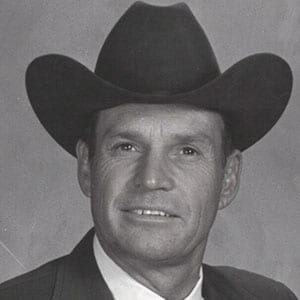
  • Dale “Tuffy” Cooper

    Tuffy Cooper was born November 7, 1925 in Lovington, New Mexico to Alaska J. Cooper (1894-1959) and Tommie Lou Bingham Cooper (1904-1990). His grandparents were James Wesley Cooper (1858-1941) and Iolia M. Weir Cooper (1868-1940) and Thomas Swindell Bingham (1872-1944) and Louella Mae Simcoe Bingham (1874-1950).

    Tuffy’s fraternal grandparents came to New Mexico in 1906, settling near Monument. They had at least six children and his father Alaska was about twelve years old when they moved from central Texas. Tuffy said that the trip from Yatesville, Texas to Lea County, which would have been by covered wagon, took three weeks. When his father Alaska was a teenager, he had worked as a ranch hand on the Bingham place, where he likely met his future wife Tommie Lou. The Alaska Cooper family later owned their own ranch.

    Image credit: National Cowboy & Western Heritage Museum

    An obituary said Tuffy started competing in rodeo events in 1935, which would have been when he was about ten years old. In a 2008 interview, he did note that he took his first cattle drive when he was only five years old and recalled helping to drive 200 head of cattle from Monument to Knowles. Tuffy said that the trip took two days and nights.

    He said that his experience on the ranch made him a better roper and also remembered an infestation of screw worms in the early 1940s when he and the other cowboys had to treat the cattle. He was only a teenager. Ranch help was hard to come by and the owner of the place hired Tuffy and his brother Jimmy because they were “the only boys in the country who can rope.”

    When Tuffy was a student at University of New Mexico, he helped to found the National Intercollegiate Rodeo Association. He competed in the Professional Rodeo Cowboys Association and won many roping titles as he competed in the calf roping, steer roping and team roping events. After his rodeo career ended, he was a spokesman for the PRCA and remained active in the sport by serving as a judge and rodeo announcer. He was also the author of a booklet of ranch and cowboy sayings called “If You Ride a Slow Horse, You Need a Long Rope,” which appears currently to be out of print.

    Tuffy was always quick witted. Once at an event in San Angelo, Texas, the San Angelo Rope Fiesta, he was serving as a flagman for the team roping event. Someone complimented him on the paint horse he was riding. Tuffy said “Yeah, he belongs to Trevor (Brazile), but he’s mine as long as I can stay mounted.”

    Tuffy was inducted into the New Mexico School Board Hall of Fame and was a founding member of the Lea County Cowboy Hall of Fame. His many honors also include being named as an inductee in the National Cowboy Hall of Fame in Oklahoma City and the Texas Rodeo Hall of Fame in Fort Worth.

    Tuffy passed in 2013 and is interred at Prairie Haven Memorial Park in Hobbs, New Mexico.

  • Fern Sawyer

    “She died in the saddle, surrounded by friends.” said Peter Holt, as quoted in the October 21, 1993 issue of the Lincoln County News, Carrizozo, New Mexico. Most recently Ms. Sawyer had resided in Nogal, Lincoln County, New Mexico.

    Fern Sawyer was born at Buchanan, De Baca County, New Mexico, on May 17, 1917 to Uyless Devoe Sawyer and Dessie Lewis Sawyer and was raised on the family ranch at Crossroads, near Tatum, New Mexico. She passed away at the age of 76 on October 16, 1993 near Blanco, Blanco County, Texas while visiting friends. Earlier in the day, Ms. Sawyer had been riding with friends and herding heifer cattle when she told another rider she was feeling tired, and shortly thereafter, she passed away.

    A funeral service was held the following Tuesday at St. Andrew’s Episcopal Church in Roswell, officiated by Rev. Robert L. Williams. The service was attended by her many friends, including Governor and Mrs. Bruce King. According to a newspaper report in the Roswell Daily Record, the eulogy was given by Mr. Holt and the service included the singing of “Amazing Grace.” After the service, she was interred at Tatum Cemetery, Tatum, Lea County, New Mexico where her mother and father are also buried.

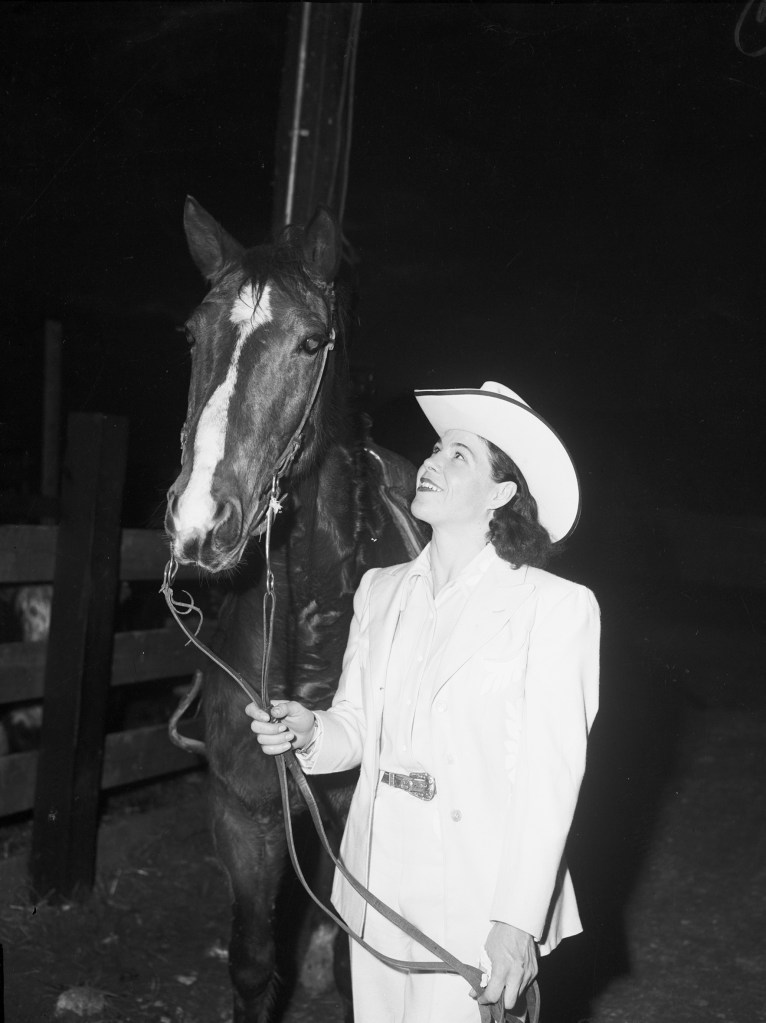
    At an early age, Fern had exhibited her talents in the area of horsemanship and became well known for her abilities. She was encouraged by her parents to work on the ranch and inspired by them to perform as well as any of the men. She began a rodeo career by competing in events previously confined to male contestants. Her many accomplishments include winning the cutting horse championship at the 1945 Southwestern Exhibition and Fat Stock Show in Fort Worth, Texas. She won the Cutting Horse competition aboard her horse “Belen.” In the competition, she eliminated Grady Blue on “Tom Cat” and R. W. McClure on “Smokey” who were second and third place finishers. She is shown below looking up at Belen.

    Image credit: University of Texas at Arlington, Digital Collection, Special Collections Identifier: AR406-6-27

    Fern’s honors include being inducted into the National Cowgirl Hall of Fame, the National Cowboy Hall of Fame and the National Cutting Horse Hall of Fame. She won the All-Around World Champion Cowgirl title in 1938 and the Cutting Horse World Champion title in 1947.

  • Jake McClure

    Sources include 60th Anniversary commemorative program for the Lea County Fair and Rodeo in 1995, newspaper articles and traditional genealogical sites:

    The Jake McClure Arena was constructed under the management of the Lea County Sheriff’s Posse and is dedicated to Jake McClure.

    Roy Leonard “Jake” McClure was born November 26, 1902 in Amarillo, Potter County, Texas to Patrick Henry McClure and Cynthia Elizabeth “Lizzie” Birdwell McClure who later moved to Lea County. Jake married the former Kathryn Matthews in 1932.

    Jake was described as walking around with a rope in his hand at age 2. He left home at 15 to work as a cowboy and learned the rodeo life under Tom Standifer in Fort Worth, Texas in 1922. He became known for his precision in roping using a small fast loop called “The Jake McClure Loop.”

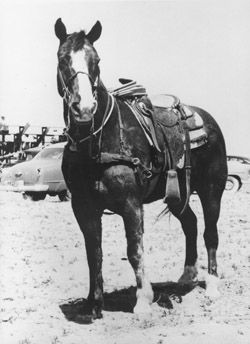
    Jake earned the title of World Championship Calf Roper in 1930. He was named World’s All-Around Cowboy at the Pendleton, Oregon Roundup and Arizona State Champion Cowboy, along with many other honors as a calf roper in the United States, Canada and Europe. Locally, he was president of the first roping club in Lovington. Over the years, Jake worked with many good roping horses including his three favorites, “Legs,” “Snip” and “Silver.” Silver was named World’s Best Calf Roping Horse.

    Image credit – Findagrave.com

    Jake suffered a severe head injury on his ranch on July 1, 1940 when his horse fell on him. He never regained consciousness and died in a Lovington hospital on July 9, 1940. He is buried in the Lovington Cemetery.


  • Old Baldy

    The unique funeral of a prominent Lovington personality was held in the quiet of the day here Monday. Not many people witnessed the burial. There was no singing, preaching, or flowers, but this personality will be missed by most all of Lovington. Old Baldy, 28-year-old roping horse owned by Troy Fort, has been laid to rest in the Lea County Fair Grounds at the site of the proposed arena.

    Baldy will be honored with all the respect he deserves when the new arena is opened sometime around the middle of June or the first of July. He will have a marker at this grave and will represent all of the roping horses in this last frontier of the west.

    This will be an appropriate time, as roundup time will be over and it is the time of the year when rodeo performers start thinking of shows across the nation such as Madison Square Garden Rodeo, Cheyenne Rodeo, Santa Rosa Roundup and others. As the gates open on the first attraction in the new arena, there will be a pause to honor one of the most famous rodeo horses in the nation.

    Baldy resided in Lovington for about 15 years. He is remembered here for carrying five men to world championship roping fame. He was the greatest. He was gentle and kind around the ranch, but not may ropers could rope off him. He had such a terrific stop that not many were able to do much more than ride him, much less try to think about catching a calf.

    Volumes could be written about Baldy. He was born in Oklahoma, and is well known there. Many ropers, both young and old, can tell you any number of tales about Baldy. One roper near Plains, Texas thought so much of Baldy that he went to Oklahoma to see Baldy’s brother!

    When arena gates open on rodeos and ropings this year, old Baldy won’t be there. As mesquite grass turns green, and soft winds of spring blow across the range, the familiar sight of Old Baldy will be missing. Baldy is laid to rest where he was most at home.

    [Lovington Leader, 18 Jan 1961, Lovington, New Mexico]


  • Lea County Fair and Rodeo

    [Transcribed from the 60th Anniversary Collector’s Edition of the Lea County Fair and Rodeo program for the event held August 5-12, 1995]

    The History of the Lea County Fair and Rodeo

    In 1935, the editor of the Lovington Daily Leader, Luke Roberts, led an effort to boost farming in this area and a meeting of interested people was called. John Easley, a local rancher and developer, attended this meeting and was made chairman of a committee to help organize the governing board for the first Lea County Fair.

    In 1936 Lea County Fair Association officers were John Easley, president, James P. McClish, vice president, and Bea McLaren, secretary-treasurer. Bea Fort was secretary to W. E. (Bunny) Flint, Lea County Agent and was secretary for the Lea County Fair Association for many years and gave invaluable help.

    Directors of the 1936 Lea County Fair were: J. W. Owens – Eunice; J. T. Wall – Tatum; Joe S. Hill – McDonald; E. L. Harbison – Lovington; A. T. Hutcherson – Crossroads; Pete Anderson – Hobbs; Luke Roberts, Hermon Robinson, and Mrs. Ham Bishop – Lovington.

    Superintendents of divisions were R. O. Beemer, J. S. Hiss, J. P. McClish, John Easley, Mrs. Denver Thompson, Mrs. H. H. Hamilton, Mrs. C. E. Kindel, Mrs. Tom Neal, Jim Clayton, Cora Mamie Wilks, Mrs. Benton Mosley, Mrs. Bunk Shipp, and Mrs Bob Stoneham. The years have brought new names to the different divisions, but these were the first.

    Community directors in 1936 came from Crossroads, Pitchfork, Caprock, Tatum, Highway, McDonald, Prairieview, Humble City, Knowles, Hobbs, Eunice, Jal, Monument, Hester, Plainview, Maljamar, Nadine, Ochoa, Lovington, and Pearl.

    The first fairs were held around the courthouse square in whatever buildings happened to be empty. The building on the corner of Love and Central was used for Livestock. During the years of World War II, there was no fair.

    In 1939, the land was bought on which the Lea Conty Fair and Rodeo is now held. The fair board was able to buy a quarter section of land for $2000. Signing the note to buy the land were Bunny Flint, Bill Anderson, Hobdy Gann and John Easley. The Lea Fair Association was incorporated in 1939. At $25 a share, 120 shares were sold to raise enough money to build the bull barn, the first building to be built on the fair grounds. It was used for the first time in 1940 for livestock. Tents were used to house other fair exhibits that year. Dances were held in the bull barn to raise more money for the buildings. When the bull barn was built, it was not with contracted labor but the volunteer labor of Easley, Hobdy Gann, Anderson, Flint, Jack Cotter and H. J. (Punk) Burns. In 1950, it was suggested that the county needed to be in charge of the fair. The old Fair Board deeded 10 acres of land to the county. The Chamber of Commerce and the County Commissioners united in an effort to pass a bond issue and the first big fair building was built.

    In 1960, part of the land bought originally by the fair board was sold and a part of the old Fair Association money was used when the McClure Rodeo Arena was built. Everything at the fairgrounds was laid out with the future in mind. Troy Fort designed the arena; Glen Werhan built the concrete walls; the lights were put up by Dale Ancell at no cost other than materials. It is impossible to name all who helped since the list would be endless.

    The old fair association was dissolved in 1969 after part of the land had been given to Lea County. The board paid $275 a share on the original $25 shares and a new fair association came into being.