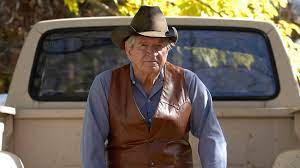
Max Allen Evans was born August 29, 1924 to Walter Burnace (W. B) Evans (1900-1979) and Hazel Glenn Swafford Evans (1904-1994) in Ropesville, Hockley County in Texas. Max was one of two children and had a younger sister named Glenda Rhue. Max grew up in the Panhandle of Texas and southeastern New Mexico and drew on his varied experiences and his knowledge of the culture to write over four dozen books, several of which were made into feature films.
Max grew up in Humble City and remembered doing errands and making delivery rounds on horseback as far as Lovington and smaller communities. His family moved there in the late 1920s. His father was farming and is said to have drilled one of the first irrigation wells for farming in the area. He grew potatoes, watermelons, strawberries and other vegetables. His father is said to have organized the township of Humble City. W. B. also organized a small school district and built a two room school house there, which Max attended though the third or fourth grade. W. B. also set up the first post office and Max’s mother Hazel served as Humble City’s first postmistress.
Max remembered living through the Great Depression there in Humble City and the difficulties his and other families experienced just getting through it and keeping their families fed. The Evans lived in Humble City for seven years in all.
Max tried his hand at ranching up in Union County in far northeastern New Mexico. He joined the United States Army in World War II and is said to have participated in the D Day landing on Omaha Beach in Normandy, France. After his return from the war, he did some painting before he turned full time to writing. Max married and lived several more places, including Taos, before settling in Albuquerque around 1967.
This is a partial list of his fiction books:
Southwest Wind (1958)
Long John Dunn of Taos (1959)
The Hi Lo Country (1962)
TheRounders (1965)
Shadow of Thunder (1969)
My Pardner (1972)
Bobby Jack Smith, You Dirty Coward! (1974)
One-Eyed Sky (1974)
The White Shadow (1977)
The Mountain of Gold (1983)
The Great Wedding (1983)
Bluefeather Fellini (1993)
Faraway Blue (1999)
Now and Forever (2003)
War and Music (2009)
The King of Taos (2020)
This is a partial list of his nonfiction books:
Sam Peckinpah, Master of Violence (1972)
This Chosen Place (1997)
Albuquerque (2000)
Madam Millie (2002)
Hi Lo Country: Under the One-Eyed Sky (2004)
Making a Hand (2005)
For the Love of a Horse (2007)
Goin’ Crazy with Sam Peckinpah and All Our Friends (2014)
Three of Evans’ works were made into feature films including The Rounders, The Wheel and The Hi-Lo Country. The Rounders was also made into a television series. Seventeen episodes were filmed in 1966 and 1967. Max was also cast as an actor in the Peckinpah film, The Ballad of Cable Hogue. His book, Sam Peckinpah, Master of Violence is about the making of that film.
For a number of years, a rodeo and celebration was held in Hobbs and was known as the High Lonesome Stampede (or Estampeda). The 1967 celebration was the ninth of its kind and one day was dedicated as “Max Evans Day” in which Max agreed to serve as parade marshall for the rodeo parade that opened up the three day affair.
Max passed in 2020. His honors include a commendation from City of Los Angeles. He was named honorary member of board of chancellors, University of Texas. He received the Saddleman Award, Western Writers of America, 1990. In 2015, he was honored with the Edgar Lee Hewett Award in recognition of his lifetime of service to the people of New Mexico. Max also received the New Mexico Governor’s Award for Excellence in the Arts and the Spur Award for Best Short Nonfiction. He continued to write up to the year that he passed away.
About 1928, as well as we can determine, land developers commissioned a structure of a Native American. It once stood in the middle of a dirt road and faced the location of the old Monument Spring.
The artist who constructed it is unknown. The monument itself had no name originally, as far as we can tell, but the local legend is that residents nicknamed it Geronimo, after the famous warrior.
Geronimo was a great tribal leader of the Apache nation, although he is not considered to have been a chief. He was of the Chiricahua tribe and the Bedonkohe band. Several translations are given for his name, pronounced Gokhleyah in Apache. One is “one who yawns” and another is “one who thinks before he acts.” lived from 1829 to 1909. As a leader and warrior, he was quite successful and conducted raids in the southwestern United States and Mexico. He eventually surrendered and lived out his senior years at Fort Sill, in Oklahoma. He died and was buried in the old cemetery at the military fort.
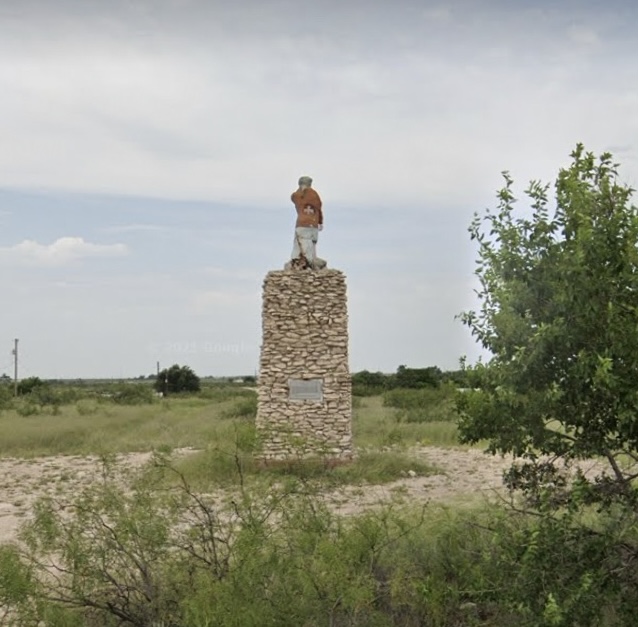
The local monument sat for many years in the middle of an unpaved road in Monument, located a few miles outside Hobbs. Around 1940, it was damaged and completely knocked to the ground when a motorist ran into it. Afterward, it was moved a few feet away from the roadway, as it appears in the above undated image.
How the monument looks currently:
Image credit: Google Streetview.
At some unknown date, a plaque was added. This is the inscription.
“Settled in 1885 and named for a marker at the springs a few miles west, monument remained a ranching community until oil was discovered in 1928. The Indian statue, called Geronimo by residents, was erected in 1928 by land developers. Monument has produced 4 world champion rodeo performers: George Weir & Roy, Betty Gayle & Jimmie B. Cooper. A centennial celebration was held in 1985.
The settlement called Pearl was named for Pearl Stark Roberts, wife of Nathan Cornelius Roberts who settled about five miles west of Monument in what was then Eddy County. Pearl Roberts was named postmistress in 1908 and the post office was housed in a room of their small pioneer home on the Roberts Ranch. The post office operated from 1908 to 1928.
Both Nathan and Pearl were born in Texas. Nathan was born in Killeen, Bell County, Texas on February 24, 1868 to Nathan Thomas Roberts (1831-1909) and Sarah M. Jeffries Roberts (1836-1905). Pearl was born in McCullough County on June 4, 1877 to Presley Summerfield Stark (1840-1929) and Martha Jane Combs Stark (1844-1915). Nathan and Pearl had at least seven children: Vernon C Roberts, Alton Lynn Roberts, Nathan T. Roberts, Stella Rosalie Roberts Peters, James Dean Roberts, Presley Stark Roberts and Alba Pearl Roberts.
Their property included a terrain feature called Pearl Valley that was described as a wide, shallow depression beginning a few miles west of Monument and running west for several miles. There is still a road named Pearl Valley Road after this feature. Nathan and Pearl moved to the area in 1902 and homesteaded when it became possible. They operated their ranch for many years. Nathan died in 1942 at the age of 74 and Pearl followed him in death in 1965 at the age of 87. Both are buried in Monument Cemetery.
Image credit – Lea County Traditions, Summer 2010 issue.
This community is situated about 5 miles south of Hobbs. There is some indication that it was formerly known as Roberts, but its first postmaster was James Henry Elijah Hughes who named it for his youngest daughter Nadine. The name was accepted by the Postal Service and still is associated with it today. Nadine had its own post office from 1909 to 1934.(1)
James Henry Elijah Hughes (1864-1924) was a store owner in the area that became Lea County and is thought to have moved to the location about 1909 with his wife, the former Jennie White (1869-1971). Nadine was the youngest of their five children and the only one to have been born in New Mexico. James died in 1924 in Ohio and Jennie survived him another forty-seven years and passed away in Roswell in 1971. Nadine died in a tragic house fire in Phoenix, Arizona in 1968.
(1) Julyan, Robert, “The Place Names of New Mexico,” University of New Mexico Press, 1998.
Oil Center is one of the “newer” communities of the county. It is located due south of Monument, sixteen miles south southwest of Hobbs and roughly seven miles west northwest of Eunice. It grew around 1937 up to serve the nearby plants of Phillips Petroleum Company and El Paso Natural Gas Company. It had a post office since about 1937. (1) It no longer has a post office, we understand. Today only a few structures and a few streets remain.
(1) Julyan, Robert, “The Place Names of New Mexico,” University of New Mexico Press, 1998.
Once located about 15 miles north of Lovington in the northern part of Lea County, this settlement grew up about 1907 as settlers began to move west into the territory. It was once called Rat, for Rat Mill, after what is described as a watering place, perhaps the location of a windmill. Rat Mill itself is believed to have been named after the RAT brand of early settler Bud Ratliff. It had a post office from about 1907 to 1929, a newspaper and several free standing buildings but was later abandoned in favor of other communities.(1) Not to be confused with the still existing town of the same name in Texas, the name Plainview is believed to be descriptive, based on the flat geography of the area.
At this time, not much is known about Bud Ratliff nor which other families he may have been connected to, if any. He is mentioned in several books about the area and generally referred to as an early resident. The name Bud probably was a nickname. It could possibly relate to Harvey Stewart “Bud” Ratliff (1857-1943), a long time rancher in Ector County, Texas, but from at least about 1910 on, this Bud Ratliff is mostly associated with a ranch near Odessa, Texas. Another Ratliff family, the John Ratliff family, is listed on various sources as having homesteaded in Lea County a few years later, around 1914, but they do not appear to be related to the person who went by the name Bud Ratliff.
(1) Mobley, May Price, “Little Texas Beginnings – In Southeastern New Mexico,” Hall-Poorbaugh Press, Inc. 1973.
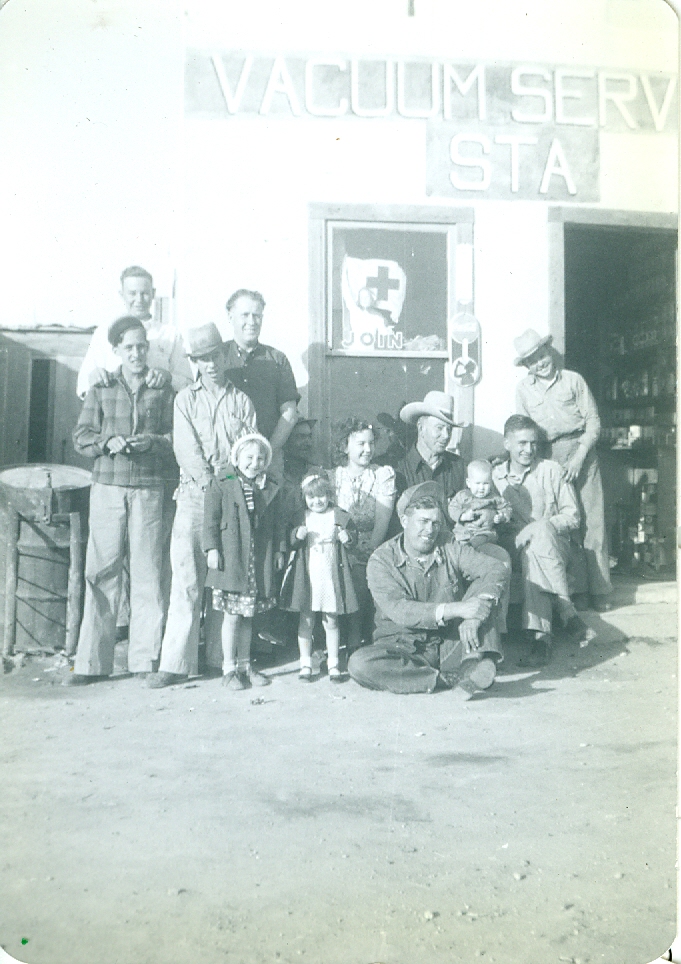
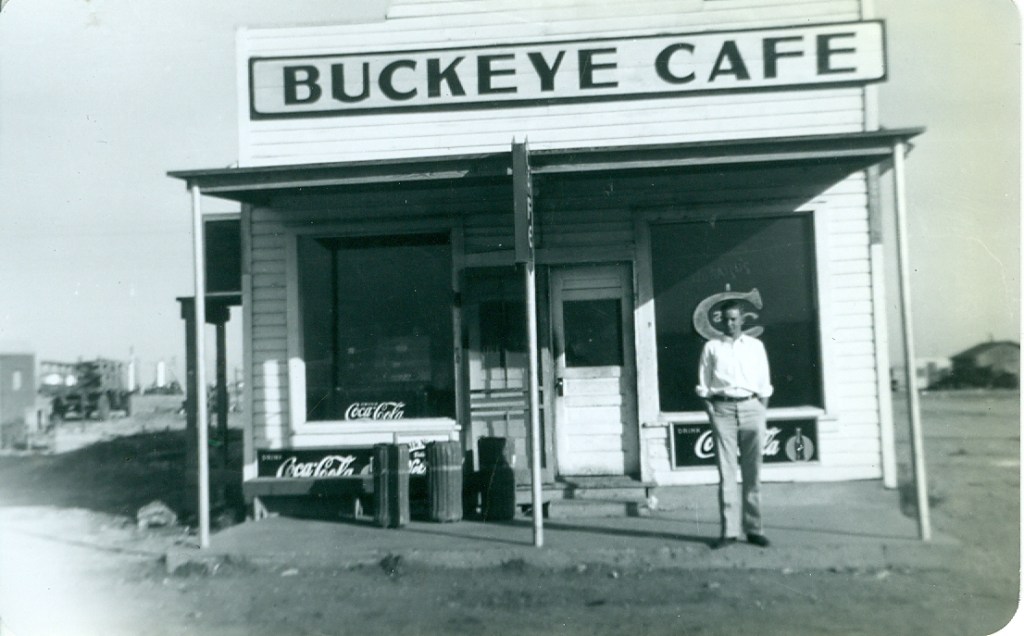
The Lovington Daily Leader carried this headline in its August 27, 1959 issue, “Intense Blaze Burns Heater at Phillips Buckeye Refinery.” We remember being awakened early that morning and told we needed to evacuate the area because the gasoline plant across the road was on fire.
Some event had ignited a fire at the Lee Plant that morning. We were living in the house nearest the road and there were six more houses to the north of us. Closer to the plant than our houses were several dozen houses of the plant employees who we assumed were getting the same emergency request.
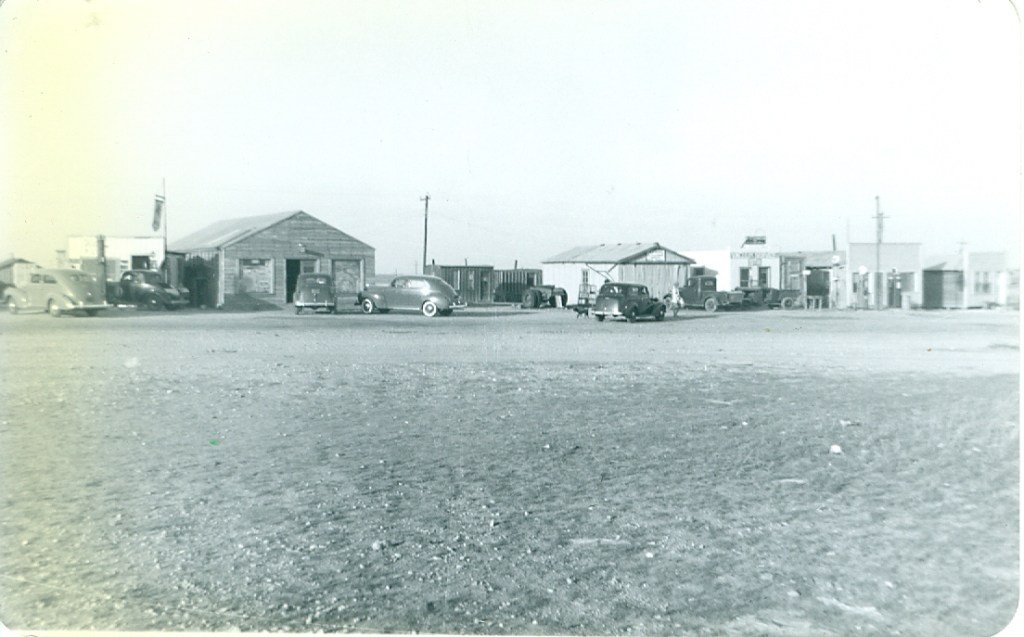
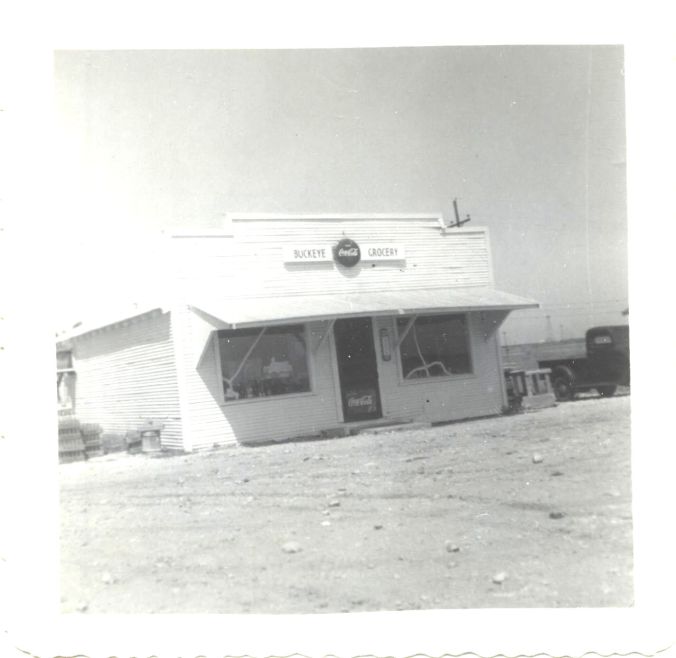
Buckeye is eighteen miles from Lovington and further than that from Hobbs, but both fire departments were called out to fight the blaze. Units from Lovington arrived a few minutes followed by elements from Hobbs just a few minutes later. Our parents quickly loaded up some clothing into our cars and drove down a half mile to the Buckeye intersection where the gas station, store and little post office were located. We all watched the fire and smoke until the blaze was safely put out and we were allowed to return to our houses.
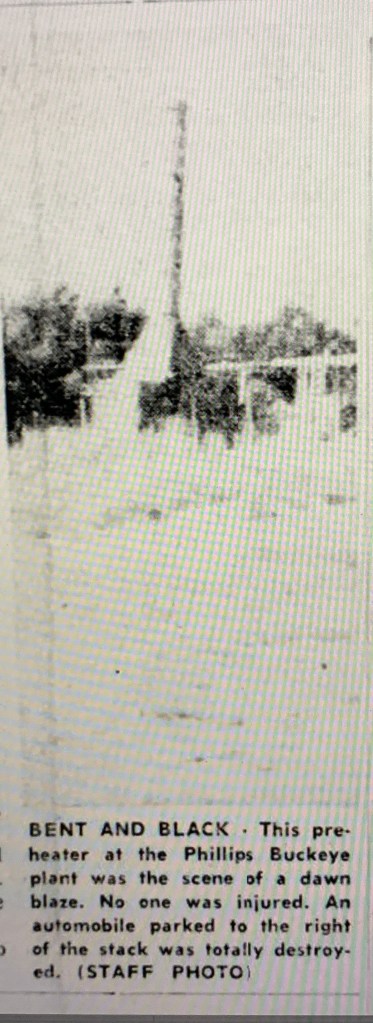
We later learned that a piece of equipment called a pre-heater had caught fire at about 5:30 a.m. and went out about sunrise. The newspaper account said the blaze lit up the sky and could be seen over the horizon all the way to Lovington. The fire departments were able to contain the blaze within about thirty minutes after they arrived. The firefighters braved the extreme heat and danger to spray foam on the flames and extinguish the blaze. Phillips praised the firefighters for their quick work and said if it had not been for their efforts, it could have led to a much more serious situation.
There were no known injuries and damage to the plant was confined to the pre-heater and surrounding equipment. There may have been more vehicles that were damaged, but we remember at least one passenger car having been melted down to a shell and hauled off on a flat bed truck. The photo below is from the August 27, 1959 issue of the Lovington Daily Leader.
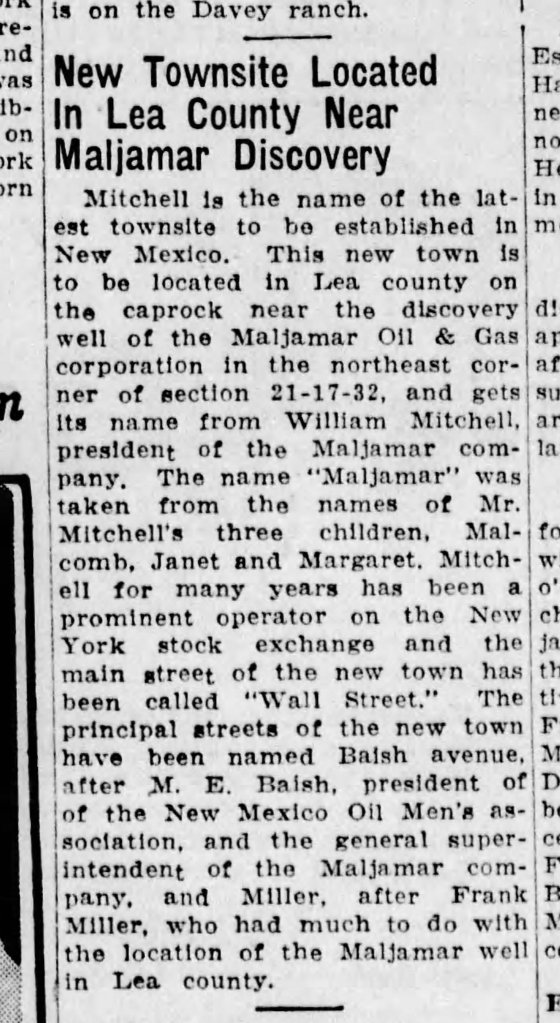
Located about 26 miles west southwest of Lovington in Highway 82, this town was founded in 1926 by William Mitchell. Mitchell owned the oil company that brought in the first oil well in the vicinity on July 26, 1926. He named his company the Maljamar Oil & Gas Company and eventually, the community of Maljamar. The word Maljamar is comprised of the first letters of the names of his children, Malcolm, Janet and Margaret. The June 12, 1926 issue of the Roswell Daily Record was not the first published record found for the Maljamar Oil and Gas Company but it listed eight wells that were being drilled.
Not usually mentioned is that the initial name of the community appears to have been Mitchell rather than Maljamar, per the newspaper clipping below.
Albuquerque Journal, 9 Apr 1926
Maljamar Oil and Gas Company was not just a New Mexico company, evidently, but so far we have not been able to find out much more about it other than it operated here before and after the founding of the community of Maljamar and it apparently build Artesia’s second refinery in 1931 which was called the Malco Refinery. We will keep looking for information about the company and William Mitchell and family.
Monument is accepted to be the first Anglo settlement in Lea County by James Cook, who built a store, appropriately enough named Cook’s Store. He used to pick up the mail in Carlsbad and bring it back to the settlement until around 1900 when the postal service granted permission to establish its own post office. It took its name from an old water source named Monument Springs.
The water source known as Monument Springs was located about ten miles west of the Texas border. Believed to have been previously used by native tribes for water, it was discovered by a detachment of the United States Army out of Fort Davis, Texas under Colonel William R. Shafter. Col. Shafter is noted for having directed the building of a seven and one half foot tall structure of native limestone rock to mark the area. This monument no longer exists and the stone is thought to have been reused in early dwellings.



 Old Lea County, N.M.