Old Lea County, N.M.

Tag: history

  • Byers and Hobbs Families

    Minnie Hobbs Byers was the daughter of James Isaac Hobbs (1852-1923) and Frances Perlee Mooring Hobbs (1857-1942). She was a twin with her sister Winnie Hobbs Dalmont and both were born March 6, 1896 when the Hobbs family was still living in Texas.

    Their parents were James Isaac Hobbs (1852-1923) and Frances Paralee Mooring Hobbs (1857-1942). Their oldest sister, Ada was about seventeen when they were born and got married later that year. There were two slightly younger siblings between Ada and the twins: Berry and Ella. The family story is that they headed west from central Texas in 1907. An uncle named Lewis D. Cain had come to New Mexico after 1900 following the death of his wife, Nancy “Nannie” Mooring Cain, sister of Mrs. James I. Hobbs, back in Texas.

    In an interview, Minnie says that their original goal had been to reach central New Mexico but they decided to stop soon after they crossed the border into the territory. Their brother Berry had made an application for a post office with the name “Taft” but it came back and was approved with the name Hobbs.

    The family of her future husband Ernest Herman Byers had come to the area by way of Houston County, Texas, though Ernest had been born in Kansas in 1882. His father Joseph Byers had passed in 1903 in Grapeland. Ernest and his sister and mother Sarah had come to New Mexico with other relatives. Minnie recounted that Ernest and his family came as far as Midland by rail and then by wagons the rest of the way. Ernest was older than Minnie, but their attraction took hold and they were married in the summer of 1912.

    Minnie’s account of their June, 1912 marriage was related in a Lovington Daily Leader interview on May 13, 1973. Minnie said that there was no minister in the immediate area, so she and Ernest rode in a buggy to Nadine where the nearest minister was located. She did not recall the name of the officiant, but remembered that the floors had just been scrubbed and were still wet when they married. The couple went on to have six children. They moved to Lovington in 1930 and their home was a landmark on 16th street.

    Minnie was active her entire life and enjoyed telling stories about the early days in Lea County. She was an artist, loved playing the violin and speaking. Ernest passed away in 1966 and Minnie survived him until her death in 1981. Both are buried in Prairie Haven Cemetery in Hobbs, New Mexico.

  • Hat Ranch

    The Hat Ranch dates back to around the mid 1890s when associates Andrew Briggs “Sug” Robertson (1855-1921) and Winfield Scott (1849-1911) began to operate in partnership. Scott is thought to have been the majority owner. Its brand has been described as a half circle over a bar. We have also seen it sketched out looking more like a rectangle over a bar.

    The ranching operation began in Mitchell County in West Texas and expanded into the New Mexico Territory in what was then Eddy County but became Lea County in 1917. The Lea County portion has longer history, of course, dating back far beyond the first Anglo settlers, but Scott is understood to have acquired it from an A. B. “Bill” Anderson and then sold a portion to Robertson.

    In Lea County, it is mostly associated with the Monument area. A number of long time Lea County residents counted working on the Hat Ranch in their resumes.

    At its peak, the Scott-Robertson holdings amounted to 1,000,000 acres and was once a large ranching business, before it began to be sold off to other settlers and homesteaders. The ranch continued to operate in Texas and New Mexico for many years. The ranch appears to have ceased operations as a Lea County entity under the ownership of Robertson and Scott around 1904 to 1906. The Fort Worth Telegram reported a large land sale in its April 3, 1907 issue. In it the real estate firm of Trammel & McCauley of Sweetwater, Texas had brokered the sale of the Texas properties formerly owned by Winfield Scott and A. B. Robertson. It included land in Lynn, Lubbock, Crosby Counties in Texas. Cowboy humorist Will Rogers also is known to have worked on the ranch, however briefly, and most likely around Midland, Texas.

    Scott was well known as an investor in Fort Worth, Texas. When he died in 1911, a large mausoleum was constructed for his family in the historic old Oakwood Cemetery in Fort Worth. Robertson died unexpectedly in Abilene in 1921 and is buried in his home town of Colorado City, Texas.

    Map attributed to J. W. Runyan, from Hobbs and Lea County by Max A. Clampitt
  • Dale “Tuffy” Cooper

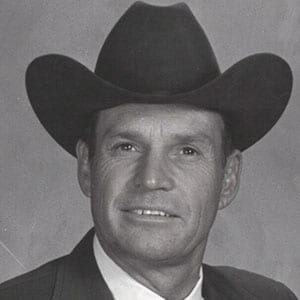
    Tuffy Cooper was born November 7, 1925 in Lovington, New Mexico to Alaska J. Cooper (1894-1959) and Tommie Lou Bingham Cooper (1904-1990). His grandparents were James Wesley Cooper (1858-1941) and Iolia M. Weir Cooper (1868-1940) and Thomas Swindell Bingham (1872-1944) and Louella Mae Simcoe Bingham (1874-1950).

    Tuffy’s fraternal grandparents came to New Mexico in 1906, settling near Monument. They had at least six children and his father Alaska was about twelve years old when they moved from central Texas. Tuffy said that the trip from Yatesville, Texas to Lea County, which would have been by covered wagon, took three weeks. When his father Alaska was a teenager, he had worked as a ranch hand on the Bingham place, where he likely met his future wife Tommie Lou. The Alaska Cooper family later owned their own ranch.

    Image credit: National Cowboy & Western Heritage Museum

    An obituary said Tuffy started competing in rodeo events in 1935, which would have been when he was about ten years old. In a 2008 interview, he did note that he took his first cattle drive when he was only five years old and recalled helping to drive 200 head of cattle from Monument to Knowles. Tuffy said that the trip took two days and nights.

    He said that his experience on the ranch made him a better roper and also remembered an infestation of screw worms in the early 1940s when he and the other cowboys had to treat the cattle. He was only a teenager. Ranch help was hard to come by and the owner of the place hired Tuffy and his brother Jimmy because they were “the only boys in the country who can rope.”

    When Tuffy was a student at University of New Mexico, he helped to found the National Intercollegiate Rodeo Association. He competed in the Professional Rodeo Cowboys Association and won many roping titles as he competed in the calf roping, steer roping and team roping events. After his rodeo career ended, he was a spokesman for the PRCA and remained active in the sport by serving as a judge and rodeo announcer. He was also the author of a booklet of ranch and cowboy sayings called “If You Ride a Slow Horse, You Need a Long Rope,” which appears currently to be out of print.

    Tuffy was always quick witted. Once at an event in San Angelo, Texas, the San Angelo Rope Fiesta, he was serving as a flagman for the team roping event. Someone complimented him on the paint horse he was riding. Tuffy said “Yeah, he belongs to Trevor (Brazile), but he’s mine as long as I can stay mounted.”

    Tuffy was inducted into the New Mexico School Board Hall of Fame and was a founding member of the Lea County Cowboy Hall of Fame. His many honors also include being named as an inductee in the National Cowboy Hall of Fame in Oklahoma City and the Texas Rodeo Hall of Fame in Fort Worth.

    Tuffy passed in 2013 and is interred at Prairie Haven Memorial Park in Hobbs, New Mexico.

  • The Madera Family and the Pitchfork Ranch

    In the October 13, 1966 issue of the Jal Record, it was reported that the Lea Soil and Water Conservation District Board of Supervisors named Rubert “Bert” Madera as the Outstanding Lea County Conservation Rancher of the year, stating that he was the operator of the Pitchfork Ranch located about twenty miles west of Jal.

    Rubert Madera: Image credt: Jal Record – October 5, 1966

    A grandson of Rufus and Pearl, also named Bert Madera, gave another interview many years later and told a bit more about the history of the ranch. The family had come to Fort Davis in West Texas around 1900. The earliest of the Madera family to live in Lea County were Rufus Frederick and Pearl Augusta Richmond Madera. Rufus had been born in 1881 in Arkansas and raised in Hill County, Texas where his family had operated a farm. Rufus and Pearl had later operated the Chico Ranch in Culbertson County, Texas south of Guadalupe Peak in Texas until they retired in the 1930s, after which they moved to Carlsbad. Rufus passed in 1956 and Pearl followed him in death in 1969.

    Two of their sons, twins Rubert and Ruford and another brother named Malcolm originally leased the Pitchfork Ranch, according to the interview, from a previous owner named Baird. Rubert and his wife Loys originally lived in a dugout on the ranch and raised their family there on the property. They told of dealing with the sometimes harsh weather conditions and (a common practice in the southwest) burning cow chips for warmth. They purchased the ranch in 1946 and later added to it as opportunities presented themselves.

    Bert Madera, the subject of the Jal Record article, said he had started out in the livestock business by purchasing heifer calves at $4 each and later purchased 40 registered Hereford cows in 1945. He practiced conservation by cross fencing, building surface tanks for water, rotating his livestock, digging storage and drinking troughs, broadcast seeding of grasses and doing his best to eliminate mesquite.


    Sources include local newspaper articles and the Summer, 2008 issue of Lea County Traditions, a periodical.

  • A Cattleman’s Will

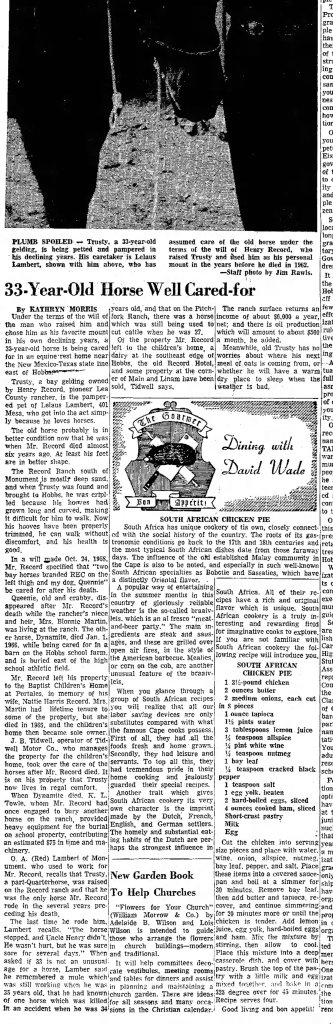
    When Henry S. Record died, he left most of his estate to the New Mexico Baptist Orphanage in Portales. The bequest was in honor and memory of his late wife, Nettie Harris Record who predeceased him. Mr. Record had been a founder of the orphanage and was actively involved in it as he got older.

    At the time of his death, Mr. Record was a member of the New Mexico Cattle Growers Association, a trustee of Hardin-Simmons University, a trustee of the Baptist Orphanage and president of the Open Range Cowboys Association.

    He also provided for his two bay horses and his dog, Queenie. Queenie disappeared in the years after his death, but the two horses lived on for a time. Dynamite died on New Year’s Day, 1966, but the bay gelding named Trusty was still living at the time of the article below from the Hobbs Daily News-Sun on February 4, 1968 at the remarkable age of 33.

    Hobbs Daily News-Sun – 4 Feb 1968
  • Founding of Eunice

    [Transcribed from the 60th Anniversary Collector’s Edition of the Lea County Fair and Rodeo program for the event held August 5-12, 1995]

    The early settlers to the Eunice area would have been the Daugherty brothers whose “84” Ranch headquarters was two miles east of what would become the town of Eunice. Before this time however, ex-buffalo hunters Barney and Jim Whalen claimed the area in 1885 by digging a well. They sold their water rights to Daugherty in 1886, and the 84 Ranch eventually became part of the Cowden Cattle Company of Midland.

    In 1908 John N. Carson of Shafter Lake, Texas came to the area and plowed a furrow around his homestead to make a claim. In 1909, Carson brought his family from Shater Lake and built a home and store. When Carson applied for post office for the area, he listed his daughter’s name, Eunice, at the bottom of the list. In 1909 he received approval along with the name “Eunice” for his post office.

    According to historical accounts, the Carson home was a two room and shed house constructed of lumber hauled in from Midland. The general store and post office was also built from lumber. W. S. Marshall carried the mail free of charge from Shafter Lake to complete the federal requirement for the post office at Eunice.

    In 1910 after raising the money for the school themselves, a one room building was completed which was on land donated by Carson and Mrs. Mat Downes. There were 23 students that first term and the teacher was Winnie Wyatt. In 1910, the teacher was Jessie Estlack who rode her mule three miles to the school.

    In 1910, the Reeders and Norton General Merchandise opened with its stock of groceries, dry goods and hardware. W. F. Turner drilled many of the water wells, established the blacksmith shop and the grist mill. Later he opened a grocery business with L. G. Warlick.

    The Carson home was the center for weekly musicals with Eunice playing the piano and Lee Downes and Marshall Drinkard playing violin while Ed Carson played the guitar and Will Grizzell played mandolin. May socials, dances, rodeos and community sings made up the social life of the small community. The school house was the center for church services and picnics. The Methodist, Baptist and Christian Church organized and met in the schoolhouse.

    To provide medical care, Eunice community leaders advertised they would provide a four room home and a Model T Ford for rounds if a doctor would relocate to their town. Dr. Wright and his large family accepted. But Eunice citizens were too healthy to provide him with enough income!

    The Eunice Plains Democrat started publication March 28, 1914.Legal notices of proved up claims kept it in business because advertising was scarce.

    In 1915, the one room school had expanded to three rooms and five teachers were hired. They included Lucille Woodward, Edith Davis Fanning, LuLu Marshall and Ruby Manning.

    The blizzard of 1918, the flu epidemic and the terrible drought dealt a hard blow to the small community as it did all the southern plains. The school year of 1922 reflected the hardship when only one teacher was needed for the students. Miss Mettie Jordan came for the 1925-26 term and related that her students ranged in age from 6 to 17.

    In 1928, Herman Carson, son of the town’s founder platted the townsite with the Carson Homestead in the center and sold lots in anticipation of a boom if oil and gas speculation continued. He proved correct when that same year the Gypsy #1 State was completed as a gas producer and in 1929 Continental brought in the first oil well in the Eunice area. By 1930 the population was 250 and a railroad spur through Eunice was being built. Oil prices fell with the great Depression, but Eunice rebounded in 1935 with renewed drilling activity. The school mushroomed and in 1934-35 financed construction of the first six brick school rooms.

    September 3, 1935 W. S. Marshall, James Nuget and Mr. Emery met to form the village government. April, 1937 Governor Tingley proclaimed Eunice a city. The little ranching community had come of age.

  • Pearl

    The settlement called Pearl was named for Pearl Stark Roberts, wife of Nathan Cornelius Roberts who settled about five miles west of Monument in what was then Eddy County. Pearl Roberts was named postmistress in 1908 and the post office was housed in a room of their small pioneer home on the Roberts Ranch. The post office operated from 1908 to 1928.

    Both Nathan and Pearl were born in Texas. Nathan was born in Killeen, Bell County, Texas on February 24, 1868 to Nathan Thomas Roberts (1831-1909) and Sarah M. Jeffries Roberts (1836-1905). Pearl was born in McCullough County on June 4, 1877 to Presley Summerfield Stark (1840-1929) and Martha Jane Combs Stark (1844-1915). Nathan and Pearl had at least seven children: Vernon C Roberts, Alton Lynn Roberts, Nathan T. Roberts, Stella Rosalie Roberts Peters, James Dean Roberts, Presley Stark Roberts and Alba Pearl Roberts.

    Their property included a terrain feature called Pearl Valley that was described as a wide, shallow depression beginning a few miles west of Monument and running west for several miles. There is still a road named Pearl Valley Road after this feature. Nathan and Pearl moved to the area in 1902 and homesteaded when it became possible. They operated their ranch for many years. Nathan died in 1942 at the age of 74 and Pearl followed him in death in 1965 at the age of 87. Both are buried in Monument Cemetery.

    Image credit – Lea County Traditions, Summer 2010 issue.
  • Deputy Jack Seay

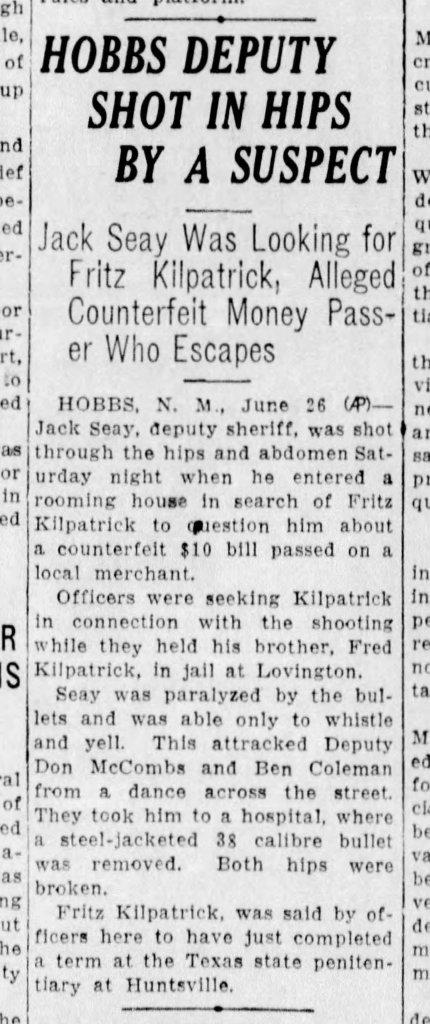
    Albuquerque Journal, 27 Jun 1932.

    The deputy went by Jack Seay, but his name was Thomas William Caspian Seay, Jr. He was born August 21, 1893 in Liberty Hill, Texas to Thomas William Seay and Bunett Louise Bingham Seay. Jack grew up in the Hill Country of Texas in Marble Falls.


    Jack registered for the World War I draft in New Wilson, Oklahoma at the age of 24 around 1916, giving his profession as undertaker. Jack served in the United States Army from September 19, 1917 to May 6, 1919.

    Jack is first mentioned in law enforcement as having served on the Jal Police Department, perhaps even being chief of police, before coming to serve as a deputy sheriff under Sheriff Bob Beverly of Lea County.

    1932 saw several major arrests. On April 19, deputies Jack Seay and Don McCombs followed a tip that individuals connected to a bank robbery in O’Donnell, Texas the week before might be in Hobbs. Accompanied by federal agent George E. Lilley working out of El Paso, they approached a house in which a car fitting the description of the suspect’s vehicle was parked. As they neared the front door, it opened and gunfire erupted from inside. They backed away and called for backup as the suspects fled in their car. Shortly afterward, they stole another car from a local resident, but in so doing, were delayed long enough for the lawmen to catch up with them. One of the suspects was shot in the ensuing gunfight. The remaining suspects were later arrested in Texas.

    The next day, Seay and Lilly arrested two men on charges of passing counterfeit currency in Hobbs, unrelated to the earlier case. Two months later, on June 25, 1932, Seay was ambushed and shot during the investigation of another counterfeiting case. The alleged assailant was Fritz Kilpatrick, believed to be passing counterfeit $10 bills in the area. The attack took place at a rooming house where Kilpatrick had been staying. Kilpatrick was said to have opened fire on Seay as he came to Kilpatrick’s room. Seay was seriously injured resulting in his partial paralysis and other injuries and never regained the ability to walk. Immediately after Seay’s shooting, he was taken to Lubbock where he survived the first of many surgeries.

    In 1933, Kilpatrick was tried and convicted of counterfeiting and sentenced to fifteen years in prison. Seay was carried into the courtroom by four men and had testified at the trial.

    Deputy Seay died in 1953 and is buried in Fairview Cemetery in Albuquerque along with his wife, Mary Little Seay, who had predeceased him in 1951. The Seays had lived in Albuquerque for a number of years. While living in Albuquerque, Jack had been a rancher and tourist court owner. He had been an active member of the Elks Lodge and the American Legion, according to his obituary.

  • Clyde D. Woolworth and the Woolworth Family

    Clyde Dean Woolworth (1883-1938) was the first member of the family to come to Lea County. He was born to a large family in Carthage, Panola County, Texas. His father was Justus Morgan Woolworth and his mother was Mary Jane Paxson Woolworth. Clyde was one of at least eight children.

    The family story is that Clyde and his sister Elizabeth and learned of land that could be homesteaded from an article in a Dallas, Texas newspaper. They came to the area in 1915, after statehood but before the county was to be created in 1917. Clyde and Elizabeth each homesteaded a half section of land and it is said that they built their home where their property adjoined, partly on each other’s land.

    The siblings were later joined by three other sisters, Martha, Litie and Clara. Their property was the nucleus of the Woolworth Ranch near Jal, New Mexico. Finding a reliable and plentiful water source was always an issue in the area. The family told of facing the usual pioneer hardships including extreme weather, rattlesnakes but managed to remain. Oil was later discovered on their property.

    After an illness of several months, Clyde died at the age of fifty-five in 1938 while residing in San Angelo, Texas. Mr. Woolworth was a single man and is buried in San Angelo, Texas. He was survived by five of his sisters: Clara, Litie, Mae and Elizabeth Woolworth, all of San Angelo, and Mrs. Claudia Woolworth Watkins of Henderson, Texas, one brother, Dr. Joseph Dean Woolworth of Louisiana; and was predeceased by one brother, James G. Woolworth and one sister, Martha Woolworth.

    The Woolworth family is noted for having donated funds to found the Jal Library.

    Sources include various newspaper articles and the Summer, 2010 edition of The Lea County Tradition, a periodical.

  • Founding of Jal

    [Transcribed from the 60th Anniversary Collector’s Edition of the Lea County Fair and Rodeo program for the event held August 5-12, 1995]

    The Cowden Brothers had operated the vast JAL Ranch since 1886 coming from Palo Pinto County, Texas. The lure of shallow water and good grass led to their coming to the Monument Draw bringing cattle branded with the JAL brand. They established waterings about every ten miles up the draw. Spencer Jowell, Gene Cowden, Autry Moore, and Stumpy Roundtree all ran the New Mexico Cowden Ranch at one time. The last foreman before the company closed out in 1915 was Bob Beverly. Settlers began to pour into the area to claim their homesteads as they learned of the grass and shallow water. Some of them would later sell out as they realized the isolation of the area because of vast sands and the impossibility of dry land farming. These homesteaders sold out and moved.

    The founder of Jal was Charles W. Justis, a Southern gentleman who arrived before 1910 and opened his mercantile business six miles east of the present city of Jal. On July 6, 1910 he was granted authority to open his post office. To obtain his permit, his sons had to carry the mail from Kermit (25 miles) three months for no charge. As Justis determined a site more suitable to his store existed, he moved his business to the present site of Jal in 1916.

    The fall of 1912 saw the first school for Jal with about 14 students. The lumber was hauled from Midland for building the 12×14 oneroom school house. Leroy Lancaster was the first teacher and he soon married his student Buna Justis, Charles’s daughter. As the number of pupils grew, Eddy County purchased a larger building twenty miles away in Texas and the patrons had to move the structure over the sands to the new site three miles east of the present school.

    The drought hit this area very hard and many settlers either moved away or were forced to leave their families and find work elsewhere. The school closed but Justis’ store and post office remained. The school hung on with Martha Woolworth Knowles as teacher for the few pupils.

    For the next decade, life in Jal centered around the various ranches where neighbors gathered for musicals and dances, barbeques and visiting. West of Jal the Charlie Goedeke home was a gathering place and on the East was the Knight place where Mrs. Knight would play the piano and the French harp. Some of the other settlers of the area were Charlie and Jim Dublin the Buffingtons, Billy and Mont Beckham and Alfred Perry Easton.

    The exploration and discovery of oil and gas made major changes in the small settlement of Jal. On November 1, 1927, The Texas Company brought in the Rhodes No. 1 six miles southeast of Jal and in June 1928 Continental Oil Company brought in Eaves No. 1 and Jal became Lea County’s first oil and gas boom town.

    With the influx of speculators, drilling crews and construction workers came the tents and shacks and formation of two townsite companies that were in competition. The Hubbs-Justis Townsite Company took in north Jal and the Jal Townsite Company formed by Floyd Stuart, Richard Herwig, and Clyde Woolworth took in the southern area. The Herwig Company became the area where most of Jal developed. The depression hit and crude oil prices fell along with Jal’s prosperity, but El Paso Natural Gas Company came in 1931 with gas gathering lines to provide employment that was to prove a stable force in Jal for years to come.

    By 1935, Jal had four service stations, two dry goods stores, two drug stores, three lumber yeards and even a movie theater. The Woolworth Hotel was in operation and served meals. New Mexico Electric Company came in 1935 and a telephone system of sorts was operating. In 1935, Dr. J. L. Burke was superintendent of schools and a four year high school started. The Jal Record owned by Floy Wynn was founded in 1950. Dr. Burke purchased the Herwig Townsite Company and donated land for church building sites. Jal was on its way to becoming the “Gas Capital” of the country.