Old Lea County, N.M.

Tag: history

  • Open Range Cowboy Association

    “To Preserve the Spirit of the Old West as a Spirit That Should Never Be Forgotten”

    This interesting Lea County group dates back to 1940. After a few years of meeting informally, it was organized as part of a national group of the same name. Its original charter members included Henry S. Record, Will Gray, Bill Duncan, Charlie Cochran, John Catchings, Frank Wyckoff, M. G Cottrell, Bob Beverly, J. D. Hart, R. F. Love, Bert Ancell, J D. Black, Max Fletcher, Robert Allie, Jim Love, W. P. Bird and Bill Montieth.

    According to old newspaper articles, it was intended to be a social group organized to “honor the memories of cowboys who rode the open range” before barbed wire and other forms of fencing became commonly used. Lovington was the headquarters. The group was open to old time cowboys and their descendants. Another goal was to erect some sort of monument to the cowboys who had gone on to their “last roundup.”

    The group has held reunions since its inaugural meeting. The initial members have long since passed away, but the group still meets to honor this unique time of western history.

    Notes from some of the newspaper coverage over the years:

    In 1941, Henry Record invited oldtimers to attend the 10th reunion. [Albuquerque Journal, Albuquerque, NM. 1 Sep 1950.]

    In 1956, some 750 people attended what was the 23rd annual reunion. Fifty-seven men were considered to be open range cowboys from the era. Attendees consumed 1,000 pounds of beef and a considerable amount of son-of-a-gun stew. The meeting was called to order not with a gavel, but with the ringing of a cowbell. The program included a lot of reminiscing, fiddle, guitar and accordion music and some brief speeches. The oldest man present was G. H. Goodrich of Lovington, age 90, and the oldest woman was Mrs. Ella Thrasher of Lovington, age 85. The person who came the longest distance to attend was Charley Wiggins, once of Lea County, but currently a resident of Lewisburg, Tennessee. The couple married the longest were Mr. and Mrs. W. R. Bilbrey of Lovington who had been married 66 years. [Albuquerque Journal, Albuquerque, NM. 2 Sep 1956.]

    Some 500 people, an estimated 200 over 60 years of age, attended the reunion. Henry Record of Monument served as president of the association. [Albuquerque Journal, Albuquerque, NM. 7 Sep 1958.]

    An estimated 500 people attended the reunion this year, it being the 27th gathering. Over half were over 60. The oldest man present was O. L. Tomlinson, 90, of Lovington. The oldest cowgirl was 87 year old Mrs. J. W. Russell of Hobbs. Mrs. Eva Woodward, 85, was named sweetheart by those attending. Henry Record served as president. [Hobbs Daily News-Sun, Hobbs, NM. 18 Sep 1960.]

  • The Peveler Family

    David Lee Roy Peveler was born in Seymour, Baylor County, Texas on June 18, 1886. He married Henri Bess Coleman on December 23, 1914 in Gaines County, Texas. David’s father, William Jasper Peveler (1855-1947) was born in June 1855 to Greenup Cauley Peveler and the former Martha A. Dennis in Young County, Texas on July 3, 1855.

    The Peveler family were early settlers to Texas and many of them lived in an area that came to be known as Peveler Valley in northern Hood County. Greenup Peveler had been a Texas Ranger serving in the Frontier Battalion in 1864 when he died in March of that year in an unrecorded incident. He was serving under his uncle, William Riley Peveler in North Texas. William was a well known Texas Ranger company captain and was later killed in September, 1864 in Jack County in a Comanche ambush, though his grave went largely unnoticed for about 100 years until he was honored and the story of his actions was recounted in local newspapers. The Frontier Battalion was a Confederate Army unit, but generally remained in Texas during the war to protect the settlers living there. It was mostly made up of local citizens and included Christopher Columbus Slaughter who survived the Civil War and went on to become a rancher in north central Texas.

    David Lee Roy Peveler is believed to have moved to what is now Lea County around 1902. He and Bess had two sons, James William “Son” Peveler (1916-1957) and Henry Leroy “Wad” Peveler (1918-2002) who lived in the Prairieview area. Their families were involved at various times in the sheep and later the cattle business. Wad also operated a boot shop in Tatum at one time.

  • The Knowles Family

    Benjamin Lewis Knowles was born in 1834 in Hardeman County, Tennessee to Samuel Lihu Knowles (1797-1887) and Elizabeth Providence Johnson Knowles (1796-1852). He married Mary Hulda Kellogg on December 23, 1852 in Mississippi. Ben served in the Mississipi State Infantry during the Civil War. Over the next twenty-some years the couple had at least ten children, most of whom were born in Mississippi. By the time the 1870 census was taken, the family had moved further west and were living in Washington County, Texas near Brenham. Ben’s occupation was listed as farmer. In 1880 per the census, they were living in Burleson County in central Texas. Benjamin was in his mid to upper 40s. Moving forward to 1890, they had moved to what was likely their last residence in Texas and were living in rural Mills County, still in central Texas. Ben’s age was listed as 66.

    A few short years later in 1903, the family moved to Lea County, just under ten miles north of Hobbs when Ben was about 70 and Mary was about the same age. Ben built a simple adobe structure with two rooms and a dog walk or breezeway separating them, a common layout for residences, including wooden houses, of that time. Ben ran a mercantile store and made a successful application for a post office. Around them sprang up a few businesses, including more stores, a school, a blacksmith shop and others. It is estimated that the community, once known as Oasis and longer as Knowles, might have had as many as 500 residents including his son Ruben Benjamin Knowles and his large family who had moved to the area with Benjamin and Mary.

    Mary died in 1907 and is buried there in Knowles. Ben lived to the age of about 91 and died in Wier, Williamson County, Texas while visiting family members. He is believed to have been interred in Texas, but there is no known headstone or grave marker. Ruben lived to be 101 years old and remained in Lea County most of his life. His wife, the former Mary Elizabeth Scrivner, had died in her mid 50s back in 1921. Ruben survived her another forty-plus years and both of them are buried at Woodbine Cemetery in Artesia.

    Benjamin Lewis Knowles was born in 1834 in Hardeman County, Tennessee to Samuel Lihu Knowles (1797-1887) and Elizabeth Providence Johnson Knowles (1796-1852). He married Mary Hulda Kellogg on December 23, 1852 in Mississippi. Ben served in the Mississipi State Infantry during the Civil War. Over the next twenty-some years the couple had at least ten children, most of whom were born in Mississippi. By the time the 1870 census was taken, the family had moved further west and were living in Washington County, Texas near Brenham. Ben’s occupation was listed as farmer. In 1880 per the census, they were living in Burleson County in central Texas. Benjamin was in his mid to upper 40s. Moving forward to 1890, they had moved to what was likely their last residence in Texas and were living in rural Mills County, still in central Texas. Ben’s age was listed as 66.

    A few short years later in 1903, the family moved to Lea County, just under ten miles north of Hobbs when Ben was about 70 and Mary was about the same age. Ben built a simple adobe structure with two rooms and a dog walk or breezeway separating them, a common layout for residences, including wooden houses, of that time. Ben ran a mercantile store and made a successful application for a post office. Around them sprang up a few businesses, including more stores, a school, a blacksmith shop and others. It is estimated that the community, once known as Oasis and longer as Knowles, might have had as many as 500 residents including his son Ruben Benjamin Knowles and his large family who had moved to the area with Benjamin and Mary.

    Mary died in 1907 and is buried there in Knowles. Ben lived to the age of about 91 and died in Wier, Williamson County, Texas while visiting family members. He is believed to have been interred in Texas, but there is no known headstone or grave marker. Ruben lived to be 101 years old and remained in Lea County most of his life. His wife, the former Mary Elizabeth Scrivner, had died in her mid 50s back in 1921. Ruben survived her another forty-plus years and both of them are buried at Woodbine Cemetery in Artesia.

    Oil was discovered near Hobbs in the 1920s which led to the decline of Knowles as an active community as people were drawn to Hobbs and other towns in the county.

  • Oil Discovery In Hobbs

    The first successful oil well was completed around 1921 and the first successful gas well was completed a year earlier, but the Midwest State No. 1, spudded in 1927 using a standard cable tool rig and found oil on June 13, 1928 at a depth of 4,065 feet is considered to be the well that revealed the huge oil deposits in this area.

    Writers have commented that the flat land surface disguised the formations below the surface. Surface formations may sometimes indicate favorable subsurface formations for petroleum products.

    Midwest Refining Company, which would later become part of Amoco and subsequently British Petroleum, had brought in a successful well near Shiprock some six years earlier in 1922 in what is now called the San Juan Basin. In the Permian Basin, oil was found in nearby Winkler County, Texas in the Scarborough Field. In an oversimplication of all the various split ups and mergers, Midwest had been operating under the name Midwest Refining Company since 1914 after a merger between Midwest Petroleum and Franco Petroleum and Amoco was created in 1911 after the federal government ordered the split up of Standard Oil Company.

    The Midwest State No. 1 was drilled using a steel derrick that came from Amarillo. The engine was rebuilt locally after a fire had occurred when the rig had reached a depth of about 1,500 feet. Exhaust from the Franklin 85 engine created a fire that involved the engine house. The cable tools were fished from the hole, repairs were made and drilling resumed.

    The first signs of oil came at just below 4,000 feet in June and the well was later completed in November, 1928 at a depth of 4,330 feet. The Las Vegas Daily Optic reported on June 15, 1928:

    “The Midwest State No. 1 well, sec 9-19-38, is standing 4000 feet in oil and promises to open a new field, C. B. Barker, attorney for the state land commissioner was advised today. ‘This is on land belonging to the state deaf, dumb and blind schools and may mean a large income for them,’ said Mr. Barker. ‘Another section of common school land adjoins this one.’”

    Early production was measured at 700 barrels of oil per day, but it promised more and greater finds in the Hobbs area. One year later, the Humble Bowers No. 1 was completed. By comparison, its production was estimated to have a potential of 10,000 barrels per day.

    Cable tool drilling is considered to be one of the earliest drilling methods, dating back thousands of years over the world for other applications, such as drilling water wells. Drilling is accomplished by percussion, repeatedly lifting and dropping a string of pipe and tools into the hole. Fluid is pumped into the hole and crushed material is pumped out. Early drilling equipment included the drill bit, the drill stem, drilling jaws, a socket and steel cable. It is still in limited use for other applications but has been replaced by more advanced methods for deeper wells.

    [Sources: American Oil and Gas Historical Society.]

  • Jake McClure

    Sources include 60th Anniversary commemorative program for the Lea County Fair and Rodeo in 1995, newspaper articles and traditional genealogical sites:

    The Jake McClure Arena was constructed under the management of the Lea County Sheriff’s Posse and is dedicated to Jake McClure.

    Roy Leonard “Jake” McClure was born November 26, 1902 in Amarillo, Potter County, Texas to Patrick Henry McClure and Cynthia Elizabeth “Lizzie” Birdwell McClure who later moved to Lea County. Jake married the former Kathryn Matthews in 1932.

    Jake was described as walking around with a rope in his hand at age 2. He left home at 15 to work as a cowboy and learned the rodeo life under Tom Standifer in Fort Worth, Texas in 1922. He became known for his precision in roping using a small fast loop called “The Jake McClure Loop.”

    Jake earned the title of World Championship Calf Roper in 1930. He was named World’s All-Around Cowboy at the Pendleton, Oregon Roundup and Arizona State Champion Cowboy, along with many other honors as a calf roper in the United States, Canada and Europe. Locally, he was president of the first roping club in Lovington. Over the years, Jake worked with many good roping horses including his three favorites, “Legs,” “Snip” and “Silver.” Silver was named World’s Best Calf Roping Horse.

    Image credit – Findagrave.com

    Jake suffered a severe head injury on his ranch on July 1, 1940 when his horse fell on him. He never regained consciousness and died in a Lovington hospital on July 9, 1940. He is buried in the Lovington Cemetery.


  • Jack Danglade

    Frank Jack Danglade was born November 4, 1898 in Jasper County, Missouri to Frank Henderson Danglade and the former Bertha Mabel McKittrick. He married Jessie June Price in 1920 and the couple had one daughter.

    Danglade and his wife had first moved to Texas in 1924 due to his wife’s poor health. The couple lived in Amarillo, Rising Star and Midland before coming to New Mexico. By about 1930, they had moved to Lea County upon the suggestion of an acquaintance who knew of the oil boom in the area. Jack recounted that a friend had remarked that Hobbs was booming and that Lovington had good possibilities, although at the time it had no paved roads, banks or rail service. He first took a room at the old Commercial Hotel, planning to stay for a short while, and lived in Lovington for the rest of his life. And he did see rail service, banks and paved roads reach Lovington, in time.

    Danglade came first and began to buy oil leases and royalties for others. He then decided to move his wife and young daughter with him. They built a home on South 5th Street in 1931. His wife passed away in 1941. During World War II, he was a civilian employee of the Navy Department in Washington, D.C. Afterward, he returned to the oil business, almost exclusively in Lea County, and was successful at it.

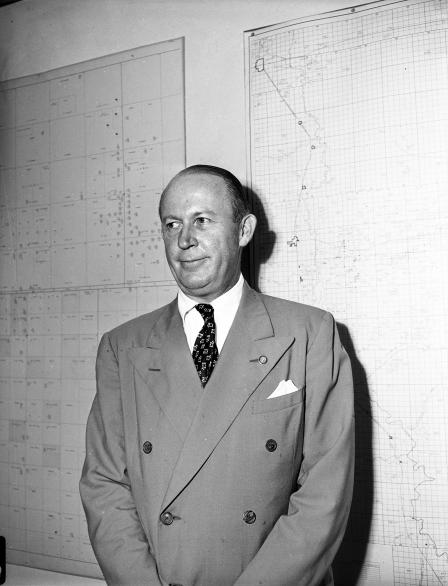
    Courtesy of UTA Libraries Digital Galleries

    He was elected to the New Mexico state senate in in 1952 and won a second term in 1956. He was generally aligned with the Republican Party, but ran as a Democrat to be able to participate in the New Mexico primary elections. During his time in the state senate, he served on a number of committees and sponsored legislation, primarily having to do with state finances.

    Danglade succumbed to cancer on May 24, 1959 while hospitalized in New York and is interred at New Hope Cemetery located in Webb City, Jasper County, Missouri. He was succeeded by Harold Runnels in the state senate after Runnels was appointed to fill Danglade’s unexpired term.

  • Joe Cooper Recalls Youth In Jal Area

    Memories of the days when he first came to Lea County were revived by The Jal Flare‘s special edition in Joe Cooper, who lives ten miles north of Jal.

    He came here in ’10 from Pyote, Texas with his parents, Mr. and Mrs. James M. Cooper, and has lived in this area for the last twenty-eight years.

    When they first arrived, they had to haul water six or seven miles, Mr. Cooper recalled, from what is known as the west wells (now Jal). But the four boys and the father soon had a house built and a well drilled.

    “Those were rough days,” Mr. Cooper said, “but still they were the sweetest of my childhood. I couldn’t see it then, but now I can realize it.”

    When the time came to drive the look back through the years and and stock to water, it fell to Joe’s lot to climb aboard the burrow and round them up. It usually took him all day, since the horses were wild.

    Sickness of two of his brothers also threw a hardship on Joe during those early days, as there was a great deal of work to be done.

    [Jal Flare, Jal, NM. 30 Mar 1939.]

  • New Hobbs, New Mexico

    There were once two towns named Hobbs: Hobbs and New Hobbs. For a number of years, they existed as separate communities. New Hobbs had its own post office at one time, as well.

    The first attempt at unifying them failed in 1932. Finally in 1937 they were consolidated with Hobbs being the survivor. The city ordinance below was published in the May 25, 1937 issue of the Hobbs Daily News and is repeated below. The essence of the ordinance was that authorized representatives of both municipalities had met and approved the consider the consolidation of both towns into one.


    Publish May 25

    ORDINANCE NO. 90

    An ordinance approving, ratifying and confirming all proceedings had and taken relative to the election for the consolidation of the Town of Hobbs and the Town of New Hobbs by annexation of the Town of New Hobbs to the Town of Hobbs; Declaring that the Town of New Hobbs shall be annexed to the Town of Hobbs and that the Board of Trustees of the Town of Hobbs shall have jurisdiction over all territory formerly withing the Town of New Hobbs; Providing for the assumption of all liabilities both present and contingent which now exist against the Town of New Hobbs; Providing that all property heretofore belonging to the Town of New Hobbs shall become the property of the Town of Hobbs; Be It Ordained by the Board of trustees of the Town of Hobbs, New Mexico:

    WHEREAS, at a regular meeting of the Board of Trustees of the Town of Hobbs held on April 5th, 1937, a resolution was duly adopted by the terms of which three citizens of the Town of Hobbs were appointed as a Board of Commissioners to meet with a like body to be appointed by the Board of Trustees of the Town of New Hobbs to report upon and recommend the advisability of and the terms and conditions upon which the Town of Hobbs and the Town of New Hobbs might be consolidated by annexing the Town of New Hobbs to the Town of Hobbs;

    WHEREAS, thereafter the said Board of Commissioners so appointed did meet with a like body appointed by the Board of Trustees of the Town of New Hobbs and did submit to the Board of Trustees of the Town of Hobbs certain recommendations,

    WHEREAS, at a special meeting of the Board of Trustees of the Town of Hobbs held on April 12th, 1937, Odinance No. 87 was duly adopted which said ordinance was styled

    “An ordinance adopting, approving and ratifying the report of the Board of Commissioners heretofore appointed to confer with a like board of commissioners appointed by the Board of Trustees of the Town of New Hobbs, New Mexico, on th e proposition of consolidating the Tow of Hobbs and the Town of New Hobbs to the Town of Hobbs.”

    which said ordinance was thereafter duly published as required by law.

    WHEREAS, at a special meeting of the Board of Trustees of the Town of Hobbs held on April 16th, 1937, there was adopted a resolution appointing the judges and clerks of election; designating polling places for said election; and appointing Boards of Registration for said election.

    WHEREAS, thereafter on May 6th, 1937, there was issued an Election Proclamation signed by Mayor Ross Walker and attested by R. E. Alsup, Clerk, which said Election Proclamation which was in due form as required by law and thereafter published as required by law.

    WHEREAS, there was held in the Town of Hobbs on May 18th, 1937, an election at which said election the duly qualified electors of town of Hobbs and the Town of New Hobbs by annexing the Town of New Hobbs to the Town of Hobbs.

    WHEREAS at said election a majority of the persons voting therein did vote in favor of said proposition mentioned above and there was duly adopted at a special meeting of the Board of Trustees of the Town of Hobbs held on May 24th, 1937, a resolution canvassing the results of said election.

    NOW THEREFORE BE IT ORDAINED BY THE Board of Trustees of the Town of Hobbs.

    1. That all proceeding heretofore had in connection with the special election held on May 18th, 1937, be and the same are hereby approved, ratified and confirmed.
    2. That the Town of New Hobbs be and the same is hereby annexed to the Town of Hobbs and that upon the taking effect of this Ordinance all territory now embraced withing the Town of New Hobbs shall become a part of the Town of Hobbs and shall be governed as a part of said Town and be under the jurisdiction of the Board of Trustees of the Town of Hobbs.
    3. That all liabilities now existing against the Town of New Hobbs both present and contingent be and the same are hereby assumed by the Town of Hobbs.
    4. That all property both real and personal now owned by the Town of New Hobbs shall become the property of the Town of Hobbs.
    5. This ordinance shall be in full force and effect on and after May 30th, 1937.

    PASSED and ADOPTED this 24th day of May, 1937.

    Attest: (Seal) R. E. Alsup, Clerk

    Ross Walker, Mayor


  • “New Town” For Lea County, 1934

    New Town To Appear On Lea County Map

    Lea County is to have its “Eldorado.” A new town by that name would open up, beginning Tuesday, July 24, projected by L. A. Daniel, who first put Hobbs on the map.

    “Eldorado is located on the railroad and highway, 16 miles south of Eunice, 8 miles north of Jal, 1 1/2 miles east of the Cooper postoffice.”

    [Hobbs News, Hobbs, NM. 27 Jul 1934.]

  • Ranchers and Water

    From the Jal Flare, Jal, NM. 7 Mar 1939:

    Here’s a story which amply illustrates how ranchers felt about water here in the early days. When Walter C. Cochran dug the first water well in this area, at the hackberry trees which are now Hubbs and Justis Water Company, he found water, the farthest west and the last this side of the Pecos River.

    Years later in describing his reaction:

    “I was happier at finding water than any man ever was at finding oil.”