Old Lea County, N.M.

Tag: leacounty

  • Creation of Lea County

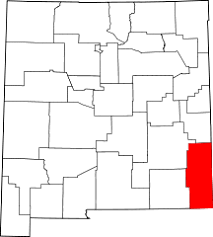
    Governor Lindsey has affixed his signature to the Lea County bill, which creates the twenty-eighth county in New Mexico.

    Lea county takes a strip off the eastern side of Eddy county, also a big piece from the southeast part of Chaves county and will have an assessed valueation of about $6,000.00. Lovington is named as the county-seat.
    [House Pioneer News, House NM. 16 Jan 1917.]


    Lea County Bill Passed By Senators.

    Santa Fe, March 5. – Lea County is almost as good as organized. The house bill providing for its establishment ws passed by the senate today without amendment.

    The bill is now ready for the signature of Governor Lindsey, and it is believed that the governor will sign it without delay. Lea will be the twenty-eighth county in New Mexico and the second to be established by the third state legislature, de Baca being the other. Lea county bill was not passed until after a hard fight. More than an hour of the time of the senate was consumed in consideration of the various amendments proposed ot the bill and in the discussion that followed the that “do now pass.” Senator Gallegos, chairman of the committee on private, county and municipal corporations, led the fight for the passage of the bill, while Senator Isaac Barth and Senator Skeen were most vigorous in opposition to it.

    It was evident that the word had been passed out that the new county should be created. The only hope of the opponents of the bill was to amend it and in that way there was a chance that amendments might not be concurred in by the house and that the bill would be lost in the eleventh hour rush.

    The advocates of the bill, however, were well organized, and one amendment after another was voted down, the count being in all cases 14 to 8 in favor of the motion to table the proposed amendment. One amendment proposed to leave the creation of the new county to a referendum vote of the people of the territory affected and on this amendment Senator Barth made his most strenuous stand.

    It was apparent that Mr. Barth was back in his old time form. With only a few days left of the session and no opportunity for hearing of the contest against him instituted by W. H. Chrisman the Bernalillo county senator seemed to feel that the shackles had been stricken from his fettered limbs and that he was a free man once more. He acted just like he used to act.

    Senator Barth charged the republican majority with playing politics in the creation of democratic counties. He acknowledged that all during the session the republicans have been courteous and considerate of the rights of the minority and lamented that such was to be the case no more. He warned the republicans that they were on a cold trail in their fell designs and declared that the only effect of stirring up dissension among Pecos Valley democrats would be to bring on more democrats in the general election.

    On the final showdown, all the republican senators voted in favor of the bill, while three democrats, Senators Calisheh, Lea and Heratelder, voted with them. The seven adverse votes were cast by the democrats – Roswell News [Lovington Leader, Lovington, NM, 9 Mar 1917.]


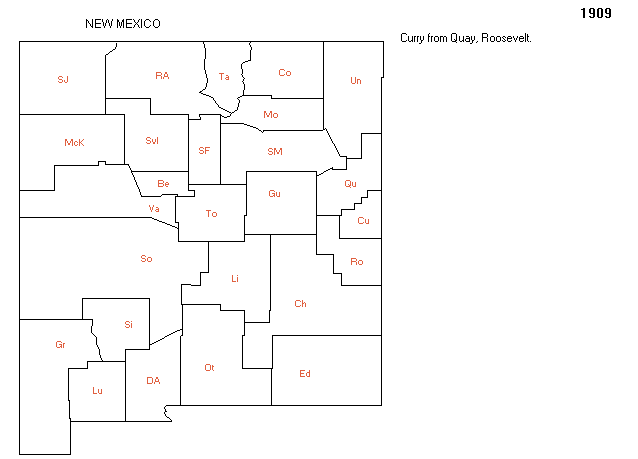
    As of 1909 – (Source unknown)

    Before and After creation of Lea County:

    As of 1917 – Image credit familysearch.org

  • Rededication of the World War II Memorial Plaque (May 30, 1950)

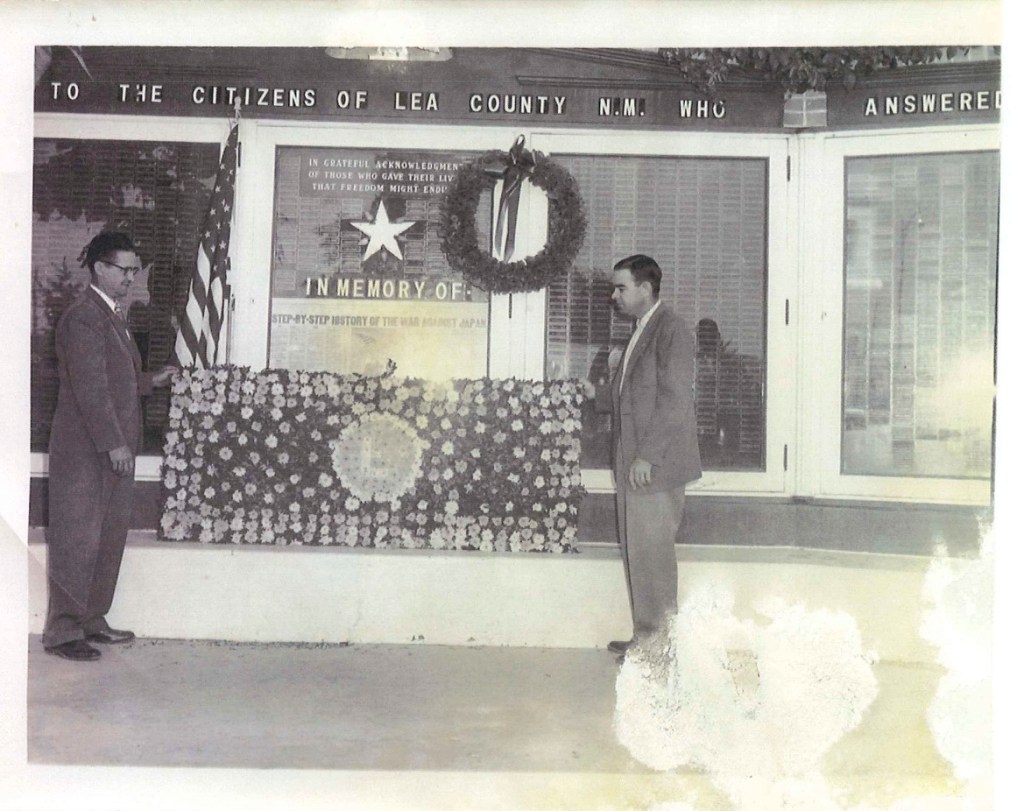
    The formal observance of Memorial Day dates back to around 1868. Before that year, a tradition had developed whereby the graves of the soldiers killed in the Civil War had been decorated with flowers. Since then, poppy flowers have become associated with Memorial Day observances. On Memorial Day, May 30, 1950, Lea County residents honored those who died in World War II in a ceremony on the court house grounds. A special plaque called the Roll of Honor was rededicated that day that bore the names. The first such memorial was dedicated six years earlier on Memorial Day, 1944.

    The 1950 ceremony was carried out at 3:00 p.m. by the Lovington unit of the American Legion. W. E. Davis acted as Master of Ceremonies. The service began with the playing of the National Anthem followed by the raising of the American flag by Press Benson. Reverend W. M. Beauchamp gave the invitation.

    The people of Lovington and Lea County will pay homage to the deceased Veterans of Lea County on Memorial Day, May 30, with a special ceremony at the site of the Memorial Plaque on the Court House lawn at 3 P.M. G. T. Hanners was the speaker. Following his remarks, he read names in the Roll of Honor and placed the memorial wreath. Poppies for the wreath were gifts of Mrs. Ida B. Gaither of Zoe, Oklahoma, a charter Member of the Lovington Unit of the American Legion Auxiliary. Miss Ethel Yadon dedicated the memorial tree planted by the members of the Lovington American Legion Auxiliary. Reverend L. W. Hardcastle gave the benediction, followed by the playing of Taps by Mrs. Patricia Burkett Lawson.

    Image credit: Leacounty.net

    Note: This memorial was later replaced by the current memorial erected in 2004, which consists of four black granite tablets bearing the names of those who died in World War I, World War II, Korea, Vietnam and later conflicts including the War on Terrorism.

  • Joseph C. Lea, Namesake of Lea County

    Joseph Calloway Lea was born November 8, 1841 in Cleveland, Tennessee to Dr. Pleasant Lea and Lucinda Francis Calloway Lea who had married three years earlier in Monroe County, Tennessee. Joseph was the second son born to the couple after Thomas C. Lea (1839) and was followed by brothers Franklin Houston Lea (1843), Alfred Erskine Lea (1845), three sisters named Mary Lea (1847), Elvina C. Lea (1847) Rebecca Caroline Lea (1852) and finally a brother John Graves Lea (1854). Along the way, in 1849 the family packed all their belongings and moved to Missouri in an area that eventually took the name Lee’s Summit. Though it was misspelled, it is believed to have been named for Dr. Lea. Lucinda Calloway Lea died in 1857 and about two years later, Dr. Lea married Francis Mahalia Clark.

    The brothers Thomas, Joe and Frank left the area before the outset of the Civil War for Colorado where they remained for a while. On September 12, 1862, Dr. Lea was killed by irregular Union troops in Missouri. The brothers returned to Missouri to enlist in the Confederate army. It is unknown whether Thomas served nor in what regiment it may have been, but both Joe and Frank are thought to have initially joined either Upton Hays’ group or the group known as Quantrill’s Raiders. They generally are known to have been known to serve with the latter, Quantrill’s Raiders. Joe and Frank served in this group until near the end of the Civil War. Joe was described as exceptionally tall for the time (6’4″), a smart and capable leader and a good planner and strategist. Joe was serving in Louisiana when the war ended, after which he returned to Missouri. During the Civil War, he reached a higher rank, but he preferred to be known by the title of Captain.

    In 1867, he married the former Ellen Douglas, widow of Douglas Burbridge. For the next several years, he was engaged in rebuilding a railroad and later in cotton planting in the southeast (Georgia and Louisiana), but returned to Missouri. Ellen died in 1871 and was buried there. Joe then moved around a bit more including living in Colorado again before returning to the southeast. In Mississippi he married Sallie E. Wildy. After first settling in Colfax County, New Mexico around 1875, Joe and his father in law William Wildy came to the area west of the Pecos River that eventually became Roswell and settled there a couple of years later. Though Joe had tried raising sheep and is said to have had a small herd of cattle, they ran a hotel for travelers and took in boarders. William Wildy, a widower, died in Roswell in 1881, leaving his property to his children. His daughter Sallie followed him in death about three years later.

    Joe and Sallie Lea had two children, Henry Harry Wildy Lea, born in 1877 in Colfax County and Eleanor Laureana “Ella” Lea, believed to be the first Anglo child born in Roswell in 1881. Around 1881, Joe organized the Lea Cattle Company, acquiring land along the Pecos River and elsewhere to the west. According to estimates, his Lea Cattle Company was one of the largest cattle operations in the history of the state, somewhat below that of John Chisum’s at its peak. After Sallie’s death in 1884, Joe continued to develop Roswell. He was joined by brothers Frank and Alfred. In 1889, Joe married the former Mabel Doss Day, widow of Col. W. H. Day of Coleman County, Texas.

    In his later years, Lea encouraged Col. Robert S. Goss to come from Fort Worth, Texas to Chaves County to establish a military school in Roswell. It operated from around 1891 to 1895 before closing for a few years. It reopened in 1898 as New Mexico Military Institute. Lea served on the board of regents until his death in 1904. An early building was named for him. That building is no longer in existence, but currently there is still a building named for him that dates back to around 1940 and 1941.

    Many “firsts” took place in Roswell during his life, including the arrival of the first physician, the first minister, the opening of the first drug store, and numerous others. Joseph Lea is known as the founder of Roswell, the founder of New Mexico Military Institute and the namesake of Lea County, created in 1917 out of the eastern portions of Eddy and Chaves counties. He died on February 4, 1904 and is buried in South Park Cemetery, Roswell, New Mexico.

    [Sources: Elvis E. Fleming, Captain Joseph C. Lea, From Confederate Guerrilla to New Mexico Patriarch, 2002; William E. Gibbs and Eugene T. Jackman, New Mexico Military Institute, A Centennial History, NMMI Centennial Commission, 1991.]

  • Opening the Cowboy Hall Of Fame and Western Heritage Museum

    Western Heritage on Display at Cowboy Hall of Fame

    By Sue Seibert

    A journey into the colorful history of Lea County and the Llano Estacado will shortly become a reality as progress toward completion of the Lea County Hall of Fame and Western Heritage Center nears conclusion. The Center, housed on the campus of New Mexico Junior College in Caster Activity Center, is a dream-in-the-making which originated in the hearts and minds of the first Board of Directors, Dale “Tuffy” Cooper, Sylvia Benge, Muriel Loya Maders, Stanley E. Newman, Tom Pearson, Dessie Sawyer, John Shepherd, Leo Sims, R. N. Tydings, and  Bill Zimmerman in 1978.

    This dream was to establish an organization dedicated to preserving Western heritage and to recognizing outstanding individuals who, through their efforts, have made Lea County a better place in which to live. The official Grand Opening for the Center is anticipated as November 1983. Therefore much thought and labor is now being put into creating the Center as the memorial of which the dream was made.

    On November 20 the center will hold its opening membership banquet at which time it will recognize this year’s three inductees into the Hall of Fame.

    The three, being selected from a nomination list of ten possible honorees, must have distinguished themselves as civic leaders in a community in Lea County, by being an outstanding rodeo performer, or by having assisted in the development of the livestock industry through an act that opened the way for others. Further, the inductees must be at least 21 years old, a long-time resident of Lea County, and of good character and reputation.

    Those nominated for this honor include Jimmie Baum Cooper, World Champion All-Around Cowboy from Monument; Allen Clinton “Daddy” Heard, who establinshed the Mallet Ranch at High Loansome and was a life member of the New Mexico Cattle Growers Assocation; Edwin David “Ed” Holt, first mayor of Tatum; Eli Jackson Jones, who assisted in the organization of the “Old Cowboys’ Reunion” and the REA; and Noran Gordon Morgan, leader in the Lea County Sheriff’s Posse, New Mexico State Cattle Inspector and consultant for the New Mexico Livestock Board of Hobbs.

    Also nominated are Alered Green “Allie” Rushing, cowboy and wagon cook for such ranches as the Hat Ranch; Tom Shipp, who assisted in establishing schools in the Knowles area south of his ranch west of Hobbs; Hugh “Rack” Ward, who homesteaded near Jal, served as Lea County Commissioner, and helped start the Jal Roping Club; “Colonel” William Standifer Williams, who incorporated the Plains Cattle and Sheep Company, settling 18 miles west of Lovington in 1898; and Adam Zimmerman, born in Frankfort, Germany, who drilled water wells in New Mexico, his first in 1901 near the New Mexico Junior College campus, and became a naturalized citizen in 1912.

    Fund raisers for the Center include the Annual Days of the Old West Rodeo held in the Jake McClure Arena at Lovington where cowboys from area ranches particpate in ranch life type events. This year’s winning ranch was the Bogle Ranch of Tatum, with Eidson Ranch second, Price Ranch third, Fort-Dickson Ranch fourth, San Simon Ranch fifth and Snyder Ranch sixth.

    All funds raised from such events go to furnish exhibits in the center which include the lobby and holding tank/windmill area, American Indian area, soldier and buffalo hunter area, open range and big ranch area, homesteader and settler area, oil industry area, pioneer street exhibit, towns’ historical area, genealogy and research area, and conference area.

    Persons wishing to contribute to the Center may do so by contacting Betty Parrish, 392-4510. Monetary contributions of $100 or more will receive an engraved display plaque in the Center. Items of historic interest may be contributed. These items become the permanent property of the Center.

    1982 Board of Directors include Sylvia Benge, Lovington; Daisy Clayton, Lovington; Bob Eidson, Lovington; Lynn Medlin, Tatum; Mark Kennedy, Lovington; Muriel McNeill, Hobbs; Leo Sims, Hobbs; Tom Pearson, Eunice; Dale Cooper, Monument; Loys Madera, Jal; and Robert Anderson, Hobbs. Chairman of the Directors is Daily Clayton, while Sylvia Benge is secretary.

    Since 1978, 22 people have been inducted into the Hall of Fame. They are:
    1978 honorees —
    Clyde Allen Browning, first Anglo child born in Lea County, growing up on the Tunnels Ranch below Caprock and establishing Lower Wells Ranch, 22 miles north of  Maljamar;
    John Thomas Easley, who came to Lea County in 1906, ranched in Monument and at the Old Plainview and Anderson Ranch near Lovington, was vice-president of the New Mexico Cattle Growers, and organized the New Mexico State Farm Bureau;
    Pello Etcheverry, born in Urepel, France, homemsteaded on what is known today as the Blackwell Ranch, 16 miles northwest of Lovington.
    Roy Lenard “Jake” McClure, who lived in Lovington, was a rancher and champion roper in the U. S. and Canada, whose horse, Silver, was recognized as World Champion Calf Roping Horse was the first person named to the National Cowboy Hall of Fame in Oklahoma City;
    Henry Record, worked on Muleshoe Ranch and the JAL outfit, owned a ranch southwest of Monument, was president of the Open Range Cowboy’s Association and the New Mexico Cattle Growers;
    George Weir, a steer roper who moved to Monument in 1905, roped in the U. S., Canada, South and Central America, and Europe, was World Champion Steer Roper in 1932;
    Dow Wood, homesteader south of Lovington, was for 42 years a cattle inspectgor and deputy sheriff, organized the Open Range Cowboy’s Association;
    1979 honorees —
    Tom Bingham, a pioneer who homesteaded in the fall of 1860 and worked to make Lea a county, was tax assessor and a law officer;
    Troy C. Fort, called “Mr. Rodeo,” a native of  Lea County born in Prairieview, World Champion Roper 1947-49, made national rodeo finals 11 times, is now on the PRCA Advisory Board;
    Mary Susan “Ma” Hooper, worked on a 320-acre homestead at Ranger Lake after her husband died, was a nurse and midwife, was a member of the Ranger Lake School Board, and was named “Lovington’s Mother of the Year” in 1954;
    Earl Hornegay, assisted in 4-H and FFA events, organized the Lea County Sheriff’s Posse, began operating a ranch at the age of 15;
    Dessie Sawyer, known as “Queen of the Democrats,” was for 26 years New Mexico National Democratic Committee Woman, worked for 4-H and FFA, keeps books for her ranch located east of Crossroads;
    Dru Taylor, came to Monument in 1903 and to Maljamar in 1907, went into ranching and was director of Lovington National Bank and Taylor Grazing Association;
    1980 honorees —
    Daniel Clyde Berry, had ranches at Tatum and Lea, played fiddle to accompany his wife’s guitar, Lea County Treasurer, State Representative 1937-38, and Lea County Commissioner in 1946;
    George Causey, brought life to the Llano-Estacado by building windmills to tap surface water, hunted buffalo, built adobe houses, trading posts and a post office;
    Robert Florence Love, was a cowboy on several differenct ranches, homesteaded 160 acres and established the township of Lovington, was postmaster in Lovington, first State Legislator from Lea County when New Mexico became a state, nicknamed “Fiddlecase,”
    Warren Snyder, a rancher, owned Ford agencies in Hobbs and Lovington, homesteaded west of Lovington;
    Will Terry, Hobbs area cowboy and rancher, he still operates the family ranch, plays the French harp;
    1981 honorees —
    Samantha Anderson, known as “A Country Girl,” was a mule-skinner, taught the Hi Lonesome School, settled at Bake’s Fist (now known as Crossroads), took over Rocking R and Quarter Circle X Ranch when her  husband died;
    Marion Rubin Bess, nicknamed “Sweety,” was on the Tatum School Board for 14 years, director of the Federal Land Bank of Lea County, broke horses for the Block Ranch at Capitan, and staked his claim northeast of Tatum;
    Richard David “Dick” Lee, was ranch manager and upgraded Herefords, worked as a cowboy at the Hat Ranch at Monument Springs, worked for the Scarbauer Cattle Company of Lea County as partner and  manager, owned the Old Swamp Angel Ranch;
    John Davidson Graham, traded cattle and horses across New Mexico, settled and bought the Causey Ranch where he raised cattle and horses, helped organize First National Bank of Lea County.

    People interested in membership in the Lea County Cowboy Hall of Fame and Western Heritage Center are invited to contact Mrs. Parrish. A one-year membership fee is $15 which includes voting rights and the annual November banquet.
    [Hobbs Flare, Hobbs, NM, 30 Sep 1982.]
  • Old Baldy

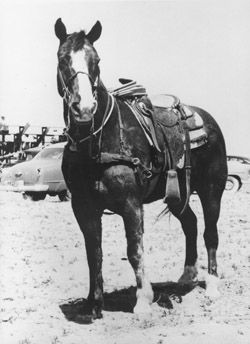
    The unique funeral of a prominent Lovington personality was held in the quiet of the day here Monday. Not many people witnessed the burial. There was no singing, preaching, or flowers, but this personality will be missed by most all of Lovington. Old Baldy, 28-year-old roping horse owned by Troy Fort, has been laid to rest in the Lea County Fair Grounds at the site of the proposed arena.

    Baldy will be honored with all the respect he deserves when the new arena is opened sometime around the middle of June or the first of July. He will have a marker at this grave and will represent all of the roping horses in this last frontier of the west.

    This will be an appropriate time, as roundup time will be over and it is the time of the year when rodeo performers start thinking of shows across the nation such as Madison Square Garden Rodeo, Cheyenne Rodeo, Santa Rosa Roundup and others. As the gates open on the first attraction in the new arena, there will be a pause to honor one of the most famous rodeo horses in the nation.

    Baldy resided in Lovington for about 15 years. He is remembered here for carrying five men to world championship roping fame. He was the greatest. He was gentle and kind around the ranch, but not may ropers could rope off him. He had such a terrific stop that not many were able to do much more than ride him, much less try to think about catching a calf.

    Volumes could be written about Baldy. He was born in Oklahoma, and is well known there. Many ropers, both young and old, can tell you any number of tales about Baldy. One roper near Plains, Texas thought so much of Baldy that he went to Oklahoma to see Baldy’s brother!

    When arena gates open on rodeos and ropings this year, old Baldy won’t be there. As mesquite grass turns green, and soft winds of spring blow across the range, the familiar sight of Old Baldy will be missing. Baldy is laid to rest where he was most at home.

    [Lovington Leader, 18 Jan 1961, Lovington, New Mexico]


  • Zip Franklin

    Oliver Gene “Zip” Franklin was an old time pilot. He was known around Lea County for having done just about anything one could do with an aircraft. He was born August 8, 1919 in Artesia and died September 11, 1991 doing what he loved, flying. An airport in Lea County was named for Zip Franklin,

    airnav.com

    Plane Crashes in Ruidoso, Killing 2

    Two men were killed and a third critically injured in the crash of a twin engine Aerostar shortly after take off from the Sierra Blanca Regional Airport in Ruidoso.

    The dead men were identified as Gary McMillan of Lubbock, Texas, and Zip Franklin, 72, of Lovington, said Lanny Maddox, criminal investigation division commander for the Ruidoso Police Department.

    The injured man was identified as Beldon Walden, 46, of Hobbs.

    Maddox said the pilot was en route to Reno, Nev., on Wednesday where the custom aerobatic plane was to be delivered to an air show.

    The plane crashed shortly before noon in a wooded area northwest of the airport.

    Witnesses say the plane burned.

    Maddox said McMillan and Franklin appeared to have been killed upon impact, and Walden was thrown from the airplane when it hit.

    The injured man was listed in critical but stable condition this morning at Eastern New Mexico Medical Center South in Roswell after being transferred from Lincoln County Medical Center, said Rick Levitt, nursing supervisor at Eastern.

    Federal Aviation Administration investigators were on their way to the crash site.

    [Clovis News Journal, 12 Sep 1991. Clovis, New Mexico.]


  • The Linam Buffalo Herd

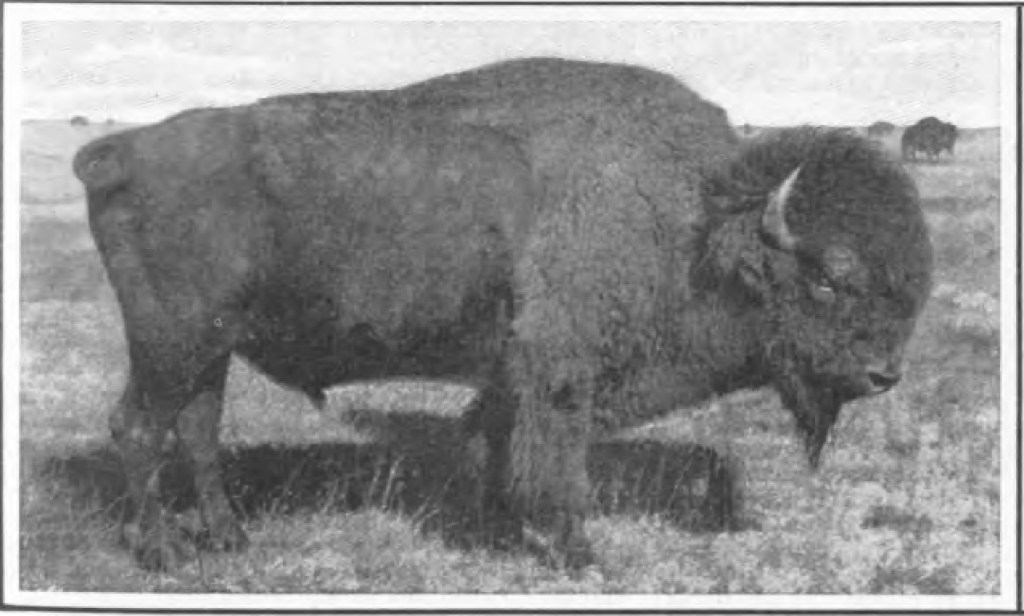
    Charles Goodnight founded a herd of buffalo on his Texas ranch. Goodnight had died in 1929 and a successor owner reportedly announced plans for a buffalo hunt on the former Goodnight ranch. Fortunately, the new owner was persuaded not to go forward with the plans. Some animals were sold, like the ones sold to Virgil Linam, and through a series of steps, the remaining animals became the Texas State Bison Herd. They now reside mainly in Caprock Canyons State Park, near Quitaque, Texas.

    Below is an excerpt from a 1949 newspaper article by Katy Marshall in the Hobbs News Sun about rancher Virgil Linam’s small herd. As a youngster, seeing these big animals was always a treat when heading into town with our family to do our payday grocery shopping.

    “Patriarch of the Goodnight Bison Herd” – Image Credit: allaboutbison.com

    Remnants of Thundering Herd Still Roam Plains Amid Oil Wells, Tourists

    Seven-Animal Herd of Virgil Linam Preserves Plains Tradition, Makes Motorists Stare Near Hobbs Limits

    By Katy Marshall

    The derrick-dotted plains of southwestern New Mexico are today a far cry from the vast herds of Buffalo that once roamed the area.

    Yet within a few miles of Hobbs a herd of the huge beasts grazes not far from the Hobbs-Carlsbad highway, causing motorists to stare and wonder if their imaginations are carrying them back to the old days.

    True, the herd is small, only seven animals, and it is one of the few remaining in the nation today, but the sight of the humped backs and lowered heads grazing among the mesquite on the Virgil Linam ranch is still a reminder of the vast open land of the old days.

    Linam purchased the beginning of his herd in 1932, from the old Goodnight Ranch near Amarillo. He originally bought three animals, and has also added to the herd. In addition there has been a calf crop every year, although the calves did not always live through the hot New Mexico summers. One cow of the original group is still on the ranch, and has calved every spring.

    The problem of keeping them within the lot arose when Linam first brought the buffaloes to the ranch. The section in which they were placed had a fence of net and four strands of barbed wire – enough to keep in any cattle. The buffalo, however, found this fence no obstacle, and jumped it, like deer, to go wandering down the road. Tracks in the dirt showed where they had jumped, Mrs. Linam said, and apparently they had not touched the top strand in going over. Two more strands were added and this has proved a high enough barrier for them, she said.

    Why keep buffalo in the first place? Mrs Linam said her husband’s original purchase came about “because he always has liked things that were a little different, something strange, or uncommon.”

    [Hobbs News Sun, Hobbs, NM, 21 Feb 1949.]


  • Seaman James Edward Teas

    by David L. Minton, Lea County Historian

    (Used with permission)

    Good Morning Fellow Lea Countians far and near.  Today I would like to remember and honor a Lea County man who lost his life in defense of our country.  James Edward Teas who preferred to be called Edward was born January 29th, 1922 in Lea County to Harvey and Minnie Teas.  Edward grew up in Lovington and graduated with the class of 1941 from the Lovington High School.

    After high school he found his way to Roswell where he was employed by the Yucca Theater.  His military career began when he enlisted in the United States Navy Reserve on May 10th, 1943.  Edward was a Seaman 2nd Class serving his nation aboard the U.S.S. Liscome Bay which was a brand-new escort carrier, launched in April 1943 and commissioned August 7, 1943.

    During the invasion of the Gilbert Islands and the battle at Makin Island on November 24, 1943 while the U.S.S. Liscome Bay was making a turn it was hit behind an engine room by a torpedo from a Japanese submarine.  The torpedo hit the ship’s bomb magazine which caused a tremendous explosion.  Debris from the U.S.S. Liscome Bay fell on the battleship New Mexico which was approximately 1500 yards away.  Seaman 2nd Class Edward Teas along with 590 other enlisted men and 53 officers were all lost, it took the U.S.S. Liscome Bay only 23 minutes to sink.  There were 272 survivors.

    Seaman 2c James Edward Teas was lost at sea, his body was not recovered.  In addition to his name being engraved on a monument in Hawaii along with other WWII losses, his parents Harvey E. and Minnie A. Teas memorialized Edward in the Lovington Cemetery with a V.A. stone.  We Salute you James Edward Teas.

  • The Hobbs Family

    James Isaac Hobbs was born January 2, 1852 in Tishomingo, Mississippi. By the time he was 19, he was working as a laborer on a farm in Prentiss, Mississippi. Eight years later in 1878, he married the former Frances Paralee “Fannie” Mooring in Point, Rains County, Texas, born in Tennessee on March 27, 1857. By 1880, the couple had been blessed with two children, a girl named Ada and a boy named John, and were still living in Rains County, Texas. James Isaac was working as a farmer. By 1900, the couple was living in Brown County, Texas. James Isaac was still working as a farmer and the last of their seven children, twins Winnie and Minnie, were born in 1896. By 1910, they had settled in what was then Eddy County and were residing in a community called Roberts, believed to be the future location of Hobbs.

    A daughter, Minnie, tells the tale of how they came to settle in southeastern New Mexico. They were originally headed to the Davis Mountains in Texas, but on the way, they met a person returning from that area who was very negative about it and the Hobbs’ prospects, should they elect to continue. As a result, they headed in a northwesterly direction and came instead to southeastern New Mexico, still then a territory. As time passed, they were joined by other settlers and the town grew up. When they applied for a post office, Minnie says that they penciled in the name “Taft” but when the name was approved, someone had changed it to “Hobbs” instead. (1) By 1920, the couple was living in the community of Nadine. Lea County had been created out of portions of Chaves and Eddy counties. James Isaac passed away three years later. Fannie survived him another nineteen years.

    At least three of the children of James Isaac and Fannie remained in the area. James Berry, called the founder of Hobbs, Winnie who married Sam Dalmont and Minnie who married Ernest Herman “Dad” Byers.


    (1) Lea County Genealogical Society, Then and Now, Lea County Families, Volume 1, Walsworth Publishing Company, 1979.


  • Charlie Campbell

    Charles Leland Campbell was born June 19, 1911 in Elida, Roosevelt County, New Mexico to Zachary Taylor Campbell and Lillie Louise Bridges Campbell. In 1920, Zachary’s profession was listed as barber and they were still living in Elida. Zachary passed away in 1930 after an illness. Charlie, as he became known, graduated from Elida High School.

    Campbell served in the U. S. Air Force in World War II. In 1945 he married the former Kathryn Smith in Buechel, Kentucky. Charlie also attended attended New Mexico Normal University at Las Vegas (now known as New Mexico Highlands University) for several years.

    The couple settled in Lovington, where Charlie was engaged with his brother, John Campbell, in the operation of Campbell’s Farm and Ranch Supply and Campbell Grain and Milling Company. Their store was located at the base of the large grain elevators, the tallest structures in Lovington.

    For many years, Charlie hosted a daily radio program on station KLEA out of Lovington. His program reported local news and events. Charlie passed away on August 29, 1984 at the Veterans Administration Hospital in Amarillo, Texas after a short illness. He was survived by his wife and children.