Old Lea County, N.M.

Tag: pioneers

  • Eugene Price

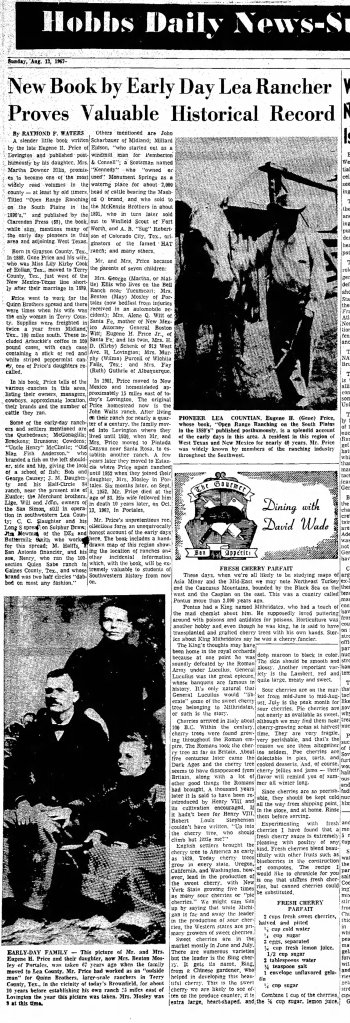
    Gene Price (full name Eugene Hubbert Price) was born on November 19, 1868, in Grayson County, Texas to Theodore Martin Price (1836 – 1927) and Martha Ann Virginia Drisella Hubbert Price (1842 – 1905). Theodore Martin Price was a farmer/rancher/merchant and also a circuit riding Methodist preacher. From his early years, Gene was keenly interested in ranching, beginning in the era of the open range.

    As a young man, he worked on several ranches in the southwest. He named the Quinn Brothers, the Hat Ranch, Pemberton Brothers and the E Ranch in his comments. In 1889, he married the former Lily Kirby Harris Cook in Eolian, Texas. Around 1901, the family homesteaded in New Mexico, at the corner where Yoakum, Gaines, Eddy, and Chaves counties met – roughly 15 miles east of the future site of Lovington.

    Mr. Price built up one of the area’s earliest high-quality registered Hereford herds. For a while, he leased the Highlonesome Ranch, and the family resided in its old headquarters house. As their children reached school age, the family bought a home in Lovington while still working the ranch. Gene served on the Lovington School Board and participated actively in community matters; he generously donated land for a second, larger school building, which served as the town’s only school for many years. He was a long time member of the Methodist Church in Lovington.

    In his later years, he authored “Open Range Ranching on the South Plains in the 1890’s,” a memoir of his early experiences that has become a valuable resource for those interested in the region’s history. Long out of print, the original publication included a reproduction of Gene’s informative hand drawn map of Lea County and the surrounding area.

    Mr. Price passed away on September 5, 1952. Mrs. Price died on October 16. 1962. Both are buried in Lovington Cemetery. In 1988, he was posthumously honored with a Bronze Cowboy award for his numerous contributions to the early traditions and settlement of Lea County.

    Image credit – Hobbs Daily News-Sun, August 13, 1967
  • Bob Causey – Blacksmith and Spur Maker

    (Used with permission)

    Robert Lincoln “Bob” Causey was born in Illinois on February 12, 1868 to George Washington Causey and Mary Adeline Crowder Causey. February 12, 1809 was the birth date of the late United States President, Abraham Lincoln. This was likely the source of Robert’s middle name. Concerning his place of birth, articles usually say that he was born in Missouri, but both the 1870 and 1880 census pages list his place of birth as Illinois. He was one of ten children born to the couple, many of whom were also born in Illinois. George W. (the father) had been born in Tennessee and in the 1870 census, his occupation was listed as farmer. He was still shown as being a farmer in the 1900 census before his death in 1907 at around 80 years of age. He died in Guthrie, Logan County, Oklahoma Territory. Mary Adeline had predeceased him, also in Oklahoma, in 1895.

    In the 1880 federal census, Bob was twelve years old, still living with his parents and two of his sisters in Adams County, Iowa. The other siblings had left the family home over time. Several of the brothers including John and Thomas (known as George), had been making their living since the 1870s as buffalo hunters and had moved west following the herds. They had begun to hunt the big animals in Kansas and as the herds worked their way south, they followed them, eventually crossing the Arkansas River and venturing into areas that had been set aside by treaty as hunting lands for the native tribes which roamed the area. George continued this until he reached the Panhandle of Texas. Still in close proximity to the roaming tribes, George was not involved in either of the two battles of Adobe Walls, but he was camped near enough to hear the shooting during one of the events, at the time assuming that it was his fellow buffalo hunters at work.

    However, by about 1882, the herds had been depleted to the point that the brothers realized that they needed to find other livelihoods. So, they headed further west to the New Mexico Territory with a plan to round up, raise and sell wild mustangs, which they did with little early success. Bob must have been drawn to the west himself, as later in 1880 he is said to have left the family home with $5 in his pocket. He made his way as far as Indian Territory where he managed to stop in an unnamed town and find a job as an apprentice in a blacksmith shop. He worked there for about four years earning a tiny wage plus room and board before moving on to join his brothers around 1884.

    In the meantime, his brother George settled for a while in the Yellow House area of West Texas before moving on. George found a seepage spring and dammed it up to provide a water supply. There he built a sod house as his home base. The area took its name from nearby geological formation of limestone bluffs that were pockmarked with caves. The name in Spanish was las casas amarillas which in English was translated “yellow houses.” The general area was to later become part of both the XIT and Yellow House (owned by Littlefield) ranches at various times. George was aware of the enormous transaction had taken place between the State of Texas and a syndicate to create the XIT and decided it was time to move on. When the XIT began to be dissolved after around 1910, the Littlefield operation acquired some 236,000 acres of the former XIT.

    George and John Causey left West Texas and resettled in southeastern New Mexico, near a place called Monument Spring before building their ranch house a bit north of there. They built their ranch headquarters about five miles south of what became the town of Lovington and roughly fifteen or so miles northwest of what became the town of Hobbs. Bob appears to have joined them at their ranch a few years later. He stayed in southeastern New Mexico until in the latter part of the 1880s, when he branched out to set up his first blacksmith shop in Odessa, then basically just a water stop for the Texas and Pacific Railroad. He was soon joined some time later by his recently widowed sister Nellie Causey Whitlock and her young son, Vivian Whitlock. As Netties’ son grew up, Bob took him under his wing at the blacksmith shop. However, Whitlock did not follow in Bob’s footsteps as a blacksmith. Instead, he became a writer. He published one book, “Cowboy Life on the Llano Estacado” and numerous stories and articles in magazines and newspapers over thirty plus years. Some knew him by his pen-name, “Ol’ Waddy” and others under his given name.

    Being one of the earliest Anglo settlers to arrive in the area and an early blacksmith, Bob is called the “first blacksmith of the Llano Estacado.” In addition to his day to day blacksmithing duties, Bob began to make spurs and bits for the local cowboys. One of his designs was called the “gal-leg” spurs. They were so labeled because the neck or shank of the spur (the part that extends behind the boot) was fashioned to resemble a woman’s leg, with the foot or toe holding the rowel pin. (Parts of a spur.) Bob is sometimes credited for coming up with the gal-leg design, but even if he was not the inventor of the design, he was at the least one of the first to make them.

    Bob remained in the Odessa area for about ten years, also serving as constable as the town grew. He moved to Eddy, now known as Carlsbad, New Mexico about 1895. There he set up a blacksmith shop on Main Street. He operated the shop for many years before partnering with Robert Osborn. Bob married Martha Agnes Bogle in 1903 and the couple had one daughter. His reputation spread and Bob became well known for his spurs and bits. He would make them up ahead of time and also make them to order. When he signed his work, he stamped the articles with his initials, “R. L. C”. In addition to the gal-leg design, he was known for fashioning the neck or shank in the shape of a horse head. He would often adorn them with Mexican coins that he would collect on his travels and save for just this purpose.

    After a few other moves, he was finally drawn to move to Safford, Arizona in 1924. He remained there until his death in 1937. He is buried in Safford City Cemetery. His wife Martha Bogle Causey survived him by twenty-four years and is also buried in Safford City Cemetery.

  • Archie Dow Wood

    The headline in the Hobbs Daily Flare issue of January 27, 1961 read “Death Takes Pair of Old-Timers From Lea Scene.” It related the recent passing of John W. Green and Archie Dow Wood. A. D. Wood was 79 years of age and lived south of Lovington on the Arkansas Junction Road. It added that he moved to Lea County as a boy, started his own ranch and also said that he had served as a deputy sheriff for fifteen years during the oil boom. Survivors included his wife and son as well as numerous grandchildren and great grandchildren.

    Archie Dow Wood was the son of George Washington Wood and Jessie Lucinda Cauble Wood. He grew up in Texas and Oklahoma before coming to New Mexico when he was fourteen years old working on ranches for others until he “filed on a government claim” of his own. After Lea County was formed, he worked as a deputy sheriff from about 1922 to 1933 and served as a New Mexico cattle inspector for nearly forty years. He retained a title as special deputy of Lea and other counties for many years as well.

    A. D. was one of the organizers of the Open Range Cowboys Association. They started meeting informally in the early 1930s and were more formally organized around 1940. He was known as a great story teller and enjoyed relating the early days of the area even before Lea County was formed.

    He was first married to Jessie Pearl Markley and secondly to Mary Beth Wilf. A. D. passed in 1961 and was interred at Lovington Cemetery. Mary Beth survived him until 1986. She is also interred at Lovington Cemetery.

  • “Uncle Bill” Oden Talks About the Old Days

    Transcribed from the Pecos Enterprise (Pecos, Texas) – August 19, 1938


    B. A. “Uncle Bill” Oden, Authentic Old-Timer, Gives Historical Sketch of Monument Landmark

    B. A. “Uncle Bill” Oden, Who’s been in the trans-Pecos country since time began, was asked recently by the Hobbs Chamber of Commerce, to give a historical sketch of the famed Rock House in Monument Springs, New Mexico.

    The rock house, subject of a recent story in the Cattleman’s magazine, is one of New Mexico’s oldest land-marks and its origin has been a controversial subject for years.

    Uncle Bill was in the New Mexico country in 1884, and is one of the oldest living early settlers of that section. The story he wrote for the Hobbs Chamber of Commerce and also for the Cattleman’s magazine, is reprinted below:


    According to promise, I am going to give you a true history of the old rock house at Monument Springs. I, a boy of 18, went to what is now the San Simon ranch in 1884. I, being young and everything being new and of interest to a lad of that age in a country as wild as that was, remember things more vividly than things that happened ten years ago.

    Bound for Lincoln!

    I hired to Mr. Divers at San Angelo some time about the middle of June of that year when he was passing though there with about 1250 head of cattle bound for Lincoln County, New Mexico. I worked for him nine years at what is now the San Simon ranch and I, as a cowboy, new all the first settlers of the country. These I will give you in the course of this article.

    From San Angelo we traveled up the North Concho to somewhere above where Sterling City now is. We turned north and crossed the T and P Railroad Company at Iatan Tank about 15 or 20 miles east of Big Spring. There we turned northwest toward the head waters of the Colorado River. There we camped around two months waiting for it to rain before starting across the Plains. Around the middle of August it began to shower and we started and as luck smiled on us, it rained the second night out and we turned the cattle loose and they all got well watered. The next water we got was in small lakes about where there the town of Hobbs now is. We stayed there for a few days and went on to Monument Spring. There we found Jim Harvey and Dick Wilkerson, two buffalo hunters, who had preempted the spring. In other words, they had what was known as squatters right to spring and so much land. They, Harvey and Wilkerson, had hauled the Monument, of rock the soldiers had built on a hill about three-quarters of a mile west, and built the rock house and a small stock correll [corral] near the spring. The little rock house had port holes in the corners for protection from the Indians and when we passed there about the 27th day of August, they slept in the gate of the correll to protect their horses from the Indians. The place where the San Simon ranch is was known by the soldiers and buffalo hunters was Dug Spring. It was only six feet to water but it had to be pumped with horse power. In the spring of 1885 R. F. Kennedy bought Monument Spring from Harvey and Wilkerson, paying them $5,000 for same, and they moved about 1000 head of cattle there from Gonzales County in Texas.

    Ranchers Begin Locating

    In the fall of 1885 E. H. Estes located eight or 10 miles west of there at a well he bought from Louis and Guyat Faulkner and started what was known as the 7Z7 ranch, which is operated for several years. In 1886 there were several ranches started in what is Lea County, New Mexico, and Gaines County, Texas. J. M. Daughtery started what was afterward known as the 84 ranch about 15 or 20 miles south of Monument Spring and also Frank and Ed Crowley located along the line of New Mexico and Texas east of the town of Hobbs.

    Uncle Henry McClentock started the next ranch about 15 miles east of the New Mexico line in Gaines county. South of the 84 ranch was McKenzie Brothers, J. M. and Gene. Farther down the draw toward the southeast corner of New Mexico was Cowden Brothers, later known as the Jal Ranch.

    The W. C. Cochran ranch was where the present town of Jal is, and east of the 84 ranch Bill and Dave Brunson settled. North of Hobbs was the Atwood or Mallet ranch, about five miles south of the present town of Lovington George Causey settled. He was a buffalo hunter and didn’t own any cattle for several years. The above named ranches were started from 1886 to 1888. In 1884 the ranch farthest west was the TJF ranch on the head waters of the Colorado river. With the exception of another old man by the name of Anderson, who had a small bunch of cattle at a weak spring at Cedar Lake in Gaines County, there were no more ranches or cattle between there and the Pecos river. The cattle we had were the first to water at Monument Spring. Harvey and Wilkerson were the only permanent settlers.

    Few Buffalo Hunters Left

    There were a few other old buffalo hunters in the country but they camped around wherever they could find water and killed antelope in the summer, and buffalo and antelope in the winter. They dried the meat, (which they called jerkey) in winter. Those who were there any length of time after I went there were Louis and Guyat Falkner, Rankin More, Judge and Jon Kink Kuykendall and an old man by the name of McConvill, who dug wells for ranchmen for several years. Rankin Moore never owned any interest in the spring, though he might have helped haul the rock. The house was built in the winter of 1883 and 1884, but it wasn’t quite finished when we passed there. The well was dug about 1888 and might have been dug by Jim Andrews as he was working for Mr. Kenney at the time. Rankin Moore settled in Andrews County, Texas, near the line of New Mexico. He dug wells for McKenzie Brothers for twenty cows and calves and ranched them there a few years and sold out to Uncle Billy Daughtery and left the country.

    During the nine years I worked for Mr. Divers, I attended roundups extending from the site of Lubbock to Drockett County and from Black River, New Mexico, to the Live Oak Creek, in Crockett County.

    H. E. Cummins, who lives in Midland now, was hired by Jim Harvey in Colorado in the fall of 1884 to skin buffalo and antelope and cook. He cooked for them all winter and caped part of the winter at the ranch where I worked and owned by Frank Divers. He has the honor of being the last of the buffalo skinners, as the winter of 1884 and 1885 was the last of the buffalo in commercial quantities.

  • Allen Clinton Heard

    A. C. “Daddy” Heard was born in February 23, 1858 in DeWitt County, Texas. His parents were Humphrey Whorley Heard and Louisa Ellenor Foster Heard, and he was one of eight children. When he was an older teenager, he began working cattle for one of his brothers in Texas. He next rode on the cattle trails as a cowboy for about three years before settling for a time in Tom Green County, Texas where he worked for his brother Jasper and Tom Word. He later worked for another rancher near the Pecos and began to build a herd of his own.

    Heard came to Southeastern New Mexico in 1894 around which time he became a co-owner with others in a cattle ranch they purchased out of the old Mallet Ranch and renamed the High Lonesome Ranch. He and others had driven cattle from Texas to what was then Eddy County. At the time, the gramma grass was said to be lush and high. Heard improved his stock by bringing in the first registered Hereford bulls to the area in 1910. His brother and former partner Jasper Newton Heard died in Texas the following year in a ranching accident in which his horse fell on him. The supposition was that both horse and rider died after getting tangled in a rope.

    Heard continued to operate the High Lonesome until around 1927 when it was sold. Heard had earlier moved his family to Carlsbad around 1900. Over the years he served as mayor of Carlsbad, county commissioner of both Eddy and Lea counties at various times, including being one of the first three county commissioners of Lea County when it was formed around 1917.

    Heard was one of the founders of the Presbyterian Church in Lovington. It is also said that he was primarily responsible for seeing to it that a paved road was built from Carlsbad to Lea County. He served as a director of the First National Bank of Carlsbad and was also a State Representative from 1920 to 1924. He was a life member of the New Mexico Cattle Growers’ Association. He and his wife, the former Talovia Elmira Newcomer, had two daughters. Heard was often mentioned in local newspapers for events happening at the ranch and for other activities involving his family. He passed away at the age of 86 on July 6, 1944 in Bernalillo County and is buried there in Albuquerque’s Fairview Memorial Park.


  • Byers and Hobbs Families

    Minnie Hobbs Byers was the daughter of James Isaac Hobbs (1852-1923) and Frances Perlee Mooring Hobbs (1857-1942). She was a twin with her sister Winnie Hobbs Dalmont and both were born March 6, 1896 when the Hobbs family was still living in Texas.

    Their parents were James Isaac Hobbs (1852-1923) and Frances Paralee Mooring Hobbs (1857-1942). Their oldest sister, Ada was about seventeen when they were born and got married later that year. There were two slightly younger siblings between Ada and the twins: Berry and Ella. The family story is that they headed west from central Texas in 1907. An uncle named Lewis D. Cain had come to New Mexico after 1900 following the death of his wife, Nancy “Nannie” Mooring Cain, sister of Mrs. James I. Hobbs, back in Texas.

    In an interview, Minnie says that their original goal had been to reach central New Mexico but they decided to stop soon after they crossed the border into the territory. Their brother Berry had made an application for a post office with the name “Taft” but it came back and was approved with the name Hobbs.

    The family of her future husband Ernest Herman Byers had come to the area by way of Houston County, Texas, though Ernest had been born in Kansas in 1882. His father Joseph Byers had passed in 1903 in Grapeland. Ernest and his sister and mother Sarah had come to New Mexico with other relatives. Minnie recounted that Ernest and his family came as far as Midland by rail and then by wagons the rest of the way. Ernest was older than Minnie, but their attraction took hold and they were married in the summer of 1912.

    Minnie’s account of their June, 1912 marriage was related in a Lovington Daily Leader interview on May 13, 1973. Minnie said that there was no minister in the immediate area, so she and Ernest rode in a buggy to Nadine where the nearest minister was located. She did not recall the name of the officiant, but remembered that the floors had just been scrubbed and were still wet when they married. The couple went on to have six children. They moved to Lovington in 1930 and their home was a landmark on 16th street.

    Minnie was active her entire life and enjoyed telling stories about the early days in Lea County. She was an artist, loved playing the violin and speaking. Ernest passed away in 1966 and Minnie survived him until her death in 1981. Both are buried in Prairie Haven Cemetery in Hobbs, New Mexico.

  • Clyde D. Woolworth and the Woolworth Family

    Clyde Dean Woolworth (1883-1938) was the first member of the family to come to Lea County. He was born to a large family in Carthage, Panola County, Texas. His father was Justus Morgan Woolworth and his mother was Mary Jane Paxson Woolworth. Clyde was one of at least eight children.

    The family story is that Clyde and his sister Elizabeth and learned of land that could be homesteaded from an article in a Dallas, Texas newspaper. They came to the area in 1915, after statehood but before the county was to be created in 1917. Clyde and Elizabeth each homesteaded a half section of land and it is said that they built their home where their property adjoined, partly on each other’s land.

    The siblings were later joined by three other sisters, Martha, Litie and Clara. Their property was the nucleus of the Woolworth Ranch near Jal, New Mexico. Finding a reliable and plentiful water source was always an issue in the area. The family told of facing the usual pioneer hardships including extreme weather, rattlesnakes but managed to remain. Oil was later discovered on their property.

    After an illness of several months, Clyde died at the age of fifty-five in 1938 while residing in San Angelo, Texas. Mr. Woolworth was a single man and is buried in San Angelo, Texas. He was survived by five of his sisters: Clara, Litie, Mae and Elizabeth Woolworth, all of San Angelo, and Mrs. Claudia Woolworth Watkins of Henderson, Texas, one brother, Dr. Joseph Dean Woolworth of Louisiana; and was predeceased by one brother, James G. Woolworth and one sister, Martha Woolworth.

    The Woolworth family is noted for having donated funds to found the Jal Library.

    Sources include various newspaper articles and the Summer, 2010 edition of The Lea County Tradition, a periodical.

  • The James B. Love Family

    James Benjamin “Jim” Love was the younger brother of Robert Florence Love. Both were sons of John Dillard Love and Mary Jane Austin Love. Jim was born on September 25, 1873 in Palo Pinto, Stephens County, Texas. By the time he was about seventeen, he began working on ranches in West Texas and on into New Mexico. (1) Jim’s father John D. Love died in 1889 at the age of 76. His mother survived John for about seventeen years and died at the age of 69.

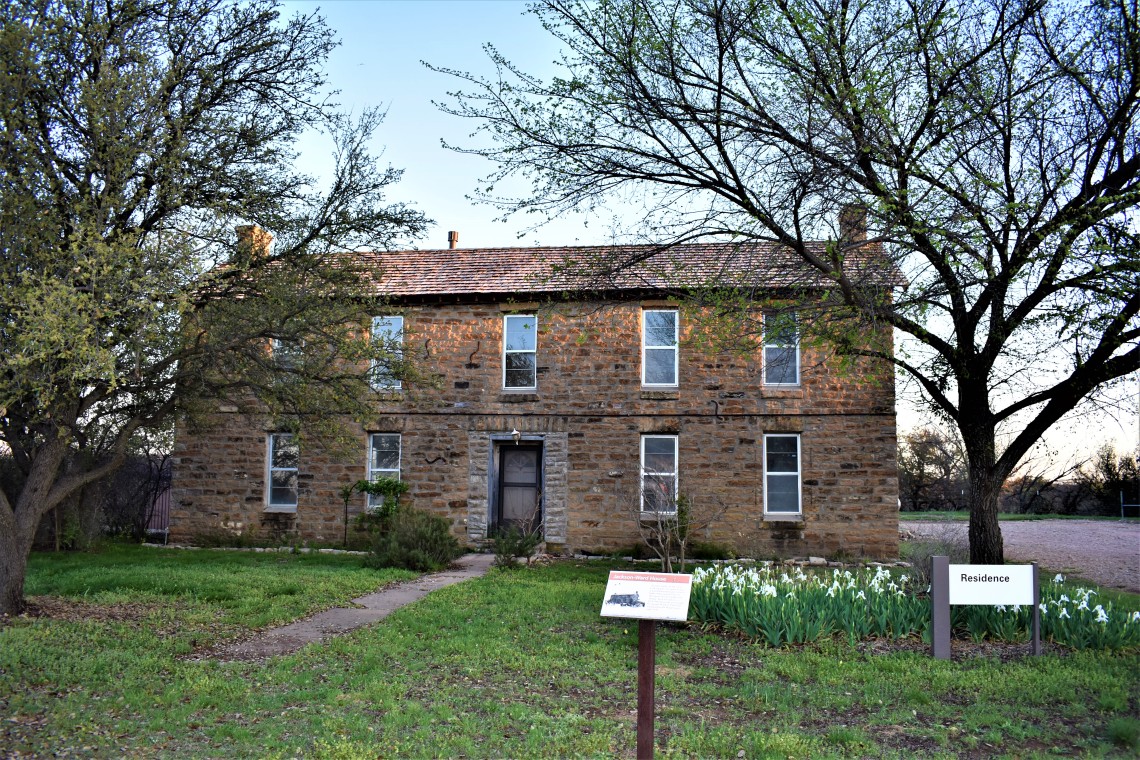
    Jim had met Mary Myrtleene “Myrtle” Ward who was living in Fort Griffin, north of Albany, Texas. Myrtle had been born in a rock house in old Fort Griffin, the town, according to her daughter Anemone Binkley’s account. There is only one remaining intact structure where Fort Griffin was located. It is called the Jackson-Ward house and is still standing, at last report. This is probably the house that Mrs. Binkley was referring to.


    Their first child, a daughter named Emma Leona was born the following year in Turkey, Texas. Another daughter, Ruth Alma, was born two years later in 1906. Soon afterward, the young family moved to southeastern New Mexico, then still a territory and settling first in the general area of Knowles. By about 1908, they were living in what would become the town of Lovington, named after the two brothers.(1)

    Jim operated the first mercantile store in Lovington on property he had acquired around what would eventually become the town square. To their family, five more children were born: Velma (1908), Jordan Ward (1910), Mary Kathleen (1910), Myrtle Jim (1914) and Anemone (1918).

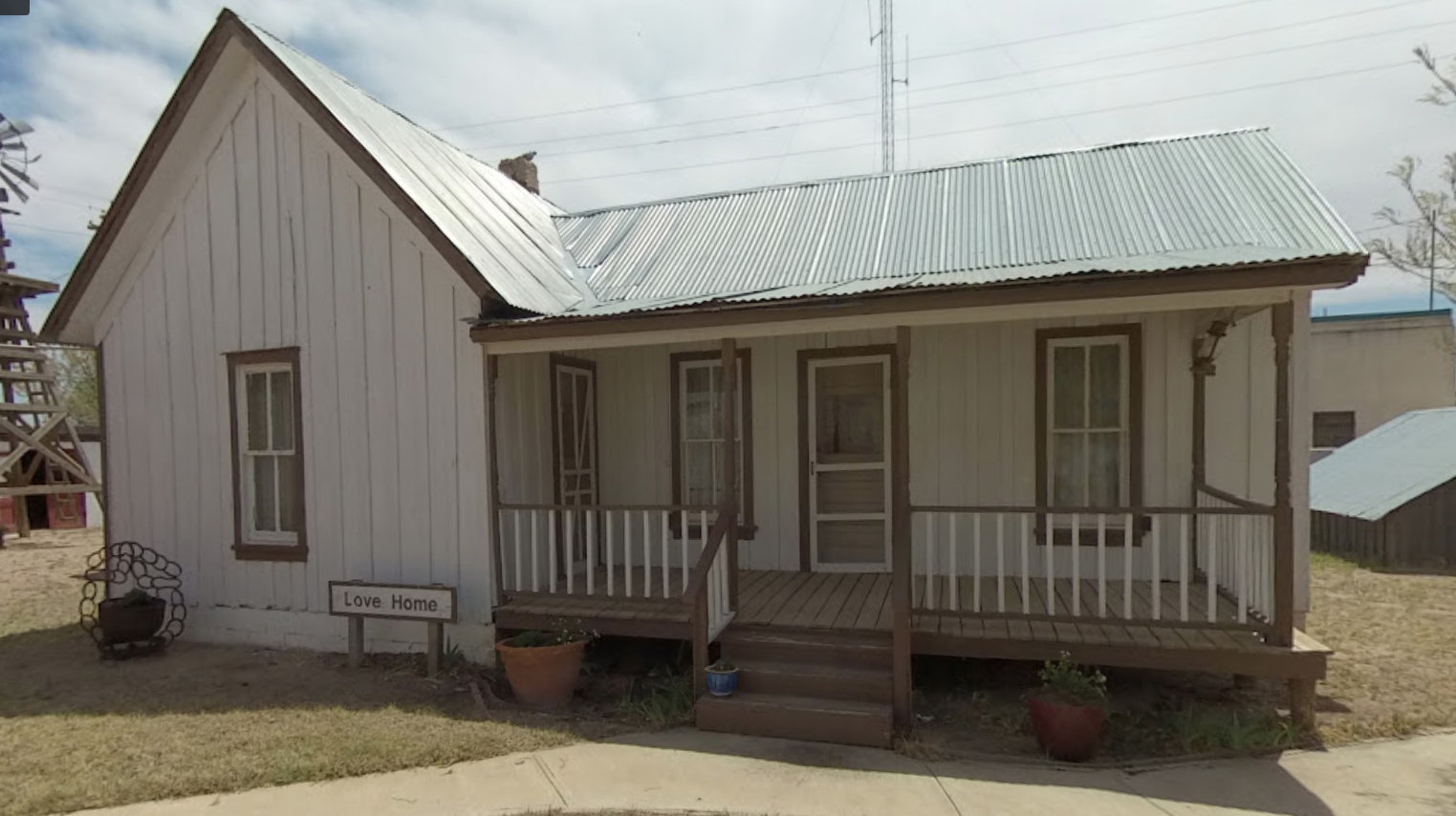
    Jim Love died in 1945. Myrtle survived him about 26 years until she passed in 1971. The home they lived in, pictured below, was originally located at 109 S. Eddy Street. In the spring of 1975, the children of Jim and Myrtle Love donated the home to the Lea County Museum. At that time, most of the children were still living, with the exception of Jordan, who had passed away in the previous year. The residence was later moved about two blocks to a location behind the Lea County Museum on Love Street, on the courthouse square. The home was renovated and furnished as it would have been in the past.


    (1) Lea County Genealogical Society, “Then and Now – Lea County Families, Vol. 1,” Walsworth Publishing Company, 1979.

  • Samuel Rose Cooper, Early Settler

    Samuel R. Cooper was an early resident of Lea County. He was born near Salina, Kansas in 1874. When he was six years old, his family moved to Erring Springs, in the Chickasaw Nation, Oklahoma Territory, now known as Oklahoma.

    As a young adult around the age of 21, Mr. Cooper left his family and moved west to Mobeetie, Texas in the Panhandle. He worked on several ranches including the XIT ranch. He also recalled hunting prairie chickens and sending them to markets in Kansas City and St. Louis, Missouri. When he was 27, he married the former Jessie May Gray and the young couple moved to a farm near Mobeetie and supplemented his income by cutting wood and transporting it by ox teams. He also hauled and sold cottonseed cake to ranches int he area.

    In 1914, two years after New Mexico became a state, Mr. Cooper sold his Panhandle farm and moved to the area. He homesteaded a half section located roughly ten miles northwest of the area that would give rise to the town of Jal and later added another half section to his homestead holdings. His brothers and father were already residing in New Mexico. Mr. Cooper built a one room house with a dirt floor early on, and lived there for a few years before building a more substantial home. The first three years they were in the area, they had to rely on water which they hauled from Mr. Cooper’s father’s property, but in 1917 they were able to drill their own well and set up a windmill to provide their water supply.

    At that time, a one room schoolhouse served the community children and also provided a place for community gatherings and Sunday School meetings each Sunday morning.

    After some time, the Coopers set up a post office with Mrs. Cooper serving as post mistress. They later established a small mercantile store near their home, supplying it with goods freighted in from Pecos, Texas. The goods were transported by two large wagons in tandem, pulled by a team of twenty burros.

    Oil was discovered in Jal around 1929, and Mr. Cooper recalls that all structures, including barns and chicken houses were converted to housing for oilfield workers. One additional benefit of the oil boom was that Mr. Cooper then was able to get natural gas service to his home where he previously only had wood and kerosene for home use.

    Mr. Cooper passed away in 1958 at the age of 84. He had lived in Lea County for forty-four years. His services were held and the Church of God in Jal, of which he was a charter member. He was buried in the Jal-Cooper Cemetery on land that he donated. His wife Jessie survived him another eighteen years. He and Jessie had eight children, four sons and four daughters, all of whom survived him along with 29 grandchildren and 17 great grandchildren.

  • The Robert F. Love Family

    Robert Florence Love was born April 17, 1870 to John Dillard Love and Nancy Jane M. Austin Love in Palo Pinto County, Texas. John Dillard Love had been born in North Carolina in 1822 while Nancy Jane was a number of years younger having been born in Arkansas in 1837. John Dillard and Nancy Jane had married in 1859 in Arkansas. Their first child, Jefferson A. Love was born in 1862 and he was followed by five more male children, Samuel Oliver (1865), John G. (1867), Robert Florence (1870), James B. (Jim) (1873), and Albert Berry (1877). The first two sons were born in Tennessee and the remaining four were born in Texas.

    In the 1880 census, Robert was living with his family in Palo Pinto County, Texas. His father was listed as being a farmer and he and his three older brothers were noted as working on the farm. By the time Robert was twenty, he had begun to move west and was working on the OHO Ranch in Stephens County, in west Texas. Robert continued to work his way further west during the next decade as he neared the Texas-New Mexico border. He is known to have worked on the J96 Ranch, owned by Joe Allen Browning and then on the old Mallet (later known as the Hi-Lonesome) Ranch. For a brief time, he returned to Stephens County, Texas before again turning west near the current town of Plains, Texas. A son, John Leman Love, relates that he worked in Stephens County on the VVN Ranch for a while. He then moved to Stanton, Texas in Martin County, where he met Matilda Anne Glascock whom he married in 1896. By the time the 1900 census was taken, the couple had four of their five children: twins John Leman and Mary Nancy (1897), Grace Elizabeth (1898) and Robert Eugene (1900), all born in Stanton.

    In 1900, the young family moved to New Mexico. They came by covered wagon and John Leman recounts that the trip took eight days. After living for a while on Matilda’s parents’ (Leman Pike and Mary Mumford Wilks Glascock) place in Portales, they settled and operated a ranch in what is Lea County. The family persisted despite two memorable winter storms, in 1906 and again in 1917 followed by a drought in 1918. Their youngest son, Florence Warren was born in 1908. For a short time, they built and operated a two story hotel in the Knowles area before selling it and returning to ranching.(1)

    The town of Lovington was established in 1908. It was first suggested by the United States Land Commissioner Wesley McAllister that it be named Love, but Robert Florence preferred the name Loving. However, since the town of Loving was already established southeast of Carlsbad, the name request was amended to Lovington. Robert’s brother Jim Love was its first postmaster. (2)

    Robert Florence acquired a store from his brother Jim on the west side of the town square and operated it for a few years. In 1911, Robert Florence was elected to the New Mexico State Legislature, serving in the first such session after the territory became a state in 1912. He later served as sheriff from 1921-1924 and returned to the legislature from 1923-1930. His final public office was serving as county assessor from 1931-1934. (1)

    Robert Florence died in March, 1944 (his grave stone says 1942) and he was buried in the Lovington Cemetery. Matilda followed him in death some eight years later in 1952, and she is buried in Portales, New Mexico.


    (1) Lea County Genealogical Society, “Then and Now, Lea County Families,” Walsworth Publishing Company, 1979.

    (2) Julyan, Robert, “The Place Names of New Mexico,” University of New Mexico Press, 1998.