Old Lea County, N.M.

Tag: tatum

  • Founding of Tatum

    [Transcribed from the 60th Anniversary Collector’s Edition of the Lea County Fair and Rodeo program for the event held August 5-12, 1995]

    Tatum, the crossroads on the high plains, began with the arrival of James Green Tatum August 9, 1909. Mr. Tatum along with his wife Mattie and daughter Martha James made the trip from San Antonio to Roswell and traveled by wagon and team across the Pecos River to reach his 320 acre homestead on the Llano Estacado.

    James Tatum had been in the mercantile business and hoped to take advantage of the need for supplies that existed in the area. Numerous settlers had begun to come into the area and this made an ideal site for a general store. The Tatum General Mercantile Company was born and an application for a post office soon followed. Three names were submitted to the Washington Postal Department – Tatum, Martha James and Bilderback (another early settler that came in 1910). The Tatum Post Office permit was granted in 1909 and Mrs. Mattie Tatum was the first postmaster.

    In the operation of his store, Mr. Tatum had to make long freight hauling trips to Roswell or Elida. At times these trips would take two weeks. Meanwhile it was up to Mrs. Tatum to deliver and pick up mail besides running the general store.

    By 1912 the Tatum School District had been formed. Dr. Charles Bridges, O. M. Daniel, and E. J. Fox traveled to Roswell to establish the school. Because funds were desperately needed for the building, box suppers and rodeos were held to raise the money. $400.00 was raised to pay for the building materials that were hauled from Elida in wagons. The school patrons donated their labor and James Tatum donated the two acres for that first white two-story schoolhouse. The first term began in 1912 with Miss Belle Norton as the teacher. The students included Anita Bridges, Willie, Mattie, and Earl Daniel, Robert and Lowell Fox, Dana Howard, Joseph James, Lambert Eaton, Lydia and Earl Seals and Mary London.

    Tatum’s first doctor arrived in 1911. Dr. D. C. Bridges arrived with his wife who was in frail health and he filed on a homestead claim. Dr. Ruff arrived the following year to set up his practice.

    Many of the smaller outlying schools consolidated with the Tatum District including Warren, Ranger Lake, McDonald, King, Bagley, Collum, Caprock, Mescalero, High Top, Gladiola, Crossroads and Pitchfork. By 1920 a new eight room school was built. In the early days of the school, church services were also held there. Reverend J. W. Allen held the first service for the Methodist Church.

    By 1912, J. W. (Mood) Smith and his family had established the first drug store while W. H. Anderson put in the first hardware store in 1914. The Tatum State Bank was organized in 1916 by W. H. Anderson, M. R. Anderson, Jim Anderson, Ott Anderson, and George Bilderback. The Plains Democrat was published by J. U. Williams in 1917 and Tatum had a newspaper. Tatum could boast a hotel opened by C. P. Byles in 1915 and a blacksmith shop in 1913 with J. J. Seals as owner.

    Tom Howard James brought the first telephone system to the Tatum Community in 1912. The party-line central switchboard style was located in the Tom Bess home and Georgia Bess and her daughter Jewell were the operators. Phone lines ran along the tops of fence wire and were attached to the fence posts.

    Tatum Power and Light was established in the early 1920s bringing electricity to the area. A diesel plant with two engines generated about fifty kilowatts of power and you were never certain about the reliability of the system. If you could hear the hum of the engine you could get electricity, otherwise you were out of luck!

    From its pioneer beginning as the center of the LIttlefield Cattle Company’s Four Lakes Ranch, Tatum has become a modern and close-knit community whose economy still depends on good ranch land and abundant water.
  • Fern Sawyer

    “She died in the saddle, surrounded by friends.” said Peter Holt, as quoted in the October 21, 1993 issue of the Lincoln County News, Carrizozo, New Mexico. Most recently Ms. Sawyer had resided in Nogal, Lincoln County, New Mexico.

    Fern Sawyer was born at Buchanan, De Baca County, New Mexico, on May 17, 1917 to Uyless Devoe Sawyer and Dessie Lewis Sawyer and was raised on the family ranch at Crossroads, near Tatum, New Mexico. She passed away at the age of 76 on October 16, 1993 near Blanco, Blanco County, Texas while visiting friends. Earlier in the day, Ms. Sawyer had been riding with friends and herding heifer cattle when she told another rider she was feeling tired, and shortly thereafter, she passed away.

    A funeral service was held the following Tuesday at St. Andrew’s Episcopal Church in Roswell, officiated by Rev. Robert L. Williams. The service was attended by her many friends, including Governor and Mrs. Bruce King. According to a newspaper report in the Roswell Daily Record, the eulogy was given by Mr. Holt and the service included the singing of “Amazing Grace.” After the service, she was interred at Tatum Cemetery, Tatum, Lea County, New Mexico where her mother and father are also buried.

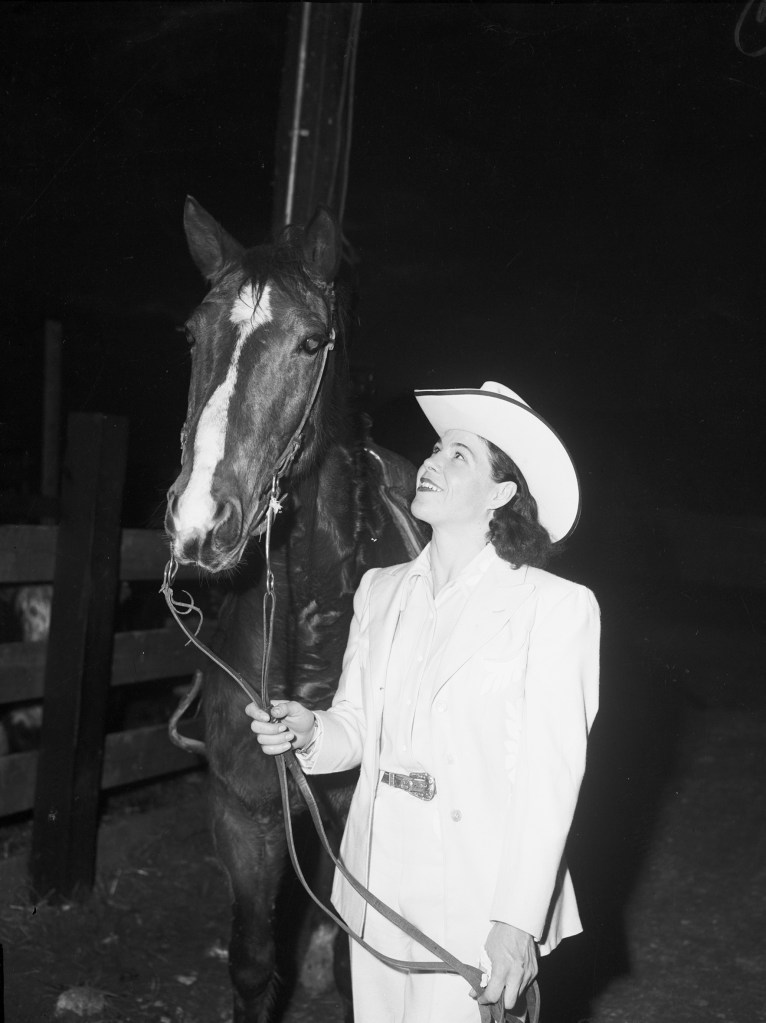
    At an early age, Fern had exhibited her talents in the area of horsemanship and became well known for her abilities. She was encouraged by her parents to work on the ranch and inspired by them to perform as well as any of the men. She began a rodeo career by competing in events previously confined to male contestants. Her many accomplishments include winning the cutting horse championship at the 1945 Southwestern Exhibition and Fat Stock Show in Fort Worth, Texas. She won the Cutting Horse competition aboard her horse “Belen.” In the competition, she eliminated Grady Blue on “Tom Cat” and R. W. McClure on “Smokey” who were second and third place finishers. She is shown below looking up at Belen.

    Image credit: University of Texas at Arlington, Digital Collection, Special Collections Identifier: AR406-6-27

    Fern’s honors include being inducted into the National Cowgirl Hall of Fame, the National Cowboy Hall of Fame and the National Cutting Horse Hall of Fame. She won the All-Around World Champion Cowgirl title in 1938 and the Cutting Horse World Champion title in 1947.

  • Deputy Sheriff J. M. Clifton (1903-1932)

    The Hobbs Flare (Hobbs, NM) of June 19, 1959 carried a column called “News of Yesteryears.” That day, the column quoted an out of print newspaper called the Lovington Tribune from February 26, 1932 and read as follows:

    “Deputy sheriff and two men were killed in a gunfight at Crossroads. The late Bob Beverly was sheriff. J. M. Clifton, stationed at Tatum was searching for robbers of Dean Hardware in Lovington and saw two men in a car at Crossroads. He went to question them, and one drew a gun, shot him in the left arm and stomach. After Clifton was shot, he was able to draw his own gun and kill both men. He then drove to Crossroads where he was taken by plane to Lubbock, Texas, dying enroute. The two men were John O’Dell and Walter Carlock. Odell was from Hobbs and Carlock from Oklahoma. Mr and Mrs. Bob Dow of Lovington were returning home from Clovis and came up on the shooting.

    Afterwards there was recovered from one of the men a watch belonging to M. P. Elsey of Corpus Christi. The news story went on to say the car was stolen.”

    Deputy Clifton had died on February 24. An aircraft had been summoned from Roswell to take him to Lubbock for emergency medical treatment, but the pilot said that the deputy had passed away about forty minutes into the flight near the Texas-New Mexico line. The incident had occurred at the community of Crossroads, about fifteen miles north of Tatum. Deputy Clifton had been badly wounded but an Albuquerque Journal article from the following day had said that he had been able to tell authorities about the incident.

    In the 1932 article, the deceased suspects were listed as Walter Carlocke of Healdon, Oklahoma and John O’Dell of Hobbs who were believed to have robbed the Lea County Hardware store. Quoting Lea County Sheriff Bob Beverly, the article continued to say that Carlocke was wanted for robbing a bank at Waurika, Oklahoma and O’Dell was believed to have been an escapee from an Oklahoma penitentiary.

    Further details included the account of an unnamed rancher who heard the shooting and ran to the location, finding Clifton barely conscious and the two suspects deceased in their car. The rancher said that Clifton had given him a brief account before he was taken to Tatum, placed in an airplane to be rushed to medical treatment in Lubbock. The suspects were apparently not involved in the hardware store robbery, as no items stolen (firearms, ammunition, knives and other articles valued at between $500 and $700) were found in the vehicle. The search continued for the robbers.

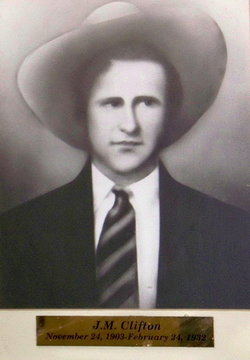
    Image credit: findagrave.com

    Officer Clifton was about 28 years old when he died. He was survived by his wife and children and was buried in Tatum Cemetery. Some of the account differs from our telling of the story, which is mostly taken from Lea County newspaper articles from 1932, but this is Deputy Clifton’s page on Officer Down Memorial Page.

  • The Peveler Family

    David Lee Roy Peveler was born in Seymour, Baylor County, Texas on June 18, 1886. He married Henri Bess Coleman on December 23, 1914 in Gaines County, Texas. David’s father, William Jasper Peveler (1855-1947) was born in June 1855 to Greenup Cauley Peveler and the former Martha A. Dennis in Young County, Texas on July 3, 1855.

    The Peveler family were early settlers to Texas and many of them lived in an area that came to be known as Peveler Valley in northern Hood County. Greenup Peveler had been a Texas Ranger serving in the Frontier Battalion in 1864 when he died in March of that year in an unrecorded incident. He was serving under his uncle, William Riley Peveler in North Texas. William was a well known Texas Ranger company captain and was later killed in September, 1864 in Jack County in a Comanche ambush, though his grave went largely unnoticed for about 100 years until he was honored and the story of his actions was recounted in local newspapers. The Frontier Battalion was a Confederate Army unit, but generally remained in Texas during the war to protect the settlers living there. It was mostly made up of local citizens and included Christopher Columbus Slaughter who survived the Civil War and went on to become a rancher in north central Texas.

    David Lee Roy Peveler is believed to have moved to what is now Lea County around 1902. He and Bess had two sons, James William “Son” Peveler (1916-1957) and Henry Leroy “Wad” Peveler (1918-2002) who lived in the Prairieview area. Their families were involved at various times in the sheep and later the cattle business. Wad also operated a boot shop in Tatum at one time.