The High Lonesome Ranch was one of five early ranches in Lea County. Below is a brief recap of how it got its start.
Two men named Dwight P. Atwood and Roswell A. Neal, along with other investors, had formed the Mallett Cattle Company in the state of Connecticut during 1883 with headquarters near Colorado City, Texas. At one point, their holdings had extended from West Texas on further north and west to into New Mexico, in Lea County, with total holdings of around ninety thousand acres. During the 1890s, due to various factors, the company’s fortunes had declined to the point where it was forced to take bankruptcy in 1893.
Bankruptcy receivers sold off assets to different individuals and companies. D. P. Earnest, a manager of one of the ranches, acquired some of the property in Howard and Mitchell counties of Texas. Two individuals out of San Antonio named Halff acquired more of the Texas property and incorporated it into their Quien Sabe Ranch. Another buyer in West Texas was Theodore Schuster who operated a livestock business there for a short time, but ultimately sold out to David DeVitt and John Scharbauer around 1895 who set up their own entity and called it the Mallet Ranch. Three people out of Midland, Texas were headed up by Allen C. Heard acquired the Lea County property and named it the High Lonesome Ranch.
It apparently took its name from the surrounding terrain, which included the highest point of the Llano Estacado between Midland and Roswell. In addition to A. C. Heard (1858 – 1944), other owners are believed to have been John Thomas White (1868 – 1926) and Jesse Heard (1845 – 1911).
Map attributed to J. W. Runyan, from Hobbs and Lea County by Max A. Clampitt
We have also occasionally seen the ranch referred to in newspaper articles as “Highlonesome,” without a dash or a space between the two words. We also see some references to a ghost town with the one word name but it is described as a one pump gas station, and exact location of it is currently unknown.
For more information about the entire Mallet Ranch that High Lonesome came from, see Mallet Ranch.
Bob was born May 5, 1872 in Ringgold, Georgia to John Purnell Beverly (1831 – 1884) and Missouri Alice Israel Beverly (1845 – 1879). Bob’s father J. P. had worked as a farmer in Georgia and was doing so when Bob was born. Soon thereafter, J. P.’s family and the Israel family moved to a place near Kimball in central Texas where a settlement was beginning to take hold on the Brazos River. Alice died in 1879 in Bosque County, Texas at the same time Bob’s sister Anna Addie Beverly was born and Alice was buried there. Afterward, J. P. moved back to Ringgold, Georgia where he and the five children remained until his death in 1884, living with Bob’s grandparents, William and Elizabeth Beverly. The family story is that soon after his father’s death, Bob came back to Texas on horseback by himself, while still a teenager.
In 1895, Bob married Nancy Ona Elizabeth Rammage with whom he had two children. She died in the Chickasaw Nation (now Oklahoma) in 1899 and by 1900, Bob was living in Johnson County with the two children in the household of Arthur and Henrietta “Etta” Israel, his aunt and uncle. Bob later remarried.
In Bob’s long career, he had worked on a farm, served as sheriff of Midland County, Texas (1908 – 1912), served as a brand inspector for the Texas and Southwestern Cattle Raiser’s Association. He was a special ranger for the Texas Rangers for a short time prior to 1920. By around 1920, Bob was operating a ranch in Nara Vista, Quay County, New Mexico and by 1930, he had relocated to a ranch in Lea County, where he would remain. He ranched and served as sheriff of Lea County for a number of years. Bob was a charter member of the Open Range Cowboy Association, which was made up of those individuals who had worked in the cattle business before the range was divided by fencing.
Bob was known to be an excellent writer and over the years penned at least one book “Hobo of the Rangeland” and many other articles. One news writer commented of the book, “Bob has written the book to raise money to send his blind five year old grandson to some school where he may have opportunities for an education.” He also wrote letters to the editors of various newspapers. He is mentioned many times in the news, some of which are noted below.
In early 1931, Albuquerque Journal carried an article under the headline “War On Slot Machines in Hobbs and Other Lea County Towns; 33 Confiscated; Three Men Jailed.” The article described a raid in Hobbs where 33 nickel and quarter slot machines were seized. As word spread of the raid, slot machines in Lovington, Tatum and other parts of the county disappeared. Beverly was quoted as saying that one of his deputies had been warned to stay out of Hobbs or be jailed himself. The gambling operation had come with the oil boom, and Beverly carried out the raid anyway with deputies Jack Seay, Bert Ivey and L. C. Mills.
An article in the Clovis News-Journal from 1940 has Beverly, no longer sheriff, warning residents of a mail fraud called the “Spanish Swindle,” Quoting from an actual letter he had been given by a potential victim, he described the swindle which was characterized by the hoaxer’s claims of needing money to free a female relative who is behind bars in a foreign country. The hoaxer needed help in accessing a tantalizing amount cash held in United States banks. If the victim helped, he would receive one-third of the funds, “at no risk.” Other variations had the hoaxer needing funds to pay for a bankruptcy trial or some other calamity.
In an article from the Roswell Daily Record in 1932, Beverly gave his account of the shootout in which deputy J. M. Clifton was mortally wounded after a gun battle in which suspected robbers named Carlock and O’Dell were killed by Clifton. In another article from the Clovis News-Journal in 1932, an account is given in which Beverly and a deputy went to Tatum and apprehended a suspected Oklahoma underworld figure by the name of Stanley Hedrick who helped them locate his associate named Pebsworth. The pair had escaped from a Roosevelt County shooting while driving a 1930 Ford Tudor. Pebsworth had been wounded and the suspects were turned over to Roosevelt County officers.
A 1938 article in the Albuquerque Journal mentions Beverly in an account of the annual XIT Ranch Reunion. Beverly was elected to serve as an officer of the reunion.
Our favorite article comes from the February 16, 1941 issue of the Clovis News-Journal on the occasion of the death of an old cowboy friend, James Irvin “Buster” Degraffenried. Beverly wrote of his friend:
“He saw unbroken trails. His footsteps marked the paths, blazed to follow, in the routes over the old west. He knew the west when barbed wire did not fence its acres. When life was safer, from the Comanche warrior, and outlaw, than today when so many Ford cars are running at you.
He saw the buffalo crowded from the range by the longhorns, and saw the longhorns disappear from the range by the stocking of blooded stock.
His early youth and manhood were spent on the prairies, before towns, and cities came to dot them with mileposts of progress. He drove through to a success in a red blooded period, when only courage could survive and initiative could win.
He caught a vision in his youth, that remained with him to the close of a long and useful life.
Now he is headed West once more, foot in the stirrup, seat in the saddle, driving his herd over another long and unknown trail. As we sit in our chairs, surrounded by modern civilization and mourn his passing, I wonder if there is yet left others in the world like Buster, who loved the solitude of the plains, the silence of the canyons, the ozone of the mountains.
So he died in El Paso. Perfectly fitting for an old puncher, of his kind, out on the border, looking ever for a land fitted with cows.
Farewell old friend. None will mourn your passing more than your old friend, Bob.
BOB BEVERLY,
Lovington, N. M.”
Bob passed away in 1958 in El Paso.
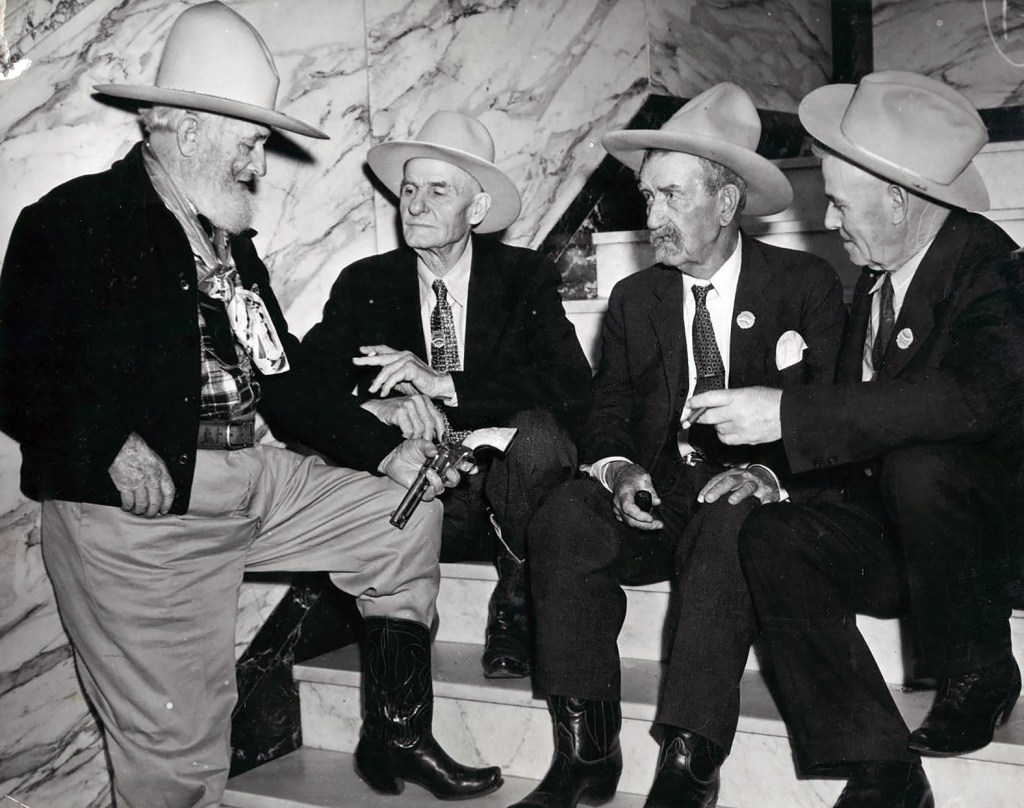
Left to right, John R. Hughes, Ellison Carroll, A. P. (Ab) Blocker, and Bob Beverly wearing cowboy hats and smoking cigars on the steps in the lobby of the Westbrook Hotel in Fort Worth at the 1939 Texas & Southwestern Cattle Raisers Association convention. Image credit: Cattle Raisers Museum in Fort Worth
Clipping:
The Collinsville News, Collinsville, Oklahoma · Thursday, February 16, 1939
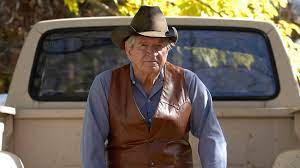
Max Allen Evans was born August 29, 1924 to Walter Burnace (W. B) Evans (1900-1979) and Hazel Glenn Swafford Evans (1904-1994) in Ropesville, Hockley County in Texas. Max was one of two children and had a younger sister named Glenda Rhue. Max grew up in the Panhandle of Texas and southeastern New Mexico and drew on his varied experiences and his knowledge of the culture to write over four dozen books, several of which were made into feature films.
Max grew up in Humble City and remembered doing errands and making delivery rounds on horseback as far as Lovington and smaller communities. His family moved there in the late 1920s. His father was farming and is said to have drilled one of the first irrigation wells for farming in the area. He grew potatoes, watermelons, strawberries and other vegetables. His father is said to have organized the township of Humble City. W. B. also organized a small school district and built a two room school house there, which Max attended though the third or fourth grade. W. B. also set up the first post office and Max’s mother Hazel served as Humble City’s first postmistress.
Max remembered living through the Great Depression there in Humble City and the difficulties his and other families experienced just getting through it and keeping their families fed. The Evans lived in Humble City for seven years in all.
Max tried his hand at ranching up in Union County in far northeastern New Mexico. He joined the United States Army in World War II and is said to have participated in the D Day landing on Omaha Beach in Normandy, France. After his return from the war, he did some painting before he turned full time to writing. Max married and lived several more places, including Taos, before settling in Albuquerque around 1967.
This is a partial list of his fiction books:
Southwest Wind (1958)
Long John Dunn of Taos (1959)
The Hi Lo Country (1962)
TheRounders (1965)
Shadow of Thunder (1969)
My Pardner (1972)
Bobby Jack Smith, You Dirty Coward! (1974)
One-Eyed Sky (1974)
The White Shadow (1977)
The Mountain of Gold (1983)
The Great Wedding (1983)
Bluefeather Fellini (1993)
Faraway Blue (1999)
Now and Forever (2003)
War and Music (2009)
The King of Taos (2020)
This is a partial list of his nonfiction books:
Sam Peckinpah, Master of Violence (1972)
This Chosen Place (1997)
Albuquerque (2000)
Madam Millie (2002)
Hi Lo Country: Under the One-Eyed Sky (2004)
Making a Hand (2005)
For the Love of a Horse (2007)
Goin’ Crazy with Sam Peckinpah and All Our Friends (2014)
Three of Evans’ works were made into feature films including The Rounders, The Wheel and The Hi-Lo Country. The Rounders was also made into a television series. Seventeen episodes were filmed in 1966 and 1967. Max was also cast as an actor in the Peckinpah film, The Ballad of Cable Hogue. His book, Sam Peckinpah, Master of Violence is about the making of that film.
For a number of years, a rodeo and celebration was held in Hobbs and was known as the High Lonesome Stampede (or Estampeda). The 1967 celebration was the ninth of its kind and one day was dedicated as “Max Evans Day” in which Max agreed to serve as parade marshall for the rodeo parade that opened up the three day affair.
Max passed in 2020. His honors include a commendation from City of Los Angeles. He was named honorary member of board of chancellors, University of Texas. He received the Saddleman Award, Western Writers of America, 1990. In 2015, he was honored with the Edgar Lee Hewett Award in recognition of his lifetime of service to the people of New Mexico. Max also received the New Mexico Governor’s Award for Excellence in the Arts and the Spur Award for Best Short Nonfiction. He continued to write up to the year that he passed away.
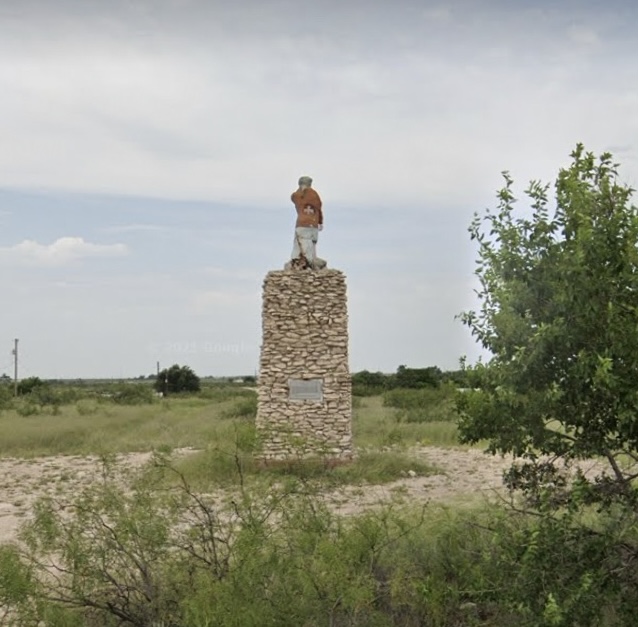
About 1928, as well as we can determine, land developers commissioned a structure of a Native American. It once stood in the middle of a dirt road and faced the location of the old Monument Spring.
The artist who constructed it is unknown. The monument itself had no name originally, as far as we can tell, but the local legend is that residents nicknamed it Geronimo, after the famous warrior.
Geronimo was a great tribal leader of the Apache nation, although he is not considered to have been a chief. He was of the Chiricahua tribe and the Bedonkohe band. Several translations are given for his name, pronounced Gokhleyah in Apache. One is “one who yawns” and another is “one who thinks before he acts.” lived from 1829 to 1909. As a leader and warrior, he was quite successful and conducted raids in the southwestern United States and Mexico. He eventually surrendered and lived out his senior years at Fort Sill, in Oklahoma. He died and was buried in the old cemetery at the military fort.
The local monument sat for many years in the middle of an unpaved road in Monument, located a few miles outside Hobbs. Around 1940, it was damaged and completely knocked to the ground when a motorist ran into it. Afterward, it was moved a few feet away from the roadway, as it appears in the above undated image.
How the monument looks currently:
Image credit: Google Streetview.
At some unknown date, a plaque was added. This is the inscription.
“Settled in 1885 and named for a marker at the springs a few miles west, monument remained a ranching community until oil was discovered in 1928. The Indian statue, called Geronimo by residents, was erected in 1928 by land developers. Monument has produced 4 world champion rodeo performers: George Weir & Roy, Betty Gayle & Jimmie B. Cooper. A centennial celebration was held in 1985.
Minnie Hobbs Byers was the daughter of James Isaac Hobbs (1852-1923) and Frances Perlee Mooring Hobbs (1857-1942). She was a twin with her sister Winnie Hobbs Dalmont and both were born March 6, 1896 when the Hobbs family was still living in Texas.
Their parents were James Isaac Hobbs (1852-1923) and Frances Paralee Mooring Hobbs (1857-1942). Their oldest sister, Ada was about seventeen when they were born and got married later that year. There were two slightly younger siblings between Ada and the twins: Berry and Ella. The family story is that they headed west from central Texas in 1907. An uncle named Lewis D. Cain had come to New Mexico after 1900 following the death of his wife, Nancy “Nannie” Mooring Cain, sister of Mrs. James I. Hobbs, back in Texas.
In an interview, Minnie says that their original goal had been to reach central New Mexico but they decided to stop soon after they crossed the border into the territory. Their brother Berry had made an application for a post office with the name “Taft” but it came back and was approved with the name Hobbs.
The family of her future husband Ernest Herman Byers had come to the area by way of Houston County, Texas, though Ernest had been born in Kansas in 1882. His father Joseph Byers had passed in 1903 in Grapeland. Ernest and his sister and mother Sarah had come to New Mexico with other relatives. Minnie recounted that Ernest and his family came as far as Midland by rail and then by wagons the rest of the way. Ernest was older than Minnie, but their attraction took hold and they were married in the summer of 1912.
Minnie’s account of their June, 1912 marriage was related in a Lovington Daily Leader interview on May 13, 1973. Minnie said that there was no minister in the immediate area, so she and Ernest rode in a buggy to Nadine where the nearest minister was located. She did not recall the name of the officiant, but remembered that the floors had just been scrubbed and were still wet when they married. The couple went on to have six children. They moved to Lovington in 1930 and their home was a landmark on 16th street.
Minnie was active her entire life and enjoyed telling stories about the early days in Lea County. She was an artist, loved playing the violin and speaking. Ernest passed away in 1966 and Minnie survived him until her death in 1981. Both are buried in Prairie Haven Cemetery in Hobbs, New Mexico.
The Hat Ranch dates back to around the mid 1890s when associates Andrew Briggs “Sug” Robertson (1855-1921) and Winfield Scott (1849-1911) began to operate in partnership. Scott is thought to have been the majority owner. Its brand has been described as a half circle over a bar. We have also seen it sketched out looking more like a rectangle over a bar.
The ranching operation began in Mitchell County in West Texas and expanded into the New Mexico Territory in what was then Eddy County but became Lea County in 1917. The Lea County portion has longer history, of course, dating back far beyond the first Anglo settlers, but Scott is understood to have acquired it from an A. B. “Bill” Anderson and then sold a portion to Robertson.
In Lea County, it is mostly associated with the Monument area. A number of long time Lea County residents counted working on the Hat Ranch in their resumes.
At its peak, the Scott-Robertson holdings amounted to 1,000,000 acres and was once a large ranching business, before it began to be sold off to other settlers and homesteaders. The ranch continued to operate in Texas and New Mexico for many years. The ranch appears to have ceased operations as a Lea County entity under the ownership of Robertson and Scott around 1904 to 1906. The Fort Worth Telegram reported a large land sale in its April 3, 1907 issue. In it the real estate firm of Trammel & McCauley of Sweetwater, Texas had brokered the sale of the Texas properties formerly owned by Winfield Scott and A. B. Robertson. It included land in Lynn, Lubbock, Crosby Counties in Texas. Cowboy humorist Will Rogers also is known to have worked on the ranch, however briefly, and most likely around Midland, Texas.
Scott was well known as an investor in Fort Worth, Texas. When he died in 1911, a large mausoleum was constructed for his family in the historic old Oakwood Cemetery in Fort Worth. Robertson died unexpectedly in Abilene in 1921 and is buried in his home town of Colorado City, Texas.
Map attributed to J. W. Runyan, from Hobbs and Lea County by Max A. Clampitt
Thomas David Linebery was born May 21, 1910 in Brown County, Texas to James William Linebery (1865-1941) and Mary Annie Watkins Linebery (1879-1954). He moved to Midland, Texas in 1929 where one of his early jobs was being an elevator operator of the Petroleum Building. While in Midland, he met and later married Evelyn Catherine Scarborough. Evelyn was the daughter of William Francis Scarborough (1868-1939) and Kara Elizabeth Wyman (1866-1937). They were married in the fall of 1933.
William Francis was one of the sons of George Washington Scarborough and Mary Elizabeth Rutland. When they first came to Texas, the family settled near Waco in the 1870s. Before 1900, they moved to West Texas. William Francis settled there and became a successful cattleman. He expanded the ranch operation into New Mexico. Another son, George Adolphus was a well known lawman in Texas and New Mexico. He is known for having been involved in many famous cases including the shootout in which John Selman, the man who shot and killed former outlaw John Wesley Hardin, was killed. Another son was Lee Rutland, also well known. Lee Rutland was a Baptist minister who was closely associated with the establishment and growth during the early days of Southwestern Baptist Theological Seminary, where he served as President for over thirty years.
Several years after Tom and Evelyn were married, her father William Francis died in 1939, and the couple took over management of the family ranches in Texas and Lea County, New Mexico, known by the name of the Frying Pan Ranch the brand of which is a circle with a line extending off to the right, resembling an old cook pan. The acreage was vast in 1939, perhaps as much as 45,000 acres but the ranch operation was deeply in debt. Tom and Evelyn worked for many years to keep the operation running and retired the debt some eleven years later. The ranch had begun as a Hereford ranch but gradually became successful as a Charolais operation.
Along the way, the Lineberys became as well known for their philanthropy as well as being successful ranchers. They were also active in civic organizations. They formed the Scarborough-Linebery Foundation and other charitable organization known as the Paragon Foundation.
Organizations that were beneficiaries of their foundations included Lea County’s College of the Southwest and its Scarborough Memorial Library, the West of the Pecos Rodeo, the West of the Pecos Museum, 4-H groups, Southwestern Baptist Theological Seminary, East Texas Baptist University, San Angelo’s Baptist Memorial Hospital, the Ranching Heritage Center at Texas Tech University, Midland Memorial Hospital, Winkler County Historical Home and Park and many others.
Evelyn attended college at Wayland Baptist, Simmons (now Hardin-Simmons University) and Texas Tech University. One of their possibly lesser known charitable grants was the Linebery Six White Horse Endowment designed to permanently fund the costs to maintain the ceremonial horses that are symbolic of Hardin-Simmons University.
After Tom’s death on March 31, 2001, he was buried in Fairview Cemetery, Midland, Texas. Evelyn followed him in death on April 14, 2001 and was interred near him in the family plot. Their memory and their generosity lives on.
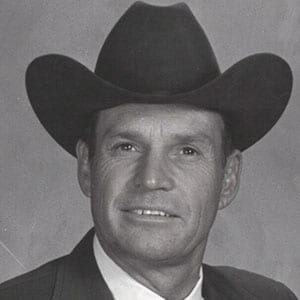
Tuffy Cooper was born November 7, 1925 in Lovington, New Mexico to Alaska J. Cooper (1894-1959) and Tommie Lou Bingham Cooper (1904-1990). His grandparents were James Wesley Cooper (1858-1941) and Iolia M. Weir Cooper (1868-1940) and Thomas Swindell Bingham (1872-1944) and Louella Mae Simcoe Bingham (1874-1950).
Tuffy’s fraternal grandparents came to New Mexico in 1906, settling near Monument. They had at least six children and his father Alaska was about twelve years old when they moved from central Texas. Tuffy said that the trip from Yatesville, Texas to Lea County, which would have been by covered wagon, took three weeks. When his father Alaska was a teenager, he had worked as a ranch hand on the Bingham place, where he likely met his future wife Tommie Lou. The Alaska Cooper family later owned their own ranch.
Image credit: National Cowboy & Western Heritage Museum
An obituary said Tuffy started competing in rodeo events in 1935, which would have been when he was about ten years old. In a 2008 interview, he did note that he took his first cattle drive when he was only five years old and recalled helping to drive 200 head of cattle from Monument to Knowles. Tuffy said that the trip took two days and nights.
He said that his experience on the ranch made him a better roper and also remembered an infestation of screw worms in the early 1940s when he and the other cowboys had to treat the cattle. He was only a teenager. Ranch help was hard to come by and the owner of the place hired Tuffy and his brother Jimmy because they were “the only boys in the country who can rope.”
When Tuffy was a student at University of New Mexico, he helped to found the National Intercollegiate Rodeo Association. He competed in the Professional Rodeo Cowboys Association and won many roping titles as he competed in the calf roping, steer roping and team roping events. After his rodeo career ended, he was a spokesman for the PRCA and remained active in the sport by serving as a judge and rodeo announcer. He was also the author of a booklet of ranch and cowboy sayings called “If You Ride a Slow Horse, You Need a Long Rope,” which appears currently to be out of print.
Tuffy was always quick witted. Once at an event in San Angelo, Texas, the San Angelo Rope Fiesta, he was serving as a flagman for the team roping event. Someone complimented him on the paint horse he was riding. Tuffy said “Yeah, he belongs to Trevor (Brazile), but he’s mine as long as I can stay mounted.”
Tuffy was inducted into the New Mexico School Board Hall of Fame and was a founding member of the Lea County Cowboy Hall of Fame. His many honors also include being named as an inductee in the National Cowboy Hall of Fame in Oklahoma City and the Texas Rodeo Hall of Fame in Fort Worth.
Tuffy passed in 2013 and is interred at Prairie Haven Memorial Park in Hobbs, New Mexico.
In the October 13, 1966 issue of the Jal Record, it was reported that the Lea Soil and Water Conservation District Board of Supervisors named Rubert “Bert” Madera as the Outstanding Lea County Conservation Rancher of the year, stating that he was the operator of the Pitchfork Ranch located about twenty miles west of Jal.
Rubert Madera: Image credt: Jal Record – October 5, 1966
A grandson of Rufus and Pearl, also named Bert Madera, gave another interview many years later and told a bit more about the history of the ranch. The family had come to Fort Davis in West Texas around 1900. The earliest of the Madera family to live in Lea County were Rufus Frederick and Pearl Augusta Richmond Madera. Rufus had been born in 1881 in Arkansas and raised in Hill County, Texas where his family had operated a farm. Rufus and Pearl had later operated the Chico Ranch in Culbertson County, Texas south of Guadalupe Peak in Texas until they retired in the 1930s, after which they moved to Carlsbad. Rufus passed in 1956 and Pearl followed him in death in 1969.
Two of their sons, twins Rubert and Ruford and another brother named Malcolm originally leased the Pitchfork Ranch, according to the interview, from a previous owner named Baird. Rubert and his wife Loys originally lived in a dugout on the ranch and raised their family there on the property. They told of dealing with the sometimes harsh weather conditions and (a common practice in the southwest) burning cow chips for warmth. They purchased the ranch in 1946 and later added to it as opportunities presented themselves.
Bert Madera, the subject of the Jal Record article, said he had started out in the livestock business by purchasing heifer calves at $4 each and later purchased 40 registered Hereford cows in 1945. He practiced conservation by cross fencing, building surface tanks for water, rotating his livestock, digging storage and drinking troughs, broadcast seeding of grasses and doing his best to eliminate mesquite.
Sources include local newspaper articles and the Summer, 2008 issue of Lea County Traditions, a periodical.
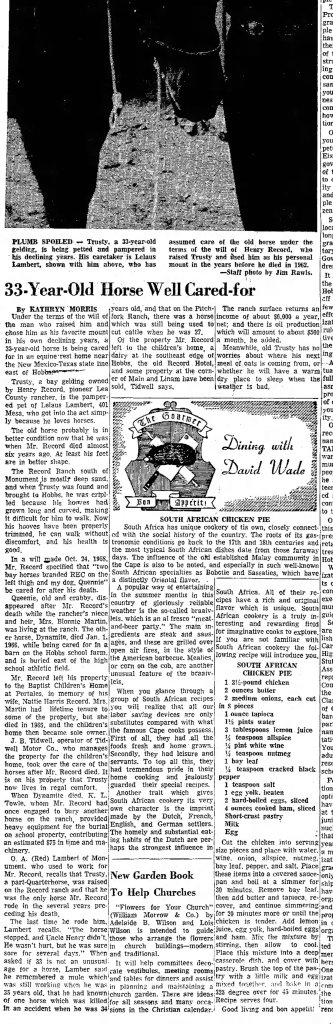
When Henry S. Record died, he left most of his estate to the New Mexico Baptist Orphanage in Portales. The bequest was in honor and memory of his late wife, Nettie Harris Record who predeceased him. Mr. Record had been a founder of the orphanage and was actively involved in it as he got older.
At the time of his death, Mr. Record was a member of the New Mexico Cattle Growers Association, a trustee of Hardin-Simmons University, a trustee of the Baptist Orphanage and president of the Open Range Cowboys Association.
He also provided for his two bay horses and his dog, Queenie. Queenie disappeared in the years after his death, but the two horses lived on for a time. Dynamite died on New Year’s Day, 1966, but the bay gelding named Trusty was still living at the time of the article below from the Hobbs Daily News-Sun on February 4, 1968 at the remarkable age of 33.





 Old Lea County, N.M.