Old Lea County, N.M.

Author: Texoso

  • Addison “Add” Jones, Well Known Black Cowboy

    Addison “Add” Jones was born a slave in Texas. Much of what we understand about his early life was told by his wife Rosa when she furnished information for his death certificate after he died. He is thought to have been born in Gonzalez County in 1845.

    Jones worked for many years for George Washington Littlefield (1842-1920), probably only a few years older than Addison, who was former soldier in the Confederate army after which he became a rancher, banker and was known as a philanthropist. Littlefield’s father had died when he was about ten years old and he grew up on the family farm, also in the general vicinity of Gonzalez County. How Jones and Littlefield became acquainted is not documented, but they were closely associated for most of Addison’s life. Addison is believed to have worked on Littlefield ranches including the LFD, Four Lakes in Lea County and Yellow House.

    There were racially discriminatory situations that occurred throughout the southwest over these years. It is said that the Black cowboys often got the hardest and most disagreeable jobs, but in ranch life, Black cowboys were quite common, either working in all Black crews or alongside other cowboys. Addison gained a reputation for being a skilled cowboy and a hard worker. He was a leader, was known to be a good horseman and would often be the first to ride wild broncs as they began the process of being broken or tamed. He was also skilled at roping horses and served as trail boss in the Littlefield outfits. Because of his skills and endurance, Add Jones was one of the best known Black cowboys in West Texas and eastern New Mexico.

    Jones does not appear to have had much formal education, if any at all, and it has been speculated that he had limited ability to read and write. He left no personally written accounts of his life, as far as is known. He owned his own home later in life and lived in Roswell when he and his wife were older.

    According to a 1993 article in the Roswell Daily Record by Elvis Fleming, Addison and Rosa were married on December 7, 1899 in the Chaves County courthouse when he was 54 and she was 36. Rosa was originally from Texas and was working in Roswell.

    The couple was living in Roswell when he died in 1926. His obituary was carried in the March 25, 1926 issue of the Roswell Daily Record, and cited his having lived in southeastern New Mexico for forty years. It also mentioned his sunny disposition and many friendships among all people. It also related that he was a member of the Knights of Pythias and that he was a Mason. His wife Rosa followed him in death in 1933. Both are buried in South Park Cemetery in Roswell, New Mexico.

    Sources include newspaper articles, and “Black Cowboys of Texas” edited by Sara R. Massey.
  • Nadine

    This community is situated about 5 miles south of Hobbs. There is some indication that it was formerly known as Roberts, but its first postmaster was James Henry Elijah Hughes who named it for his youngest daughter Nadine. The name was accepted by the Postal Service and still is associated with it today. Nadine had its own post office from 1909 to 1934.(1)

    James Henry Elijah Hughes (1864-1924) was a store owner in the area that became Lea County and is thought to have moved to the location about 1909 with his wife, the former Jennie White (1869-1971). Nadine was the youngest of their five children and the only one to have been born in New Mexico. James died in 1924 in Ohio and Jennie survived him another forty-seven years and passed away in Roswell in 1971. Nadine died in a tragic house fire in Phoenix, Arizona in 1968.


    (1) Julyan, Robert, “The Place Names of New Mexico,” University of New Mexico Press, 1998.

  • Oil Center

    Oil Center is one of the “newer” communities of the county. It is located due south of Monument, sixteen miles south southwest of Hobbs and roughly seven miles west northwest of Eunice. It grew around 1937 up to serve the nearby plants of Phillips Petroleum Company and El Paso Natural Gas Company. It had a post office since about 1937. (1) It no longer has a post office, we understand. Today only a few structures and a few streets remain.


    (1) Julyan, Robert, “The Place Names of New Mexico,” University of New Mexico Press, 1998.

  • J. T. Easley and Lorena Lee Anderson

    When this couple married in Post, Texas in the 1920s, the wedding united two families who were early settlers in the area that became Lea County. John Thomas Easley was one of eight children born to Robert Henry Easley (1864 -1928) and Rosa Belle Jones Easley (1873 – 1962). The other children included Minnie, Levie, Charlie, Blanche, Ruth, Jack and R. H., Jr. Robert Henry and Rosa lived in several locations, mostly within the current boundaries of Lea County, including Monument, Plainview, Hagerman and a few miles north of Lovington before returning to Post, Garza County, Texas where they would remain for a number of years. Robert Henry died in Littlefield in 1928 and Rosa survived him almost thirty five years before she passed away in Post.

    John Thomas was born in 1899 in Oklahoma where the family was living at the time. He grew up mostly in Post and also lived in Lovington. He and Lorena married in Post in 1921.

    Lorena was the second child born to James Smith Anderson (1873 – 1930) and Minnie Myrtle Stringer Anderson (1881 – 1967). The other children were W. A. (Bill), Preston Pond, Roy Lewis. James and Minnie also came to the area in 1906, settling on a place about four miles east of Lovington. Their property included two dry lakes at the time. The lakes eventually filled up during an extended rainy period. These later became known as Easley’s Lakes to county residents. James died in 1930 and Minnie Myrtle survived him another thirty-seven years. After James died, J. T. and Lorena moved to the county to operate the Anderson ranch and lived there for the rest of their lives.

    The couple was active in the community and the county. J. T. served on several boards and area groups including serving as County Commissioner in the 1960s and as President of the county fair board during the time when the McClure Arena was conceived and built.


    Sources include various genealogy resources, newspaper archives and Lea County Genealogical Society’s “Then and Now – Lea County Families, Volume 1” published by Waldworth Publishing Company, 1979.

  • Plainview

    Once located about 15 miles north of Lovington in the northern part of Lea County, this settlement grew up about 1907 as settlers began to move west into the territory. It was once called Rat, for Rat Mill, after what is described as a watering place, perhaps the location of a windmill. Rat Mill itself is believed to have been named after the RAT brand of early settler Bud Ratliff. It had a post office from about 1907 to 1929, a newspaper and several free standing buildings but was later abandoned in favor of other communities.(1) Not to be confused with the still existing town of the same name in Texas, the name Plainview is believed to be descriptive, based on the flat geography of the area.

    At this time, not much is known about Bud Ratliff nor which other families he may have been connected to, if any. He is mentioned in several books about the area and generally referred to as an early resident. The name Bud probably was a nickname. It could possibly relate to Harvey Stewart “Bud” Ratliff (1857-1943), a long time rancher in Ector County, Texas, but from at least about 1910 on, this Bud Ratliff is mostly associated with a ranch near Odessa, Texas. Another Ratliff family, the John Ratliff family, is listed on various sources as having homesteaded in Lea County a few years later, around 1914, but they do not appear to be related to the person who went by the name Bud Ratliff.


    (1) Mobley, May Price, “Little Texas Beginnings – In Southeastern New Mexico,” Hall-Poorbaugh Press, Inc. 1973.

  • Fire at the Buckeye Gasoline Plant

    The Lovington Daily Leader carried this headline in its August 27, 1959 issue, “Intense Blaze Burns Heater at Phillips Buckeye Refinery.” We remember being awakened early that morning and told we needed to evacuate the area because the gasoline plant across the road was on fire.

    Some event had ignited a fire at the Lee Plant that morning. We were living in the house nearest the road and there were six more houses to the north of us. Closer to the plant than our houses were several dozen houses of the plant employees who we assumed were getting the same emergency request.

    Buckeye is eighteen miles from Lovington and further than that from Hobbs, but both fire departments were called out to fight the blaze. Units from Lovington arrived a few minutes followed by elements from Hobbs just a few minutes later. Our parents quickly loaded up some clothing into our cars and drove down a half mile to the Buckeye intersection where the gas station, store and little post office were located. We all watched the fire and smoke until the blaze was safely put out and we were allowed to return to our houses.

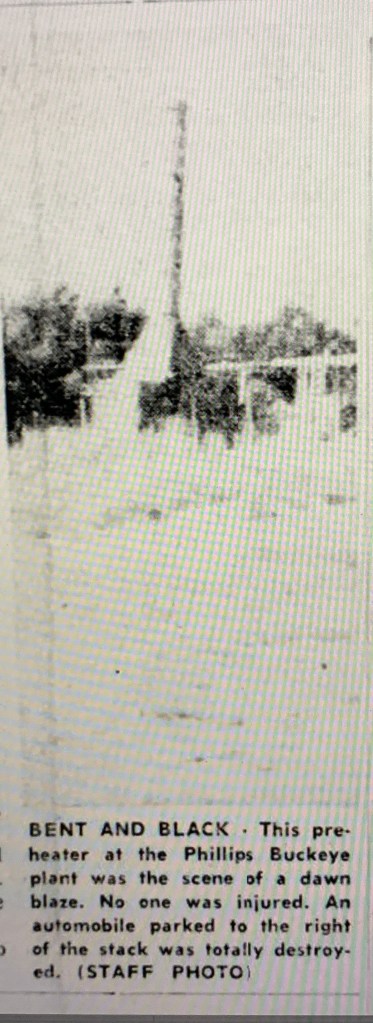
    We later learned that a piece of equipment called a pre-heater had caught fire at about 5:30 a.m. and went out about sunrise. The newspaper account said the blaze lit up the sky and could be seen over the horizon all the way to Lovington. The fire departments were able to contain the blaze within about thirty minutes after they arrived. The firefighters braved the extreme heat and danger to spray foam on the flames and extinguish the blaze. Phillips praised the firefighters for their quick work and said if it had not been for their efforts, it could have led to a much more serious situation.

    There were no known injuries and damage to the plant was confined to the pre-heater and surrounding equipment. There may have been more vehicles that were damaged, but we remember at least one passenger car having been melted down to a shell and hauled off on a flat bed truck. The photo below is from the August 27, 1959 issue of the Lovington Daily Leader.

  • Fern Sawyer

    “She died in the saddle, surrounded by friends.” said Peter Holt, as quoted in the October 21, 1993 issue of the Lincoln County News, Carrizozo, New Mexico. Most recently Ms. Sawyer had resided in Nogal, Lincoln County, New Mexico.

    Fern Sawyer was born at Buchanan, De Baca County, New Mexico, on May 17, 1917 to Uyless Devoe Sawyer and Dessie Lewis Sawyer and was raised on the family ranch at Crossroads, near Tatum, New Mexico. She passed away at the age of 76 on October 16, 1993 near Blanco, Blanco County, Texas while visiting friends. Earlier in the day, Ms. Sawyer had been riding with friends and herding heifer cattle when she told another rider she was feeling tired, and shortly thereafter, she passed away.

    A funeral service was held the following Tuesday at St. Andrew’s Episcopal Church in Roswell, officiated by Rev. Robert L. Williams. The service was attended by her many friends, including Governor and Mrs. Bruce King. According to a newspaper report in the Roswell Daily Record, the eulogy was given by Mr. Holt and the service included the singing of “Amazing Grace.” After the service, she was interred at Tatum Cemetery, Tatum, Lea County, New Mexico where her mother and father are also buried.

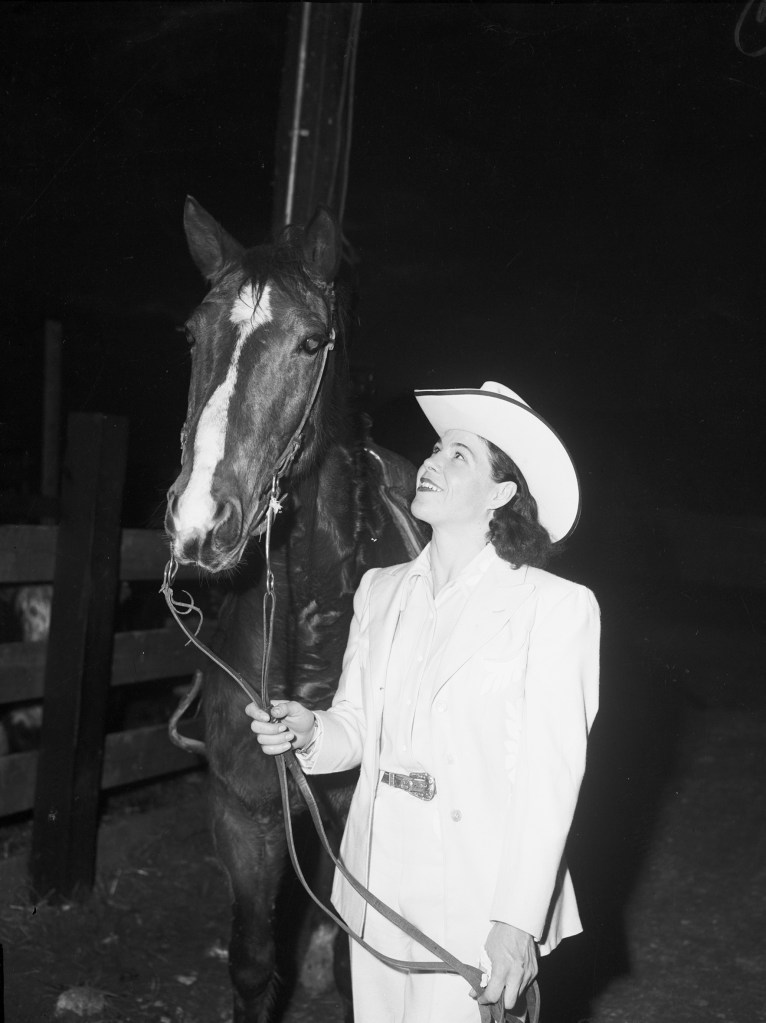
    At an early age, Fern had exhibited her talents in the area of horsemanship and became well known for her abilities. She was encouraged by her parents to work on the ranch and inspired by them to perform as well as any of the men. She began a rodeo career by competing in events previously confined to male contestants. Her many accomplishments include winning the cutting horse championship at the 1945 Southwestern Exhibition and Fat Stock Show in Fort Worth, Texas. She won the Cutting Horse competition aboard her horse “Belen.” In the competition, she eliminated Grady Blue on “Tom Cat” and R. W. McClure on “Smokey” who were second and third place finishers. She is shown below looking up at Belen.

    Image credit: University of Texas at Arlington, Digital Collection, Special Collections Identifier: AR406-6-27

    Fern’s honors include being inducted into the National Cowgirl Hall of Fame, the National Cowboy Hall of Fame and the National Cutting Horse Hall of Fame. She won the All-Around World Champion Cowgirl title in 1938 and the Cutting Horse World Champion title in 1947.

  • Maljamar

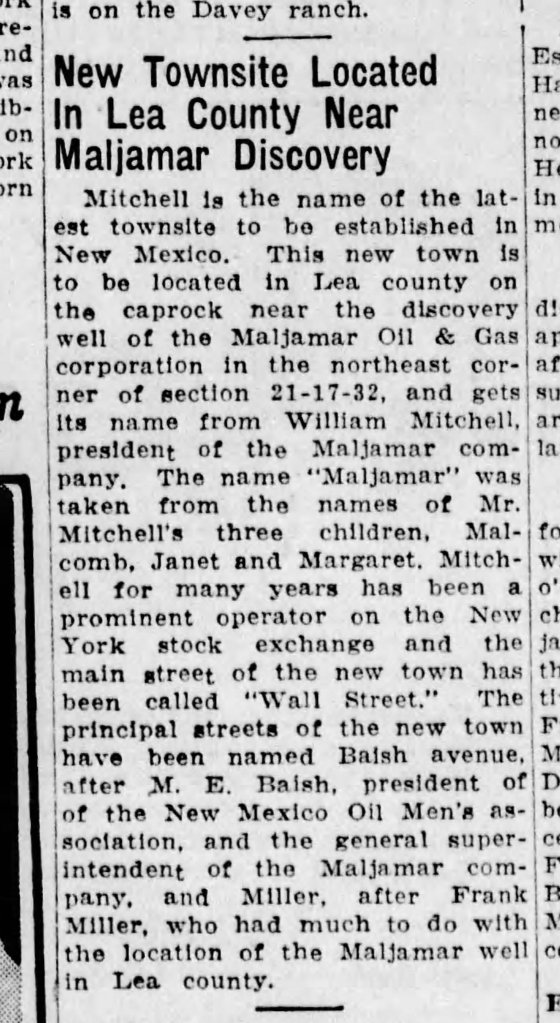
    Located about 26 miles west southwest of Lovington in Highway 82, this town was founded in 1926 by William Mitchell. Mitchell owned the oil company that brought in the first oil well in the vicinity on July 26, 1926. He named his company the Maljamar Oil & Gas Company and eventually, the community of Maljamar. The word Maljamar is comprised of the first letters of the names of his children, Malcolm, Janet and Margaret. The June 12, 1926 issue of the Roswell Daily Record was not the first published record found for the Maljamar Oil and Gas Company but it listed eight wells that were being drilled.

    Not usually mentioned is that the initial name of the community appears to have been Mitchell rather than Maljamar, per the newspaper clipping below.

    Albuquerque Journal, 9 Apr 1926

    Maljamar Oil and Gas Company was not just a New Mexico company, evidently, but so far we have not been able to find out much more about it other than it operated here before and after the founding of the community of Maljamar and it apparently build Artesia’s second refinery in 1931 which was called the Malco Refinery. We will keep looking for information about the company and William Mitchell and family.

  • Monument

    Monument is accepted to be the first Anglo settlement in Lea County by James Cook, who built a store, appropriately enough named Cook’s Store. He used to pick up the mail in Carlsbad and bring it back to the settlement until around 1900 when the postal service granted permission to establish its own post office. It took its name from an old water source named Monument Springs.

    The water source known as Monument Springs was located about ten miles west of the Texas border. Believed to have been previously used by native tribes for water, it was discovered by a detachment of the United States Army out of Fort Davis, Texas under Colonel William R. Shafter. Col. Shafter is noted for having directed the building of a seven and one half foot tall structure of native limestone rock to mark the area. This monument no longer exists and the stone is thought to have been reused in early dwellings.

  • McDonald

    McDonald was the name given to the community located about thirteen miles north of Lovington. It was founded around 1912 and given the name of the first state governor of New Mexico, William C. McDonald of Lincoln County, who served in that capacity from 1912 to 1917. It had its own post office from 1912 to 1941.(1) The first postmistress was Mirtlelee Autry.(2)

    In addition to the post office, the community also once included a grocery store, a combination grocery and dry goods store and even briefly, its own newspaper.(2) Now some residences and private businesses remain near the former site. None of the original structures have survived.


    (1) Robert Julyan, “The Place Names of New Mexico,” University of New Mexico Press, 1998.

    (2) Lynn C. Mauldin, “Lea County New Mexico, A Pictorial History,” Downing Company Publishers, 1997.