Old Lea County, N.M.

Category: people

  • Max Evans

    Max Allen Evans was born August 29, 1924 to Walter Burnace (W. B) Evans (1900-1979) and Hazel Glenn Swafford Evans (1904-1994) in Ropesville, Hockley County in Texas. Max was one of two children and had a younger sister named Glenda Rhue. Max grew up in the Panhandle of Texas and southeastern New Mexico and drew on his varied experiences and his knowledge of the culture to write over four dozen books, several of which were made into feature films.

    Max grew up in Humble City and remembered doing errands and making delivery rounds on horseback as far as Lovington and smaller communities. His family moved there in the late 1920s. His father was farming and is said to have drilled one of the first irrigation wells for farming in the area. He grew potatoes, watermelons, strawberries and other vegetables. His father is said to have organized the township of Humble City. W. B. also organized a small school district and built a two room school house there, which Max attended though the third or fourth grade. W. B. also set up the first post office and Max’s mother Hazel served as Humble City’s first postmistress.

    Max remembered living through the Great Depression there in Humble City and the difficulties his and other families experienced just getting through it and keeping their families fed. The Evans lived in Humble City for seven years in all.

    Max tried his hand at ranching up in Union County in far northeastern New Mexico. He joined the United States Army in World War II and is said to have participated in the D Day landing on Omaha Beach in Normandy, France. After his return from the war, he did some painting before he turned full time to writing. Max married and lived several more places, including Taos, before settling in Albuquerque around 1967.

    This is a partial list of his fiction books:

    •   Southwest Wind (1958)
    •    Long John Dunn of Taos (1959)
    •    The Hi Lo Country (1962)
    •    The Rounders (1965)
    •    Shadow of Thunder (1969)
    •    My Pardner (1972)
    •    Bobby Jack Smith, You Dirty Coward! (1974)
    •    One-Eyed Sky (1974)
    •    The White Shadow (1977)
    •    The Mountain of Gold (1983)
    •    The Great Wedding (1983)
    •    Bluefeather Fellini (1993)
    •    Faraway Blue (1999)
    •    Now and Forever (2003)
    •    War and Music (2009)
    •    The King of Taos (2020)

    This is a partial list of his nonfiction books:

    • Sam Peckinpah, Master of Violence (1972)
    • This Chosen Place (1997)
    • Albuquerque (2000)
    • Madam Millie (2002)
    • Hi Lo Country: Under the One-Eyed Sky (2004)
    • Making a Hand (2005)
    • For the Love of a Horse (2007)
    • Goin’ Crazy with Sam Peckinpah and All Our Friends (2014)

    Three of Evans’ works were made into feature films including The Rounders, The Wheel and The Hi-Lo Country. The Rounders was also made into a television series. Seventeen episodes were filmed in 1966 and 1967. Max was also cast as an actor in the Peckinpah film, The Ballad of Cable Hogue. His book, Sam Peckinpah, Master of Violence is about the making of that film.

    For a number of years, a rodeo and celebration was held in Hobbs and was known as the High Lonesome Stampede (or Estampeda). The 1967 celebration was the ninth of its kind and one day was dedicated as “Max Evans Day” in which Max agreed to serve as parade marshall for the rodeo parade that opened up the three day affair.

    Max passed in 2020. His honors include a commendation from City of Los Angeles. He was named honorary member of board of chancellors, University of Texas. He received the Saddleman Award, Western Writers of America, 1990. In 2015, he was honored with the Edgar Lee Hewett Award in recognition of his lifetime of service to the people of New Mexico. Max also received the New Mexico Governor’s Award for Excellence in the Arts and the Spur Award for Best Short Nonfiction. He continued to write up to the year that he passed away.
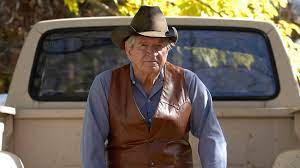
    Image credit: variety.com
  • Byers and Hobbs Families

    Minnie Hobbs Byers was the daughter of James Isaac Hobbs (1852-1923) and Frances Perlee Mooring Hobbs (1857-1942). She was a twin with her sister Winnie Hobbs Dalmont and both were born March 6, 1896 when the Hobbs family was still living in Texas.

    Their parents were James Isaac Hobbs (1852-1923) and Frances Paralee Mooring Hobbs (1857-1942). Their oldest sister, Ada was about seventeen when they were born and got married later that year. There were two slightly younger siblings between Ada and the twins: Berry and Ella. The family story is that they headed west from central Texas in 1907. An uncle named Lewis D. Cain had come to New Mexico after 1900 following the death of his wife, Nancy “Nannie” Mooring Cain, sister of Mrs. James I. Hobbs, back in Texas.

    In an interview, Minnie says that their original goal had been to reach central New Mexico but they decided to stop soon after they crossed the border into the territory. Their brother Berry had made an application for a post office with the name “Taft” but it came back and was approved with the name Hobbs.

    The family of her future husband Ernest Herman Byers had come to the area by way of Houston County, Texas, though Ernest had been born in Kansas in 1882. His father Joseph Byers had passed in 1903 in Grapeland. Ernest and his sister and mother Sarah had come to New Mexico with other relatives. Minnie recounted that Ernest and his family came as far as Midland by rail and then by wagons the rest of the way. Ernest was older than Minnie, but their attraction took hold and they were married in the summer of 1912.

    Minnie’s account of their June, 1912 marriage was related in a Lovington Daily Leader interview on May 13, 1973. Minnie said that there was no minister in the immediate area, so she and Ernest rode in a buggy to Nadine where the nearest minister was located. She did not recall the name of the officiant, but remembered that the floors had just been scrubbed and were still wet when they married. The couple went on to have six children. They moved to Lovington in 1930 and their home was a landmark on 16th street.

    Minnie was active her entire life and enjoyed telling stories about the early days in Lea County. She was an artist, loved playing the violin and speaking. Ernest passed away in 1966 and Minnie survived him until her death in 1981. Both are buried in Prairie Haven Cemetery in Hobbs, New Mexico.

  • Tom and Evelyn Linebery

    Thomas David Linebery was born May 21, 1910 in Brown County, Texas to James William Linebery (1865-1941) and Mary Annie Watkins Linebery (1879-1954). He moved to Midland, Texas in 1929 where one of his early jobs was being an elevator operator of the Petroleum Building. While in Midland, he met and later married Evelyn Catherine Scarborough. Evelyn was the daughter of William Francis Scarborough (1868-1939) and Kara Elizabeth Wyman (1866-1937). They were married in the fall of 1933.

    William Francis was one of the sons of George Washington Scarborough and Mary Elizabeth Rutland. When they first came to Texas, the family settled near Waco in the 1870s. Before 1900, they moved to West Texas. William Francis settled there and became a successful cattleman. He expanded the ranch operation into New Mexico. Another son, George Adolphus was a well known lawman in Texas and New Mexico. He is known for having been involved in many famous cases including the shootout in which John Selman, the man who shot and killed former outlaw John Wesley Hardin, was killed. Another son was Lee Rutland, also well known. Lee Rutland was a Baptist minister who was closely associated with the establishment and growth during the early days of Southwestern Baptist Theological Seminary, where he served as President for over thirty years.

    Several years after Tom and Evelyn were married, her father William Francis died in 1939, and the couple took over management of the family ranches in Texas and Lea County, New Mexico, known by the name of the Frying Pan Ranch the brand of which is a circle with a line extending off to the right, resembling an old cook pan. The acreage was vast in 1939, perhaps as much as 45,000 acres but the ranch operation was deeply in debt. Tom and Evelyn worked for many years to keep the operation running and retired the debt some eleven years later. The ranch had begun as a Hereford ranch but gradually became successful as a Charolais operation.

    Along the way, the Lineberys became as well known for their philanthropy as well as being successful ranchers. They were also active in civic organizations. They formed the Scarborough-Linebery Foundation and other charitable organization known as the Paragon Foundation.

    Organizations that were beneficiaries of their foundations included Lea County’s College of the Southwest and its Scarborough Memorial Library, the West of the Pecos Rodeo, the West of the Pecos Museum, 4-H groups, Southwestern Baptist Theological Seminary, East Texas Baptist University, San Angelo’s Baptist Memorial Hospital, the Ranching Heritage Center at Texas Tech University, Midland Memorial Hospital, Winkler County Historical Home and Park and many others.

    Evelyn attended college at Wayland Baptist, Simmons (now Hardin-Simmons University) and Texas Tech University. One of their possibly lesser known charitable grants was the Linebery Six White Horse Endowment designed to permanently fund the costs to maintain the ceremonial horses that are symbolic of Hardin-Simmons University.

    After Tom’s death on March 31, 2001, he was buried in Fairview Cemetery, Midland, Texas. Evelyn followed him in death on April 14, 2001 and was interred near him in the family plot. Their memory and their generosity lives on.

  • Dale “Tuffy” Cooper

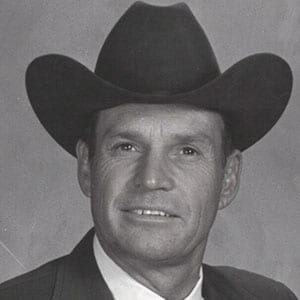
    Tuffy Cooper was born November 7, 1925 in Lovington, New Mexico to Alaska J. Cooper (1894-1959) and Tommie Lou Bingham Cooper (1904-1990). His grandparents were James Wesley Cooper (1858-1941) and Iolia M. Weir Cooper (1868-1940) and Thomas Swindell Bingham (1872-1944) and Louella Mae Simcoe Bingham (1874-1950).

    Tuffy’s fraternal grandparents came to New Mexico in 1906, settling near Monument. They had at least six children and his father Alaska was about twelve years old when they moved from central Texas. Tuffy said that the trip from Yatesville, Texas to Lea County, which would have been by covered wagon, took three weeks. When his father Alaska was a teenager, he had worked as a ranch hand on the Bingham place, where he likely met his future wife Tommie Lou. The Alaska Cooper family later owned their own ranch.

    Image credit: National Cowboy & Western Heritage Museum

    An obituary said Tuffy started competing in rodeo events in 1935, which would have been when he was about ten years old. In a 2008 interview, he did note that he took his first cattle drive when he was only five years old and recalled helping to drive 200 head of cattle from Monument to Knowles. Tuffy said that the trip took two days and nights.

    He said that his experience on the ranch made him a better roper and also remembered an infestation of screw worms in the early 1940s when he and the other cowboys had to treat the cattle. He was only a teenager. Ranch help was hard to come by and the owner of the place hired Tuffy and his brother Jimmy because they were “the only boys in the country who can rope.”

    When Tuffy was a student at University of New Mexico, he helped to found the National Intercollegiate Rodeo Association. He competed in the Professional Rodeo Cowboys Association and won many roping titles as he competed in the calf roping, steer roping and team roping events. After his rodeo career ended, he was a spokesman for the PRCA and remained active in the sport by serving as a judge and rodeo announcer. He was also the author of a booklet of ranch and cowboy sayings called “If You Ride a Slow Horse, You Need a Long Rope,” which appears currently to be out of print.

    Tuffy was always quick witted. Once at an event in San Angelo, Texas, the San Angelo Rope Fiesta, he was serving as a flagman for the team roping event. Someone complimented him on the paint horse he was riding. Tuffy said “Yeah, he belongs to Trevor (Brazile), but he’s mine as long as I can stay mounted.”

    Tuffy was inducted into the New Mexico School Board Hall of Fame and was a founding member of the Lea County Cowboy Hall of Fame. His many honors also include being named as an inductee in the National Cowboy Hall of Fame in Oklahoma City and the Texas Rodeo Hall of Fame in Fort Worth.

    Tuffy passed in 2013 and is interred at Prairie Haven Memorial Park in Hobbs, New Mexico.

  • A Cattleman’s Will

    When Henry S. Record died, he left most of his estate to the New Mexico Baptist Orphanage in Portales. The bequest was in honor and memory of his late wife, Nettie Harris Record who predeceased him. Mr. Record had been a founder of the orphanage and was actively involved in it as he got older.

    At the time of his death, Mr. Record was a member of the New Mexico Cattle Growers Association, a trustee of Hardin-Simmons University, a trustee of the Baptist Orphanage and president of the Open Range Cowboys Association.

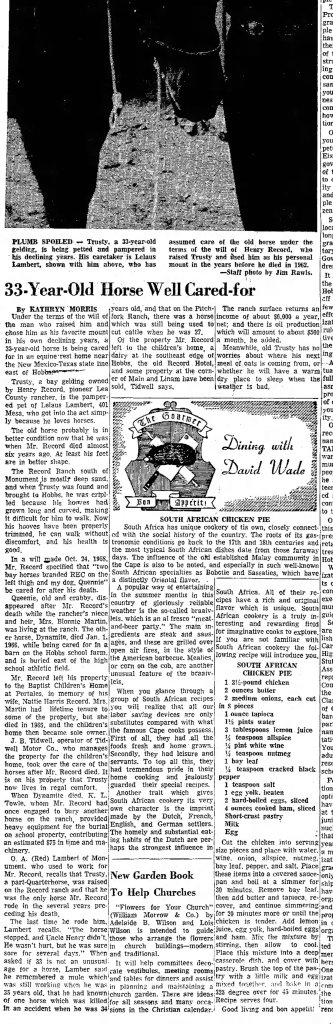
    He also provided for his two bay horses and his dog, Queenie. Queenie disappeared in the years after his death, but the two horses lived on for a time. Dynamite died on New Year’s Day, 1966, but the bay gelding named Trusty was still living at the time of the article below from the Hobbs Daily News-Sun on February 4, 1968 at the remarkable age of 33.

    Hobbs Daily News-Sun – 4 Feb 1968
  • Deputy Jack Seay

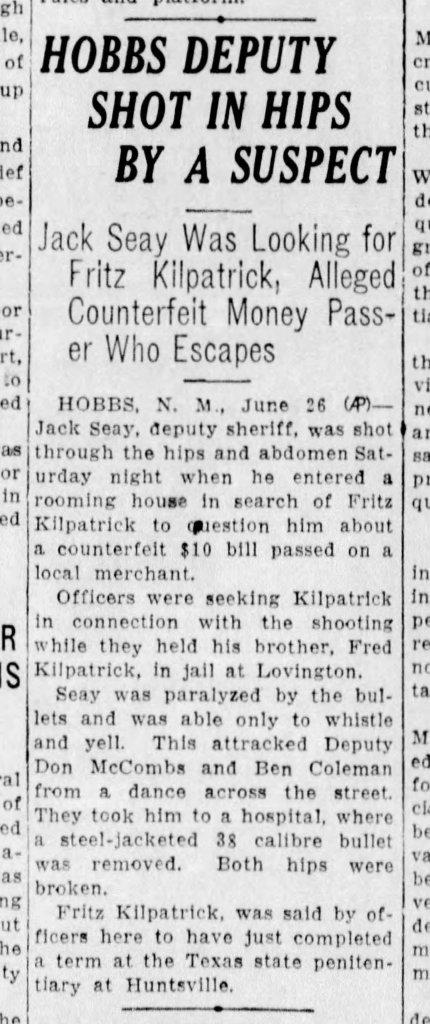
    Albuquerque Journal, 27 Jun 1932.

    The deputy went by Jack Seay, but his name was Thomas William Caspian Seay, Jr. He was born August 21, 1893 in Liberty Hill, Texas to Thomas William Seay and Bunett Louise Bingham Seay. Jack grew up in the Hill Country of Texas in Marble Falls.


    Jack registered for the World War I draft in New Wilson, Oklahoma at the age of 24 around 1916, giving his profession as undertaker. Jack served in the United States Army from September 19, 1917 to May 6, 1919.

    Jack is first mentioned in law enforcement as having served on the Jal Police Department, perhaps even being chief of police, before coming to serve as a deputy sheriff under Sheriff Bob Beverly of Lea County.

    1932 saw several major arrests. On April 19, deputies Jack Seay and Don McCombs followed a tip that individuals connected to a bank robbery in O’Donnell, Texas the week before might be in Hobbs. Accompanied by federal agent George E. Lilley working out of El Paso, they approached a house in which a car fitting the description of the suspect’s vehicle was parked. As they neared the front door, it opened and gunfire erupted from inside. They backed away and called for backup as the suspects fled in their car. Shortly afterward, they stole another car from a local resident, but in so doing, were delayed long enough for the lawmen to catch up with them. One of the suspects was shot in the ensuing gunfight. The remaining suspects were later arrested in Texas.

    The next day, Seay and Lilly arrested two men on charges of passing counterfeit currency in Hobbs, unrelated to the earlier case. Two months later, on June 25, 1932, Seay was ambushed and shot during the investigation of another counterfeiting case. The alleged assailant was Fritz Kilpatrick, believed to be passing counterfeit $10 bills in the area. The attack took place at a rooming house where Kilpatrick had been staying. Kilpatrick was said to have opened fire on Seay as he came to Kilpatrick’s room. Seay was seriously injured resulting in his partial paralysis and other injuries and never regained the ability to walk. Immediately after Seay’s shooting, he was taken to Lubbock where he survived the first of many surgeries.

    In 1933, Kilpatrick was tried and convicted of counterfeiting and sentenced to fifteen years in prison. Seay was carried into the courtroom by four men and had testified at the trial.

    Deputy Seay died in 1953 and is buried in Fairview Cemetery in Albuquerque along with his wife, Mary Little Seay, who had predeceased him in 1951. The Seays had lived in Albuquerque for a number of years. While living in Albuquerque, Jack had been a rancher and tourist court owner. He had been an active member of the Elks Lodge and the American Legion, according to his obituary.

  • Clyde D. Woolworth and the Woolworth Family

    Clyde Dean Woolworth (1883-1938) was the first member of the family to come to Lea County. He was born to a large family in Carthage, Panola County, Texas. His father was Justus Morgan Woolworth and his mother was Mary Jane Paxson Woolworth. Clyde was one of at least eight children.

    The family story is that Clyde and his sister Elizabeth and learned of land that could be homesteaded from an article in a Dallas, Texas newspaper. They came to the area in 1915, after statehood but before the county was to be created in 1917. Clyde and Elizabeth each homesteaded a half section of land and it is said that they built their home where their property adjoined, partly on each other’s land.

    The siblings were later joined by three other sisters, Martha, Litie and Clara. Their property was the nucleus of the Woolworth Ranch near Jal, New Mexico. Finding a reliable and plentiful water source was always an issue in the area. The family told of facing the usual pioneer hardships including extreme weather, rattlesnakes but managed to remain. Oil was later discovered on their property.

    After an illness of several months, Clyde died at the age of fifty-five in 1938 while residing in San Angelo, Texas. Mr. Woolworth was a single man and is buried in San Angelo, Texas. He was survived by five of his sisters: Clara, Litie, Mae and Elizabeth Woolworth, all of San Angelo, and Mrs. Claudia Woolworth Watkins of Henderson, Texas, one brother, Dr. Joseph Dean Woolworth of Louisiana; and was predeceased by one brother, James G. Woolworth and one sister, Martha Woolworth.

    The Woolworth family is noted for having donated funds to found the Jal Library.

    Sources include various newspaper articles and the Summer, 2010 edition of The Lea County Tradition, a periodical.

  • Power’s Motel in Lovington

    Early settlers, Dick and Mary Power, owned a motel south of downtown Lovington and it served the area for many decades. Mary was the former Mary Eaves whose family had come to what became Lea County in 1909 and Dick arrived in 1914. She was the daughter of Paschal Simeon and Mary Susan Brown Eaves. Dick’s full name was Earnest H. Power. He was the son of Augustus Earnest and Edna Latham Power. Before he and Mary ran the hotel, Dick once owned and operated a cafe named Dick’s Cafe that was located downtown

    The address of the motel was 215 E. Avenue B. The grounds had some beautiful elm and pecan trees which were formerly part of the Eaves family’s orchard. The oldest units were 27 rooms built in 1947 and 12 more units were added in 1953. The old motel was demolished many years ago and a City office building now sits on the former site.

    Dick passed in 1974 and Mary followed him in death in 1982. Both are buried in Lovington Cemetery.

    The Power’s Motel Lovington, NM in 1940 – Image credit: cardcow.com
  • Jimmy Franklin

    In the late 1980s we had moved to a neighborhood with cable television. We just signed up for up for it and were channel surfing to see what was available. One of the sports channels was showing stunt flying and the screen captured an upside down plane snagging a ribbon suspended between two soda bottles sitting on the runway. The announcer then named the pilot: Jimmy Franklin.

    Jim Marshall “Jimmy” Franklin was born May 16, 1948 to Oliver Gene “Zip” Franklin and Valerie Jones Franklin. Jimmy grew up on a ranch in the northern part of Lea County. Zip was a crop duster, rancher and sport flyer. Jimmy’s first experience with flying, according to an article, was riding on Zip’s lap while still in diapers as Zip flew between two of their properties. Another family legend has Jimmy sneaking out to have his first solo flight at age twelve. He learned aerobatics while still in high school and bought his first airplane, a 1940 Waco UPF-7, when he was nineteen years old. He used it to begin flying in air shows that same year, 1967.

    For the next thirty-eight years, Jimmy flew in air shows and made numerous other film and television appearances, credited and uncredited. His Internet Movie Database (imdb.com) page lists him in “Three Amigos!” and “The Rocketeer” but according to his family, Jimmy’s other credits include “Forever Young,” “Terminal Velocity,” and “Choke Canyon” in addition to numerous television appearances where he was stunt flying.

    Image credit: airshow.fandom.com

    Jimmy was well known in flying circles, having premiered air show acts, flying with wing walkers, stunt flying, dogfight scenarios, making pickups from riders on motorcycles, portraying characters of his own invention and making one of a kind aircraft modifications, such as adding jet power to one of his Waco airplanes. He was honored with many awards including being named to the ICAS (International Council of Air Shows) Foundation Hall of Fame.

    Jimmy and his long time friend and fellow performer Bobby Younkin were both killed in Moose Jaw, Saskatchewan, Canada on July 10, 2005. He and Bobby had created an act they called Masters of Disaster. This act had quickly become a popular draw at air shows. It was in this configuration that they were flying when their two airplanes collided and both were killed. Jimmy was fifty-seven years old. His memorial service was held several months later in Ruidoso, New Mexico and he is buried in Lincoln County at Ruidoso’s Forest Lawn Cemetery.

  • Beverly Thomas “Tootie” Schnaubert

    “Tootie” Schnaubert was born January 29, 1917 to Stephen Arthur Schnaubert and Ella M. Adams Schnaubert in Rankin, Texas. Both parents died in December, 1918 when he was not quite two years old, their causes of death unstated. Tootie and his two siblings, Leon and Stephen, went to live with their grandparents, Arthur and Mentie Schnaubert in Upton County, Texas. By 1930, the combined family was living in Carlsbad, New Mexico where Arthur was working as an electrician for Carlsbad Light and Power Company.

    Tootie married Peggy Jo Parks in 1939 and the couple would remain married until Peggy’s death in 1987. Tootie registered for the draft in 1940 naming his grandfather Arthur Francis as his next of kin and his employer as Homer Bryan of Carlsbad. He was 23 years old.

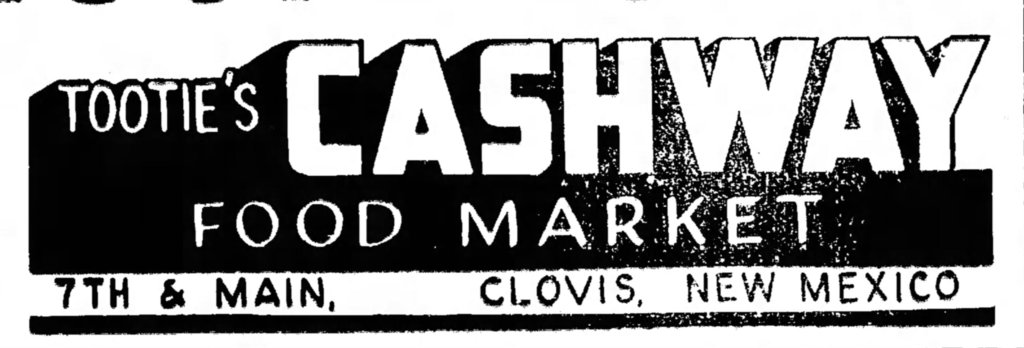
    Around 1950, Tootie opened up his first retail grocery stores in Hobbs and called them Tootie’s Cashway. A 1952 article in the Lovington Leader announced the remodeling of their Hobbs store giving it the largest floor space of a grocery store in Hobbs. It offered not Green Stamps but Pacific Stamps.

    It was not uncommon for the grocery to take out full page ads in local newspapers. The company also ran commercials on local radio stations. The melody was taken from an old Al Jolson song “Toot, Toot, Tootsie, Goodbye” and singer sang these lyrics. “Toot, Toot, Tootie’s Cashway. Ladies hear what we say…”

    Clovis News Journal Sun, August 30, 1959

    The company expanded to have multiple stores in places like Hobbs, Lovington and Clovis. It was not unusual to see Tootie’s image on the ads. Tootie eventually retired. Over the years, the company employed many people. An internet search of obituaries would mention that different individuals had worked in some capacity for Tootie’s Cashway.

    Peggy Jo passed away in 1987 and Tootie followed him in death in 1997. Both are buried in Memory Gardens in Hobbs, New Mexico.