Richard David “Dick” Lee, Sr. was born November 23, 1877 in Brownwood, Brown County, Texas to Brooks William Lee and Nancy Lenora “Jennie” Millican Lee. He married Sarah Viola Forrester in Scurry County, Texas on January 24, 1900.
Dick came to the New Mexico Territory with his parents in 1886 from Texas when he was not quite ten years old. He recounted living in a dugout near Seminole when he was younger and helping out as the family ranched on the open range. In New Mexico, he started working as a cowboy on the Hat Ranch near Monument when he was about 21. Soon afterward, he and Viola were married. For a while he and Viola lived in Indian Territory working on a cattle ranch for the Connell family before moving back to Texas, near Midland where he worked for the C Ranch. Dick later went to work for Clarence Scharbauer around 1920 still in Texas. When the Scharbauer Cattle Company expanded their operations round 1925 to the recently formed Lea County, he came back to New Mexico. He worked for Scharbauer for a number of years as ranch manager and partner, before he began ranching on his own, settling near the current location of Buckeye, New Mexico.
Dick was always known as a most capable rancher and developed a Hereford operation there. He also served in the management of Lea County. Dick and Viola had four children, all of whom stayed and lived in the county: Brookie Wanda Lee Anderson, Roy Lester Lee, Richard David Lee, Jr. and Giles Milton Lee. Dick passed away on May 12, 1940 and Viola survived him about another 34 years, passing away in 1974. Both are buried in Lovington Cemetery.
David Lee Roy Peveler was born in Seymour, Baylor County, Texas on June 18, 1886. He married Henri Bess Coleman on December 23, 1914 in Gaines County, Texas. David’s father, William Jasper Peveler (1855-1947) was born in June 1855 to Greenup Cauley Peveler and the former Martha A. Dennis in Young County, Texas on July 3, 1855.
The Peveler family were early settlers to Texas and many of them lived in an area that came to be known as Peveler Valley in northern Hood County. Greenup Peveler had been a Texas Ranger serving in the Frontier Battalion in 1864 when he died in March of that year in an unrecorded incident. He was serving under his uncle, William Riley Peveler in North Texas. William was a well known Texas Ranger company captain and was later killed in September, 1864 in Jack County in a Comanche ambush, though his grave went largely unnoticed for about 100 years until he was honored and the story of his actions was recounted in local newspapers. The Frontier Battalion was a Confederate Army unit, but generally remained in Texas during the war to protect the settlers living there. It was mostly made up of local citizens and included Christopher Columbus Slaughter who survived the Civil War and went on to become a rancher in north central Texas.
David Lee Roy Peveler is believed to have moved to what is now Lea County around 1902. He and Bess had two sons, James William “Son” Peveler (1916-1957) and Henry Leroy “Wad” Peveler (1918-2002) who lived in the Prairieview area. Their families were involved at various times in the sheep and later the cattle business. Wad also operated a boot shop in Tatum at one time.
Sources include 60th Anniversary commemorative program for the Lea County Fair and Rodeo in 1995, newspaper articles and traditional genealogical sites:
The Jake McClure Arena was constructed under the management of the Lea County Sheriff’s Posse and is dedicated to Jake McClure.
Roy Leonard “Jake” McClure was born November 26, 1902 in Amarillo, Potter County, Texas to Patrick Henry McClure and Cynthia Elizabeth “Lizzie” Birdwell McClure who later moved to Lea County. Jake married the former Kathryn Matthews in 1932.
Jake was described as walking around with a rope in his hand at age 2. He left home at 15 to work as a cowboy and learned the rodeo life under Tom Standifer in Fort Worth, Texas in 1922. He became known for his precision in roping using a small fast loop called “The Jake McClure Loop.”
Jake earned the title of World Championship Calf Roper in 1930. He was named World’s All-Around Cowboy at the Pendleton, Oregon Roundup and Arizona State Champion Cowboy, along with many other honors as a calf roper in the United States, Canada and Europe. Locally, he was president of the first roping club in Lovington. Over the years, Jake worked with many good roping horses including his three favorites, “Legs,” “Snip” and “Silver.” Silver was named World’s Best Calf Roping Horse.
Image credit – Findagrave.com
Jake suffered a severe head injury on his ranch on July 1, 1940 when his horse fell on him. He never regained consciousness and died in a Lovington hospital on July 9, 1940. He is buried in the Lovington Cemetery.
Frank Jack Danglade was born November 4, 1898 in Jasper County, Missouri to Frank Henderson Danglade and the former Bertha Mabel McKittrick. He married Jessie June Price in 1920 and the couple had one daughter.
Danglade and his wife had first moved to Texas in 1924 due to his wife’s poor health. The couple lived in Amarillo, Rising Star and Midland before coming to New Mexico. By about 1930, they had moved to Lea County upon the suggestion of an acquaintance who knew of the oil boom in the area. Jack recounted that a friend had remarked that Hobbs was booming and that Lovington had good possibilities, although at the time it had no paved roads, banks or rail service. He first took a room at the old Commercial Hotel, planning to stay for a short while, and lived in Lovington for the rest of his life. And he did see rail service, banks and paved roads reach Lovington, in time.
Danglade came first and began to buy oil leases and royalties for others. He then decided to move his wife and young daughter with him. They built a home on South 5th Street in 1931. His wife passed away in 1941. During World War II, he was a civilian employee of the Navy Department in Washington, D.C. Afterward, he returned to the oil business, almost exclusively in Lea County, and was successful at it.
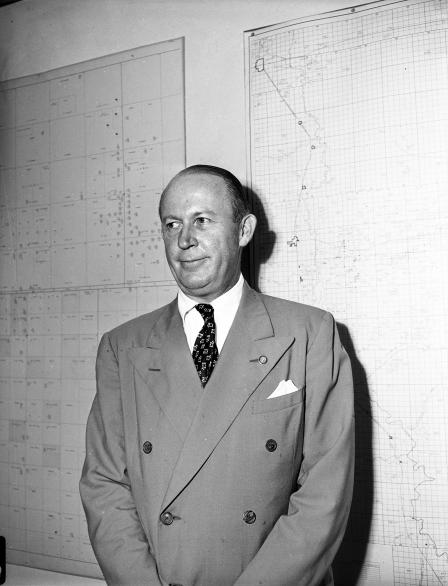
Courtesy of UTA Libraries Digital Galleries
He was elected to the New Mexico state senate in in 1952 and won a second term in 1956. He was generally aligned with the Republican Party, but ran as a Democrat to be able to participate in the New Mexico primary elections. During his time in the state senate, he served on a number of committees and sponsored legislation, primarily having to do with state finances.
Danglade succumbed to cancer on May 24, 1959 while hospitalized in New York and is interred at New Hope Cemetery located in Webb City, Jasper County, Missouri. He was succeeded by Harold Runnels in the state senate after Runnels was appointed to fill Danglade’s unexpired term.
Walter Cochran was born August 14, 1952 in Georgia to Col. Winston W. Cochran and the former Mary Dickson. His family is believed to have moved to Texas when he was still an infant. He married Nannie Dodson in the 1880s.
Walter C. Cochran came to Jal in 1883 from Palo Pinto County in North Central Texas. He moved his cattle from the JAL ranch in the spring of 1885. According to a 1939 article in the Jal Flare, his cattle were already branded with the Muleshoe brand, so he named the ranch the Muleshoe Ranch.
He had become acquainted with the area by hearing stories of his friends the Cowdens, also of Palo Pinto. When he first came to New Mexico, he set up his cattle ranching operation further east but relocated to what became the townsite of Jal.
Mr. Cochran lived in the area until 1893 after which he moved his ranching operation to around Midland, Texas. He was remembered as being a local favorite for his witty and droll demeanor. Considered to be very knowledgeable, he was sought out by younger ranchers for advice.
Mr. Cochran died of natural causes on October 31, 1934 while living in Midland, Texas and is buried there in Fairview Cemetery. His wife Nannie survived him until 1940 and is also buried there.
One of the early families to come to the area were the Forts. Benjamin Herman Fort was born December 15, 1857 in Scott County, Arkansas to John Gabriel Fort and Dorinda Jane Bell Fort and was the youngest of their eleven children. Benjamin married the former Louisa Swilling “Lou” Bramlett in Paris, Arkansas in 1879. In the years that followed, they had at least about twelve children of their own and lived first in Arkansas before settling down in Brown County, Texas. They were living in Texas when in 1902, they decided to take the younger children and make the long trip by covered wagon to New Mexico. However, Lou did not survive the journey. She passed away about 130 miles from their destination and was buried in the small community of Fluvanna, Scurry County, Texas. Benjamin and the children continued on to the area near Lovington, which was then part of Chaves County.
Fort Family about 1902 – Walter, Dorinda, Mae, Nannie, Lula Second Row: Herman, Johnny Front Row: Lillie, Eddie, Benjamin H. (Father), holding Bessie, Louise (Mother), holding Adriane and Claudie. Photo is believed to be in the public domain.
Benjamin and the children settled not far from the Texas border. Some, if not all, of their property has remained in the family since that time. A number of the children of Benjamin and Lou Fort remained in the area or came to the area to live including Nannie Fort Allen, Benjamin Walter Fort, Dorinda Jane Fort Mann, John Ruben Fort, William Herman Fort, Eddie Thomas Fort and Claudie Adolphus Fort. Benjamin died in Texas in 1929 and is buried with several other family members in Antioch Cemetery in eastern Lea County.
William Standifer Williams was born in the early 1860s in Chattanooga, Tennessee to Samuel Lowry Williams (1807-1898) and Katuriah Taylor Williams (1825-1893), a farming family. His father was one of the earliest Anglo residents of that area and is known as the Father of Chattanooga. William was one of the youngest of some thirteen siblings and half siblings. Some accounts give William’s year of birth as 1861 and others show it to be as late as 1864. William lived with his large family until at least 1880. The actual date of their marriage is unknown, but William married Minnie Alice Anderson of Sabine County, Texas prior to 1900. The couple resided for a number of years in Indian Territory, now Oklahoma. William is said to have traveled to what was then Chaves County, New Mexico Territory in 1898 and began to acquire land but returned to his cattle operation in the Oklahoma Territory with his wife. They were still living in Indian Territory in 1900 when their first child was born. Two more children were born there and after the third, George Howell Williams, was born, they came by wagon in 1907 to William’s property and officially homesteaded in New Mexico on property located just east of the Caprock and roughly sixteen miles west of Lovington. The location was near a water source known as Old Cedar Lake. It was water, but was once described as “gippy” by a descendant. Cedar Lake was a landmark in the area, however.
William and Minnie operated their cattle ranch for the next thirty-eight years until William’s death in 1936. It was known as the Plains Cattle and Sheep Company and at one point amounted to at least 275 sections of land. The ranch headquarters had initially consisted of a dugout residence but most of the time, the family resided in Artesia. Williams was often referred to in the local newspapers in connection with his cattle operation. Williams acquired the nickname “Colonel” reportedly from his stately stature while astride his horse, but he is not known to have served in the military. The ranch was on the western side of Lea County when it was created out of Eddy and Chaves counties in 1917.
William was nominated for the Lea County Cowboy Hall of Fame for a number of years and was inducted into the organization in 1992. Comments about Williams included mention that his ranch headquarters was always a welcome stop for freighters passing through the area and that Mr. Williams was known to be a mentor to younger ranchers in the area.
Mr. Williams died in 1936. Mrs. Williams survived him until 1956. Both are interred in Woodbine Cemetery in Artesia. After Mr. Williams’ death, the ranch was divided among the couple’s children.
The Lea County second water Conservation District Board of Supervisors have selected Henry Harada as Conservation Farmer for 1969.
Henry was born and raised at Rocky Ford, Colorado. In 1942 he went into the armed services where he served until 1945. In 1946 he married Amy Watanave, also from Colorado.
…
Henry farmed one year at Rocky Ford after he left the service before moving to Lea County in February 1948.
He purchased 1200 acres of land which was all in sod. He now operates about 906 acres. His cropping system consists of alfalfa, cotton, oats, grain sorghum and vegetables in rotation. Vegetables are made up of onions, peppers, tomatoes, cabbage, peas, beans, cantaloupe, squash, okra and cucumbers. Crops are staggered so that each is coming off at different times of the year. This permits best of irrigation, with each having a different time of the year for peak irrigation.
In 1956 Henry laid 4 mile of concrete ditch. Since that time he has continued to install permanent irrigation practices to improve the efficiency of his irrigation. He now has nearly two miles of concrete ditch and 1/2 mile of underground irrigation pipeline installed.
Henry has many market outlets for his produce. He markets small vegetables at Midland, Clovis Lubbock and Hobbs. Onions are transported to Rocky Ford, Colorado. Labor does not seem to be a problem in Henry’s operation. Most of his hands live in or around Lovington. He employs 60 to 70 hands during cantaloupe harvest. He employs school kids during the summer months. He keeps six hands employed year around.
Henry is a member of Farm Bureau and the Chamber of Commerce. He has been a member of the Chamber for five years.
His wife Amy is very active in the Methodist Church and is a member of the Woman’s Club. Both belong to bowling leagues.
[Lovington Daily Leader, Lovington, NM. 4 Dec 1969.]
It’s not all that often that someone from Lea County gets written up in a state wide magazine, but in 1977, the Hobbs Flare told of Lovington resident Pearl Ditmore’s write up in the June issue of New Mexico Magazine. Pearl came to Lovington shortly after World War II and in her first local restaurant configuration, she served meals and took in boarders at an old house at 19 West Central, the road that runs south of the court house. Pearl liked to cook and be with people. Her cooking style widely appealed to those in the region who would come there to eat or take away meals for later. She eventually moved to her best known location on Love Street. All meals were $2.50. There were no waiters or waitresses and no tips were allowed. Patrons were asked serve themselves and to bus their own dishes and silverware when they were finished with their meals.
Ditmore began serving breakfast at 6:30 AM and that meal lasted until 10:30. Lunch was served from 10:30 to 2:00 in the afternoon. There was no regularly scheduled evening meal, but a larger back room was available for gatherings such as banquets, luncheons and dinners. It was not unusual to read announcements in the local paper that a meeting of one of the civic clubs would be held at some appointed time at Pearl’s.
Pearl Barbour was born in Bartlesville, Oklahoma in 1914. She was taught to cook by her grandmother. After graduating from high school and attending business school, she had difficulty finding a job. Her grandmother helped her to open a hamburger restaurant in Gladewater, Texas where she catered to oilfield customers. After a number of other moves following the oil boom, she relocated to Lovington. Pearl married Don Dorrell Ditmore in 1952. Pearl also operated a boarding house before demand allowed her to tear out some walls and open it up to create a larger dining area.
Family style cooking was the norm and it became a popular place to eat in the county. For many years, the business did not even have a sign to announce the name. It wasn’t needed. Pearl was also known for her kindness to people down on their luck, including spouses of prisoners at the jail. She died in 2012 at the age of 97. Her obituary closed with these words, “We salute Pearl Barbour Ditmore for her long tenure of unselfish service to our community. Pearl, you have earned your crown of jewels in Heaven.”
On last Friday evening, June 8, 1928, at 6:30 at the home of his daughter, Mrs. John Gaither, near Pearl, New Mexico, our beloved friend T.P. Bingham, closed his eyes on the pain and suffering of this world to open them in that City beyond where pain and suffering are unknown.
He had been a constant sufferer for more than two years and almost daily expressed a desire that God would call him up higher, yet he never lost interest in his fellow man, his Church nor in the political activities of his state and nation.
He was a noble character, always holding out a helping hand to cheer and always had a kind word for all.
He was born in Choctaw County, Miss. January 10, 1840. He moved to Texas when he was 5 years old. He was truly a frontiersman. He joined the Texas Rangers at the age of 20, working with them to keep down Indian depredations in Western Texas and Eastern New Mexico.
When the Civil War was declared, he received a discharge from the Ranger force and enlisted in the 19th Texas Company, serving in various capacities till the close of the war. In 1866, he married Miss Mary Jane Morgan of Milford, Ellis County, Texas. She passed away in 1886. He later was married to Mrs. Letha Ann Smith of Corsica, Texas. We have often heard him say that he had been fortunate in having married the two best women in the world.
In 1918, he was again called to give up a dear companion, and since then he has made his home with his children.
No one is perhaps better known or more loved in Lea County than he, by both old and young. He was indeed “a friend to every one.”
He came to New Mexico 25 years ago and has always been a staunch worker for the good of his state, county and town and always very optimistic as to their future. He served as Justice of the Peace for a number of years at Monument and also at Lovington. He also served as Probate Judge of Lea County for four years. He has been a member of the Baptist Church nearly 65 years, a consistent, devoted Christian, living the “golden rule”.
He leaves 5 children to reverence his memory. They were all with him at the time of his death. They are Mrs. Nanny L. Cathey, Jayton, Texas; T.S. Bingham, Lovington; Mrs. John Gaither, Pearl; Bailey Bingham, Aspermont, Texas; and Mrs. B. Hardin, Carlsbad.
There are 21 grandchildren and 8 great grandchildren, all of whom revere the name of grandfather. The funeral services were at the Baptist Church in Lovington of which he was a consistent member and was conducted by Rev. W.G. McArthur, Supt. of the Orphans Home at Portales, assisted by Rev. Parker and Beauchamp. This service was very beautiful and impressive, Rev. McArthur being his old-time friend who paid many loving tributes to his memory. One of the most beautiful things said was that Judge Bingham had had more influence in his spiritual development than any other man. The music consisted of some of the favorite songs of the deceased, among them being, “Rock of Ages”, “Shall We Gather by the River”, “When the Roll is Called up Yonder”, and “By the Touch of His Hand on Mine”.
A short service was held at the Lovington Cemetery, after which all that was mortal of “Grandpa” Bingham was tenderly laid to rest by the side of his dear wife, whom most remember with love. This dear old “Soldier of the Cross” has passed earth’s shadow into a glorious life beyond, where no partings are, neither pain, nor sorrow and where he lovingly beckons us to follow.
[Lovington Leader, Lovington, NM. 15 Jun 1928. Submitted by David L. Minton, Lea County Historian.]
1916 – Left to right: Dad Steele, T. P. Bingham, George McGonigal – Preparing to attend Confederate Veterans Reunion in Washington, D. C. – Image from Findagrave.com



 Old Lea County, N.M.