Old Lea County, N.M.

Tag: hobbs

  • Sister Mary Fides

    [This article about Sister Mary Fides was transcribed from the Hobbs Flare issue of March 1, 1984. It was written by Patricia Breyman.]

    This week’s old timer is 80 years old, is devoted, compassionate, courageous, loving, caring — all of these plus dedication personified. However, what this reporter also quickly recognized in her beautiful face is happiness, contentment, laugh lines from a marvelous sense of humor, warmth. tenderness, eyes alive and alight with expectation, and a readiness for helpful escapades that has about worn out her guardian angel!

    She is sister Mary Fides, Dominican Order, serving St. Helena’s Catholic Church in Hobbs in a full-time and very active position as Director of Religious Education.

    She was born as Agnes Cecelia Gough on June 22. 1903 to George Joseph Gough and Ophelia (Pickard) Gough. Her father was from Kentucky and her mother from southern Illinois. They met at a small Baptist College in Illinois, married. and Agnes Cecelia was born into a mixed marriage home – half Catholic and half Baptist. It later became an all Catholic marriage and home. They lived in Uniontown, Kentucky.

    CATHOLIC/YANKEE

    The family moved from Uniontown to Oceola, Arkansas, smack in the middle of the Bible-belt and into a southern stronghold. Young Cecelia found herself as she put it, with two strikes against her she was Catholic and a “damnyankee” to boot.

    She was timid and shy but at seven, assured her mother she knew the way to the home of an aunt and uncle in Oceola and was perfectly capable of walking there alone. She didn’t get far from home when she realized she was hopelessly lost. Lost to such an extent she could not find the home of the relatives nor could she find her own home again. She finally gathered her courage, marched up to the front door of the nearest home, and asked for help. It was the Methodist parsonage and the minister’s daughter walked her around and up and down streets until she recognized her own home. She said she always had respect for people of other faiths and the memory of that event only strengthened that respect.

    Agnes Cecelia attended public schools until she was a junior in high school. Her mother was afraid she would become “wild” so she sent her to St. Agnes Academy in Memphis, about 60 miles away. The good sister was quick to assure she definitely was not “wild” and has no idea what criteria her mother used to arrive at that fear.

    SISTERHOOD REJECTED

    She said the last thing on her mind was to enter religious training in any form, much less to become a nun. When asked by friends and family if she considered that as an avocation, her stock answer was ”No, I am not about to wear all those clothes.”

    She said “the Lord finally had enough of her foolishness and moved her to the decision to enter training.” Soon after she finished high school, she entered the Mother House at Bardstown, Kentucky to train as a Sister of Dominican Order.

    Dominican Sisterhood was founded as a teaching order in 1822. Dominican priests working in the area, started a school for boys (in those days, boys and girls were educated from separate accommodations. They quickly saw the need for sisters to teach the girls. An appeal was soon made from the pulpit on a Sunday morning and eight young ladies answered the call.

    The father of one of the eight gave a parcel of land with a log cabin on it as the beginning of the Dominican Sisterhood, with the priests training the eight original young ladies. The first years were a hard struggle but they grew into an order with a magnificent Mother House that covers many acres and they are now one of the most active orders.

    When Agnes Cecelia entered the Mother House in January of 1923 to begin training, the Mistress who accepted her had the list of names for the twelve young ladies in that class. Since Agnes Cecelia was first to arrive, she was given her choice of names. She chose Diana, but the Mistress said that had been spoken for; second choice was Mary Thomas, again that had been spoken for by one of the young ladies, because Mary was her mother’s name and Thomas was her father’s name; finally. Agnes Cecelia said, just give me Mary Fides, no one else would choose that anyway. She learned that Fides is Latin for Faith and has been happy with that choice since.

    BEGINS TEACHING

    After a year and a half, she was sent to the missions and taught at Matoon, Illinois. She spent her longest time – ten years – at St. Catharine of Siena in Memphis, Tennessee.

    In between her years of teaching, Sister Fides found time to earn a bachelor degree and two masters. She attended De Paul University at Chicago and got her first degree, a B.S., in Chemistry in 1935. After teaching that subject for some time, she became interested in mathematics, went back to De Paul, built up her prerequisites, and got a masters in mathematics in 1940. She was asked later if she had any interest in home economics, and thought that would be an interesting field. She returned to school, this time to the University Of Wisconsin and got a masters in Home Economies in 1949.

    Prior to the Vatican Council II in 1969, Sisters in the Dominican Order (and most other orders as well) were sent where their church felt they were needed – they had no choice.

    After Vatican Council II, the late Pope John was said to have thrown open the window and declared the church needed fresh air. To begin this process, he asked the Orders to update themselves.

    From that edict, came a gradual modernization “by degrees” of their habit and finally, the greatest change of all, permitting the Sisters to choose their field, the location, and to make their own contracts.

    After the 1969 decision to leave regular teaching for religious education. Sister Fides went to Notre Dame Seminary at New Orleans, Louisiana for several summers to prepare herself for yet another branch of her profession.

    NEBRASKA

    Her first self-contracted job was at the Diocese of Grand Island, Nebraska where she had the entire western half of the State of Nebraska. While there, she got her first drivers license.

    In 1973, she left Nebraska for the Diocese of Little Rock, Arkansas and her territory was the entire state of Arkansas. She visited 50 different parishes, some of them several times, where her primary work was in the field or teacher training in church, not in school. She was in Little Rock for three years and loved her work, but realized she was spreading herself thin. She decided to work for one Church so she could devote more time to her new profession. She chose West Memphis, Arkansas and went to work at St. Michael’s where she spent six happy years and made some dear friends. She visits there and Grand Island for vacations when she gets the chance.

    In 1979, at the age of 76, she was all set for retirement because she crippled from arthritis and two minor falls. She had resigned from St. Michael’s where the congregation was furious with the pastor for accepting her resignation – the poor man asked them what was he to do other than accept it? Father John, now pastor at St. Helena’s, persuaded her to come to Carlsbad to the religious center and she agreed to if it was not teaching. She had served more than 40 years in that capacity and said times had changed so she did not want to enter that field again. Too, she accepted, because she thought this climate might help her arthritic knee.

    HOBBS

    She visited Hobbs several times while working at Carlsbad and when the opportunity came to work at St. Helena’s in religious education, she accepted. However. She’s retiring, again, come June of this year, and I am sure it will be with deep regret that this resignation is accepted.

    She said religious education is very different from teaching in Catholic schools but that it is very satisfying work. She is responsible for retreats, discussion groups, preparations for confirmations, baptismal preparations, conducting classes on Sundays for approximately 230 children of Kindergarten through sixth grades. a variety of programs for junior and senior high school age, and the 5:30 Sunday Mass which is designated “youth mass.”

    She teaches a sexual education class – careful never to the word “sex” as opposed to “sexual” and bases every statement on scripture. She seems to enjoy the reaction her appearance always brings when she enters this classroom – a nun and one who is 80 years old teaching sexual education!! She laughs to herself, not just for the fun of it, but in conjunction with her classes. She uses a book which she wrote. “My Sexuality – A gift of God” in these classes and feels it is helping some to combat the ideas these children and youth are getting from their peers, from television, and from the streets. She is distressed that they are missing the moral implications and stresses love in all that she teaches. She said they need dwell on the different kinds of love – love Of God, love of parents, love of friends, and romantic love.

    This serene lady has many happy memories of her years of teaching and in religious education, among them taking a group of children to Little Rock to visit the Cathedral of St. Andrew where their Bishop, who knew the children were coming, spent extra time explaining each vestment and sacrament to the children. Later he met with them and gave Sister Fides money to treat them to lunch at McDonalds. He said they might have happy memories of the day if he, Bishop McDonald, sent them to McDonalds for lunch!

    She still has contact with many of her former students and parishioners – one, Philip Wray from St. Michael’s had called the day of this interview to report success in his first real job.

    CHURCH FAMILY

    She said only recently, she was thinking how alone she was with most of her family gone, when she looked around at the huge church family she has and realized she was not alone and never would be.

    She celebrated her golden jubilee in 1976 when friends sent her on a trip to Paris, Vienna, Belgium, Italy, Isle of Capri, and highlighted by a group audience with Pope Paul. She has traveled to Mexico City more recently for a pilgrimage and mass at the Shrine of Our Lady of Guadalupe celebrating the new diocese of New Mexico, headed by Bishop Ricardo Ramirez.

    She reads incessantly, enjoys crafts such as crochet, making banners, and ojo de dios; she is doing for others – such as the wild trip at Christmas to drive the vehicle of another Sister to Tennessee and then fly home. Before long, the terrible winter blizzard conditions overtook them, she had three very close calls, but with God’s help (and that poor frazzled “guardian angel” watching over her) they arrived safely.

    She relatively good health now except for a broken wrist she got the day before Thanksgiving, and it is still in a cast. For several years she was crippled to the point of having great difficulty in getting around until she came to Hobbs and Dr. Maldanado operated on her knee. He inserted a plastic one, and now walks without even a cane.

    In facing her retirement, she says her one dream for religious education is training on an ungraded basis. She hates leaving without accomplishing this but hopes others will carry on the programs to that goal.

    This serene lady’s only concession to “old age” (and even the mention of the word in conjunction with this active person seems sacrilegious) is sleeping late. She said she arose at 5 o’clock each morning for almost all her life but now sleeps “late.” Late to her is 7 o’clock at which time she arises, goes to her office for prayers, then Mass, and another day at work.

    By Patricia Breyman

    [Transcribed from Hobbs Flare, March 1, 1984.]

  • Dr. Allen Price Terrell

    Dr. Terrell served as a medical doctor for many years in Lea County. In 1941, he purchased the Shuler Hospital from Dr. A.C. Shuler after Dr. Shuler announced that he was relocating to Carlsbad to join the Womack Clinic.

    The building where the medical practice and hospital was located was going to be renamed the Terrell Hospital. It had been built in 1931 and was once of the first brick buildings to be built in Hobbs. It could accommodate six patients.

    An article in the Hobbs Daily News-Sun on February 16, 1941 recounted that Dr. and Mrs. Terrell had lived in Hobbs for the past eleven years and that the former owner, Dr. Shuler had lived in Hobbs for five years. The article continued that no changes were anticipated in the operation of the hospital following the change of ownership.

    Dr. Price was the son of Albert Pinkney Terrell (1852 – 1914) and Bennora Trabue Terrell (1861 – 1942). He was born to the couple in Kentucky on December 16, 1884. Allen P. Terrell was living with his parents and four siblings in Missouri in the 1900 census. By 1910, he was about twenty-five years old, single and was working as a physician in Dallas, Texas. He was living with his parents and two siblings. Dr. Terrell served in the field artillery during World War I at the rank of major. By 1920, Dr. Terrell appears to have been living in Wichita Falls, Texas, was single at the time and was practicing as a physician. He relocated to Hobbs, Lea County, New Mexico in 1929.

    Dr. Terrell was last married to Maude Hawkins Terrell (1888 – 1967). Mrs. Terrell was a nurse by profession and during the time in which they owned the Terrell Hospital in Hobbs worked and helped to manage the facility.

    Dr. Terrell passed away in 1947 while still living in Hobbs, New Mexico. Mrs. Terrell survived him by another twenty years and both are buried in Riverside Cemetery near downtown Wichita Falls, Texas.

  • The Monument in Monument

    About 1928, as well as we can determine, land developers commissioned a structure of a Native American. It once stood in the middle of a dirt road and faced the location of the old Monument Spring.

    The artist who constructed it is unknown. The monument itself had no name originally, as far as we can tell, but the local legend is that residents nicknamed it Geronimo, after the famous warrior.


    Geronimo was a great tribal leader of the Apache nation, although he is not considered to have been a chief. He was of the Chiricahua tribe and the Bedonkohe band. Several translations are given for his name, pronounced Gokhleyah in Apache. One is “one who yawns” and another is “one who thinks before he acts.” lived from 1829 to 1909. As a leader and warrior, he was quite successful and conducted raids in the southwestern United States and Mexico. He eventually surrendered and lived out his senior years at Fort Sill, in Oklahoma. He died and was buried in the old cemetery at the military fort.

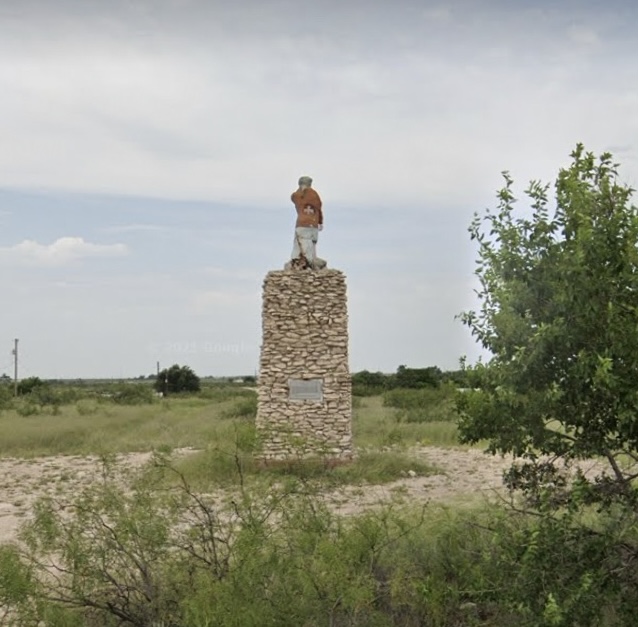
    The local monument sat for many years in the middle of an unpaved road in Monument, located a few miles outside Hobbs. Around 1940, it was damaged and completely knocked to the ground when a motorist ran into it. Afterward, it was moved a few feet away from the roadway, as it appears in the above undated image.

    How the monument looks currently:

    Image credit: Google Streetview.

    At some unknown date, a plaque was added. This is the inscription.

    “Settled in 1885 and named for a marker at the springs a few miles west, monument remained a ranching community until oil was discovered in 1928. The Indian statue, called Geronimo by residents, was erected in 1928 by land developers. Monument has produced 4 world champion rodeo performers: George Weir & Roy, Betty Gayle & Jimmie B. Cooper. A centennial celebration was held in 1985.

    Erected by Monument Centennial Committee”

  • Hobbs’ First Teacher

    Mrs. Harold P. Collier, formerly Miss Olive Manning, was hired to teach in Hobbs in 1915. She recounted her early memories in a newspaper article in the Hobbs Daily News back in 1936.

    The first school building was also completed in 1915, but in stages. Only the basement had been dug by October of that year, so they started holding classes there although the floors and walls were still dirt. Initially thirty students were enrolled and classes ran from the first to the ninth grade. Since the area was still part of Eddy County at that time, it was part of the school district of that county. The administrator was W. A. Poore of Carlsbad.

    Construction labor was donated by area residents and school went on while the above-ground work was completed. It became a community center where local events were held.

    The school building itself was completed around the first of the year in 1916 and the students were able to occupy the it and move from the basement. Mrs. Collier recalled that they had a library of fifty books. Her recollections of Hobbs at that time were that there were not many cars, maybe as many as three or four in town. Transportation was mostly by horseback or wagon. The railroad had not reached Hobbs at that time and there were few businesses in addition to the early post office.

    The building was referred to as the All-Hobbs school building and served the area for around twenty years. It was expanded to add more rooms before being replaced.


    Little else is presently known about Mrs. Collier. The couple had at least two sons, Harold and Kenneth while living in Lea County. Kenneth lost his life in the Philippines during World War II. The Colliers eventually moved to the state of Washington. Olive and her son Harold are buried at Woodbine Cemetery in Puyallup, Pierce County, Washington. The burial location for her husband, Harold P. Collier, is presently unknown.

  • The Loose Balloon

    On May 6, 1978, an advertising balloon became detached from the ground at a motor vehicle dealership in Hobbs. A doctor and an employee of the dealership noticed that it was coming untethered and got in touch with Lea County pilot Zip Franklin who first flew after the loose balloon and finally brought it down after shooting it with a .22 and finally with a shotgun. It came down outside Levelland, Texas and when it did, the dealership employee who had been trailing it in his pickup became trapped in the fabric of the collapsed balloon. Franklin and the doctor administered aid until medical assistance arrived. The dealership employee had to be hospitalized but all three survived.

    Franklin said that the balloon reached heights of 15,000 feet above sea level and estimated that at its peak, the balloon was as large as a house.

    (Thanks to R.O.F. for telling us this story.)

  • Beverly Thomas “Tootie” Schnaubert

    “Tootie” Schnaubert was born January 29, 1917 to Stephen Arthur Schnaubert and Ella M. Adams Schnaubert in Rankin, Texas. Both parents died in December, 1918 when he was not quite two years old, their causes of death unstated. Tootie and his two siblings, Leon and Stephen, went to live with their grandparents, Arthur and Mentie Schnaubert in Upton County, Texas. By 1930, the combined family was living in Carlsbad, New Mexico where Arthur was working as an electrician for Carlsbad Light and Power Company.

    Tootie married Peggy Jo Parks in 1939 and the couple would remain married until Peggy’s death in 1987. Tootie registered for the draft in 1940 naming his grandfather Arthur Francis as his next of kin and his employer as Homer Bryan of Carlsbad. He was 23 years old.

    Around 1950, Tootie opened up his first retail grocery stores in Hobbs and called them Tootie’s Cashway. A 1952 article in the Lovington Leader announced the remodeling of their Hobbs store giving it the largest floor space of a grocery store in Hobbs. It offered not Green Stamps but Pacific Stamps.

    It was not uncommon for the grocery to take out full page ads in local newspapers. The company also ran commercials on local radio stations. The melody was taken from an old Al Jolson song “Toot, Toot, Tootsie, Goodbye” and singer sang these lyrics. “Toot, Toot, Tootie’s Cashway. Ladies hear what we say…”

    Clovis News Journal Sun, August 30, 1959

    The company expanded to have multiple stores in places like Hobbs, Lovington and Clovis. It was not unusual to see Tootie’s image on the ads. Tootie eventually retired. Over the years, the company employed many people. An internet search of obituaries would mention that different individuals had worked in some capacity for Tootie’s Cashway.

    Peggy Jo passed away in 1987 and Tootie followed him in death in 1997. Both are buried in Memory Gardens in Hobbs, New Mexico.

  • Oil Discovery In Hobbs

    The first successful oil well was completed around 1921 and the first successful gas well was completed a year earlier, but the Midwest State No. 1, spudded in 1927 using a standard cable tool rig and found oil on June 13, 1928 at a depth of 4,065 feet is considered to be the well that revealed the huge oil deposits in this area.

    Writers have commented that the flat land surface disguised the formations below the surface. Surface formations may sometimes indicate favorable subsurface formations for petroleum products.

    Midwest Refining Company, which would later become part of Amoco and subsequently British Petroleum, had brought in a successful well near Shiprock some six years earlier in 1922 in what is now called the San Juan Basin. In the Permian Basin, oil was found in nearby Winkler County, Texas in the Scarborough Field. In an oversimplication of all the various split ups and mergers, Midwest had been operating under the name Midwest Refining Company since 1914 after a merger between Midwest Petroleum and Franco Petroleum and Amoco was created in 1911 after the federal government ordered the split up of Standard Oil Company.

    The Midwest State No. 1 was drilled using a steel derrick that came from Amarillo. The engine was rebuilt locally after a fire had occurred when the rig had reached a depth of about 1,500 feet. Exhaust from the Franklin 85 engine created a fire that involved the engine house. The cable tools were fished from the hole, repairs were made and drilling resumed.

    The first signs of oil came at just below 4,000 feet in June and the well was later completed in November, 1928 at a depth of 4,330 feet. The Las Vegas Daily Optic reported on June 15, 1928:

    “The Midwest State No. 1 well, sec 9-19-38, is standing 4000 feet in oil and promises to open a new field, C. B. Barker, attorney for the state land commissioner was advised today. ‘This is on land belonging to the state deaf, dumb and blind schools and may mean a large income for them,’ said Mr. Barker. ‘Another section of common school land adjoins this one.’”

    Early production was measured at 700 barrels of oil per day, but it promised more and greater finds in the Hobbs area. One year later, the Humble Bowers No. 1 was completed. By comparison, its production was estimated to have a potential of 10,000 barrels per day.

    Cable tool drilling is considered to be one of the earliest drilling methods, dating back thousands of years over the world for other applications, such as drilling water wells. Drilling is accomplished by percussion, repeatedly lifting and dropping a string of pipe and tools into the hole. Fluid is pumped into the hole and crushed material is pumped out. Early drilling equipment included the drill bit, the drill stem, drilling jaws, a socket and steel cable. It is still in limited use for other applications but has been replaced by more advanced methods for deeper wells.

    [Sources: American Oil and Gas Historical Society.]

  • New Hobbs, New Mexico

    There were once two towns named Hobbs: Hobbs and New Hobbs. For a number of years, they existed as separate communities. New Hobbs had its own post office at one time, as well.

    The first attempt at unifying them failed in 1932. Finally in 1937 they were consolidated with Hobbs being the survivor. The city ordinance below was published in the May 25, 1937 issue of the Hobbs Daily News and is repeated below. The essence of the ordinance was that authorized representatives of both municipalities had met and approved the consider the consolidation of both towns into one.


    Publish May 25

    ORDINANCE NO. 90

    An ordinance approving, ratifying and confirming all proceedings had and taken relative to the election for the consolidation of the Town of Hobbs and the Town of New Hobbs by annexation of the Town of New Hobbs to the Town of Hobbs; Declaring that the Town of New Hobbs shall be annexed to the Town of Hobbs and that the Board of Trustees of the Town of Hobbs shall have jurisdiction over all territory formerly withing the Town of New Hobbs; Providing for the assumption of all liabilities both present and contingent which now exist against the Town of New Hobbs; Providing that all property heretofore belonging to the Town of New Hobbs shall become the property of the Town of Hobbs; Be It Ordained by the Board of trustees of the Town of Hobbs, New Mexico:

    WHEREAS, at a regular meeting of the Board of Trustees of the Town of Hobbs held on April 5th, 1937, a resolution was duly adopted by the terms of which three citizens of the Town of Hobbs were appointed as a Board of Commissioners to meet with a like body to be appointed by the Board of Trustees of the Town of New Hobbs to report upon and recommend the advisability of and the terms and conditions upon which the Town of Hobbs and the Town of New Hobbs might be consolidated by annexing the Town of New Hobbs to the Town of Hobbs;

    WHEREAS, thereafter the said Board of Commissioners so appointed did meet with a like body appointed by the Board of Trustees of the Town of New Hobbs and did submit to the Board of Trustees of the Town of Hobbs certain recommendations,

    WHEREAS, at a special meeting of the Board of Trustees of the Town of Hobbs held on April 12th, 1937, Odinance No. 87 was duly adopted which said ordinance was styled

    “An ordinance adopting, approving and ratifying the report of the Board of Commissioners heretofore appointed to confer with a like board of commissioners appointed by the Board of Trustees of the Town of New Hobbs, New Mexico, on th e proposition of consolidating the Tow of Hobbs and the Town of New Hobbs to the Town of Hobbs.”

    which said ordinance was thereafter duly published as required by law.

    WHEREAS, at a special meeting of the Board of Trustees of the Town of Hobbs held on April 16th, 1937, there was adopted a resolution appointing the judges and clerks of election; designating polling places for said election; and appointing Boards of Registration for said election.

    WHEREAS, thereafter on May 6th, 1937, there was issued an Election Proclamation signed by Mayor Ross Walker and attested by R. E. Alsup, Clerk, which said Election Proclamation which was in due form as required by law and thereafter published as required by law.

    WHEREAS, there was held in the Town of Hobbs on May 18th, 1937, an election at which said election the duly qualified electors of town of Hobbs and the Town of New Hobbs by annexing the Town of New Hobbs to the Town of Hobbs.

    WHEREAS at said election a majority of the persons voting therein did vote in favor of said proposition mentioned above and there was duly adopted at a special meeting of the Board of Trustees of the Town of Hobbs held on May 24th, 1937, a resolution canvassing the results of said election.

    NOW THEREFORE BE IT ORDAINED BY THE Board of Trustees of the Town of Hobbs.

    1. That all proceeding heretofore had in connection with the special election held on May 18th, 1937, be and the same are hereby approved, ratified and confirmed.
    2. That the Town of New Hobbs be and the same is hereby annexed to the Town of Hobbs and that upon the taking effect of this Ordinance all territory now embraced withing the Town of New Hobbs shall become a part of the Town of Hobbs and shall be governed as a part of said Town and be under the jurisdiction of the Board of Trustees of the Town of Hobbs.
    3. That all liabilities now existing against the Town of New Hobbs both present and contingent be and the same are hereby assumed by the Town of Hobbs.
    4. That all property both real and personal now owned by the Town of New Hobbs shall become the property of the Town of Hobbs.
    5. This ordinance shall be in full force and effect on and after May 30th, 1937.

    PASSED and ADOPTED this 24th day of May, 1937.

    Attest: (Seal) R. E. Alsup, Clerk

    Ross Walker, Mayor


  • The Hobbs Family

    James Isaac Hobbs was born January 2, 1852 in Tishomingo, Mississippi. By the time he was 19, he was working as a laborer on a farm in Prentiss, Mississippi. Eight years later in 1878, he married the former Frances Paralee “Fannie” Mooring in Point, Rains County, Texas, born in Tennessee on March 27, 1857. By 1880, the couple had been blessed with two children, a girl named Ada and a boy named John, and were still living in Rains County, Texas. James Isaac was working as a farmer. By 1900, the couple was living in Brown County, Texas. James Isaac was still working as a farmer and the last of their seven children, twins Winnie and Minnie, were born in 1896. By 1910, they had settled in what was then Eddy County and were residing in a community called Roberts, believed to be the future location of Hobbs.

    A daughter, Minnie, tells the tale of how they came to settle in southeastern New Mexico. They were originally headed to the Davis Mountains in Texas, but on the way, they met a person returning from that area who was very negative about it and the Hobbs’ prospects, should they elect to continue. As a result, they headed in a northwesterly direction and came instead to southeastern New Mexico, still then a territory. As time passed, they were joined by other settlers and the town grew up. When they applied for a post office, Minnie says that they penciled in the name “Taft” but when the name was approved, someone had changed it to “Hobbs” instead. (1) By 1920, the couple was living in the community of Nadine. Lea County had been created out of portions of Chaves and Eddy counties. James Isaac passed away three years later. Fannie survived him another nineteen years.

    At least three of the children of James Isaac and Fannie remained in the area. James Berry, called the founder of Hobbs, Winnie who married Sam Dalmont and Minnie who married Ernest Herman “Dad” Byers.


    (1) Lea County Genealogical Society, Then and Now, Lea County Families, Volume 1, Walsworth Publishing Company, 1979.