Old Lea County, N.M.

Tag: lovington

  • Eugene Price

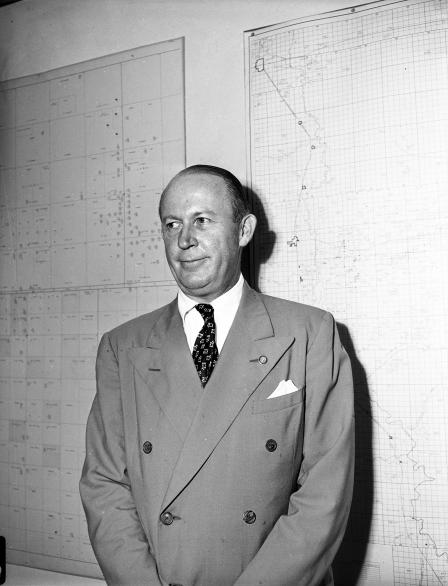
    Gene Price (full name Eugene Hubbert Price) was born on November 19, 1868, in Grayson County, Texas to Theodore Martin Price (1836 – 1927) and Martha Ann Virginia Drisella Hubbert Price (1842 – 1905). Theodore Martin Price was a farmer/rancher/merchant and also a circuit riding Methodist preacher. From his early years, Gene was keenly interested in ranching, beginning in the era of the open range.

    As a young man, he worked on several ranches in the southwest. He named the Quinn Brothers, the Hat Ranch, Pemberton Brothers and the E Ranch in his comments. In 1889, he married the former Lily Kirby Harris Cook in Eolian, Texas. Around 1901, the family homesteaded in New Mexico, at the corner where Yoakum, Gaines, Eddy, and Chaves counties met – roughly 15 miles east of the future site of Lovington.

    Mr. Price built up one of the area’s earliest high-quality registered Hereford herds. For a while, he leased the Highlonesome Ranch, and the family resided in its old headquarters house. As their children reached school age, the family bought a home in Lovington while still working the ranch. Gene served on the Lovington School Board and participated actively in community matters; he generously donated land for a second, larger school building, which served as the town’s only school for many years. He was a long time member of the Methodist Church in Lovington.

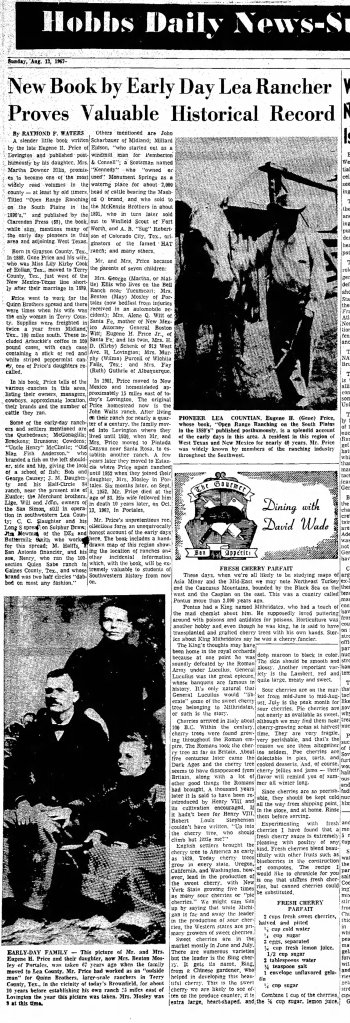
    In his later years, he authored “Open Range Ranching on the South Plains in the 1890’s,” a memoir of his early experiences that has become a valuable resource for those interested in the region’s history. Long out of print, the original publication included a reproduction of Gene’s informative hand drawn map of Lea County and the surrounding area.

    Mr. Price passed away on September 5, 1952. Mrs. Price died on October 16. 1962. Both are buried in Lovington Cemetery. In 1988, he was posthumously honored with a Bronze Cowboy award for his numerous contributions to the early traditions and settlement of Lea County.

    Image credit – Hobbs Daily News-Sun, August 13, 1967
  • Bob Causey – Blacksmith and Spur Maker

    (Used with permission)

    Robert Lincoln “Bob” Causey was born in Illinois on February 12, 1868 to George Washington Causey and Mary Adeline Crowder Causey. February 12, 1809 was the birth date of the late United States President, Abraham Lincoln. This was likely the source of Robert’s middle name. Concerning his place of birth, articles usually say that he was born in Missouri, but both the 1870 and 1880 census pages list his place of birth as Illinois. He was one of ten children born to the couple, many of whom were also born in Illinois. George W. (the father) had been born in Tennessee and in the 1870 census, his occupation was listed as farmer. He was still shown as being a farmer in the 1900 census before his death in 1907 at around 80 years of age. He died in Guthrie, Logan County, Oklahoma Territory. Mary Adeline had predeceased him, also in Oklahoma, in 1895.

    In the 1880 federal census, Bob was twelve years old, still living with his parents and two of his sisters in Adams County, Iowa. The other siblings had left the family home over time. Several of the brothers including John and Thomas (known as George), had been making their living since the 1870s as buffalo hunters and had moved west following the herds. They had begun to hunt the big animals in Kansas and as the herds worked their way south, they followed them, eventually crossing the Arkansas River and venturing into areas that had been set aside by treaty as hunting lands for the native tribes which roamed the area. George continued this until he reached the Panhandle of Texas. Still in close proximity to the roaming tribes, George was not involved in either of the two battles of Adobe Walls, but he was camped near enough to hear the shooting during one of the events, at the time assuming that it was his fellow buffalo hunters at work.

    However, by about 1882, the herds had been depleted to the point that the brothers realized that they needed to find other livelihoods. So, they headed further west to the New Mexico Territory with a plan to round up, raise and sell wild mustangs, which they did with little early success. Bob must have been drawn to the west himself, as later in 1880 he is said to have left the family home with $5 in his pocket. He made his way as far as Indian Territory where he managed to stop in an unnamed town and find a job as an apprentice in a blacksmith shop. He worked there for about four years earning a tiny wage plus room and board before moving on to join his brothers around 1884.

    In the meantime, his brother George settled for a while in the Yellow House area of West Texas before moving on. George found a seepage spring and dammed it up to provide a water supply. There he built a sod house as his home base. The area took its name from nearby geological formation of limestone bluffs that were pockmarked with caves. The name in Spanish was las casas amarillas which in English was translated “yellow houses.” The general area was to later become part of both the XIT and Yellow House (owned by Littlefield) ranches at various times. George was aware of the enormous transaction had taken place between the State of Texas and a syndicate to create the XIT and decided it was time to move on. When the XIT began to be dissolved after around 1910, the Littlefield operation acquired some 236,000 acres of the former XIT.

    George and John Causey left West Texas and resettled in southeastern New Mexico, near a place called Monument Spring before building their ranch house a bit north of there. They built their ranch headquarters about five miles south of what became the town of Lovington and roughly fifteen or so miles northwest of what became the town of Hobbs. Bob appears to have joined them at their ranch a few years later. He stayed in southeastern New Mexico until in the latter part of the 1880s, when he branched out to set up his first blacksmith shop in Odessa, then basically just a water stop for the Texas and Pacific Railroad. He was soon joined some time later by his recently widowed sister Nellie Causey Whitlock and her young son, Vivian Whitlock. As Netties’ son grew up, Bob took him under his wing at the blacksmith shop. However, Whitlock did not follow in Bob’s footsteps as a blacksmith. Instead, he became a writer. He published one book, “Cowboy Life on the Llano Estacado” and numerous stories and articles in magazines and newspapers over thirty plus years. Some knew him by his pen-name, “Ol’ Waddy” and others under his given name.

    Being one of the earliest Anglo settlers to arrive in the area and an early blacksmith, Bob is called the “first blacksmith of the Llano Estacado.” In addition to his day to day blacksmithing duties, Bob began to make spurs and bits for the local cowboys. One of his designs was called the “gal-leg” spurs. They were so labeled because the neck or shank of the spur (the part that extends behind the boot) was fashioned to resemble a woman’s leg, with the foot or toe holding the rowel pin. (Parts of a spur.) Bob is sometimes credited for coming up with the gal-leg design, but even if he was not the inventor of the design, he was at the least one of the first to make them.

    Bob remained in the Odessa area for about ten years, also serving as constable as the town grew. He moved to Eddy, now known as Carlsbad, New Mexico about 1895. There he set up a blacksmith shop on Main Street. He operated the shop for many years before partnering with Robert Osborn. Bob married Martha Agnes Bogle in 1903 and the couple had one daughter. His reputation spread and Bob became well known for his spurs and bits. He would make them up ahead of time and also make them to order. When he signed his work, he stamped the articles with his initials, “R. L. C”. In addition to the gal-leg design, he was known for fashioning the neck or shank in the shape of a horse head. He would often adorn them with Mexican coins that he would collect on his travels and save for just this purpose.

    After a few other moves, he was finally drawn to move to Safford, Arizona in 1924. He remained there until his death in 1937. He is buried in Safford City Cemetery. His wife Martha Bogle Causey survived him by twenty-four years and is also buried in Safford City Cemetery.
  • The Rock Hill Neighborhood of Lovington

    Source: “Then and Now – Lea County Families,” Lea County Genealogical Society, Walsworth Publishing Company, 1979.

    Tom Conway interviewed Robert L. “Preacher” Jones for an article in the above mentioned book. In the interview, Rev. Jones was said to be the first person of African American descent to move to Lovington, arriving in 1931 and staying a short time. He had previously lived in Hobbs, moving there from North Texas where he said he had grown up on the “Wagner” (probably a reference to the Waggoner) Ranch near Vernon, Texas.

    The interview stated that he had moved to Hobbs, attracted by the oil boom, where he did some carpentry work. After that, he left the area for a while, returning in 1933 to Lovington where he bought property on a high place to the east of town.

    The article stated that one David Martin was the second person of African American descent to come to Lovington around 1935. Mr. Martin bought some of Rev. Jones’ land where he built a home and lived until the 1950s. While in Lovington, Mr. Martin, reportedly disabled, worked shining shoes at Simpson’s barber shop. He is said to have later moved to Hobbs where he worked for the Postal Service.

    Rev. Jones was a pentecostal minister and a carpenter and remained in Lovington the rest of his life. The article stated that he had built some seventeen churches and many homes. Rev. Jones is said to have named the neighborhood Rock Hill. Rev. Jones also was the first garbage collector for the neighborhood. He would drive around and pick up garbage in his pickup truck.

    In addition to Jones and Martin, the article also mentions other early residents: the Cottons, Andover Williams, Olene Fillmore. The article also mentions B. W. “Overcoat” Williams as being an early resident.


    Rev. Robert L. Jones died in 1986 and is buried in Lovington Cemetery along with his wife, Annie.

  • Power’s Motel in Lovington

    Early settlers, Dick and Mary Power, owned a motel south of downtown Lovington and it served the area for many decades. Mary was the former Mary Eaves whose family had come to what became Lea County in 1909 and Dick arrived in 1914. She was the daughter of Paschal Simeon and Mary Susan Brown Eaves. Dick’s full name was Earnest H. Power. He was the son of Augustus Earnest and Edna Latham Power. Before he and Mary ran the hotel, Dick once owned and operated a cafe named Dick’s Cafe that was located downtown

    The address of the motel was 215 E. Avenue B. The grounds had some beautiful elm and pecan trees which were formerly part of the Eaves family’s orchard. The oldest units were 27 rooms built in 1947 and 12 more units were added in 1953. The old motel was demolished many years ago and a City office building now sits on the former site.

    Dick passed in 1974 and Mary followed him in death in 1982. Both are buried in Lovington Cemetery.

    The Power’s Motel Lovington, NM in 1940 – Image credit: cardcow.com
  • The Robert F. Love Family

    Robert Florence Love was born April 17, 1870 to John Dillard Love and Nancy Jane M. Austin Love in Palo Pinto County, Texas. John Dillard Love had been born in North Carolina in 1822 while Nancy Jane was a number of years younger having been born in Arkansas in 1837. John Dillard and Nancy Jane had married in 1859 in Arkansas. Their first child, Jefferson A. Love was born in 1862 and he was followed by five more male children, Samuel Oliver (1865), John G. (1867), Robert Florence (1870), James B. (Jim) (1873), and Albert Berry (1877). The first two sons were born in Tennessee and the remaining four were born in Texas.

    In the 1880 census, Robert was living with his family in Palo Pinto County, Texas. His father was listed as being a farmer and he and his three older brothers were noted as working on the farm. By the time Robert was twenty, he had begun to move west and was working on the OHO Ranch in Stephens County, in west Texas. Robert continued to work his way further west during the next decade as he neared the Texas-New Mexico border. He is known to have worked on the J96 Ranch, owned by Joe Allen Browning and then on the old Mallet (later known as the Hi-Lonesome) Ranch. For a brief time, he returned to Stephens County, Texas before again turning west near the current town of Plains, Texas. A son, John Leman Love, relates that he worked in Stephens County on the VVN Ranch for a while. He then moved to Stanton, Texas in Martin County, where he met Matilda Anne Glascock whom he married in 1896. By the time the 1900 census was taken, the couple had four of their five children: twins John Leman and Mary Nancy (1897), Grace Elizabeth (1898) and Robert Eugene (1900), all born in Stanton.

    In 1900, the young family moved to New Mexico. They came by covered wagon and John Leman recounts that the trip took eight days. After living for a while on Matilda’s parents’ (Leman Pike and Mary Mumford Wilks Glascock) place in Portales, they settled and operated a ranch in what is Lea County. The family persisted despite two memorable winter storms, in 1906 and again in 1917 followed by a drought in 1918. Their youngest son, Florence Warren was born in 1908. For a short time, they built and operated a two story hotel in the Knowles area before selling it and returning to ranching.(1)

    The town of Lovington was established in 1908. It was first suggested by the United States Land Commissioner Wesley McAllister that it be named Love, but Robert Florence preferred the name Loving. However, since the town of Loving was already established southeast of Carlsbad, the name request was amended to Lovington. Robert’s brother Jim Love was its first postmaster. (2)

    Robert Florence acquired a store from his brother Jim on the west side of the town square and operated it for a few years. In 1911, Robert Florence was elected to the New Mexico State Legislature, serving in the first such session after the territory became a state in 1912. He later served as sheriff from 1921-1924 and returned to the legislature from 1923-1930. His final public office was serving as county assessor from 1931-1934. (1)

    Robert Florence died in March, 1944 (his grave stone says 1942) and he was buried in the Lovington Cemetery. Matilda followed him in death some eight years later in 1952, and she is buried in Portales, New Mexico.


    (1) Lea County Genealogical Society, “Then and Now, Lea County Families,” Walsworth Publishing Company, 1979.

    (2) Julyan, Robert, “The Place Names of New Mexico,” University of New Mexico Press, 1998.

  • Jake McClure

    Sources include 60th Anniversary commemorative program for the Lea County Fair and Rodeo in 1995, newspaper articles and traditional genealogical sites:

    The Jake McClure Arena was constructed under the management of the Lea County Sheriff’s Posse and is dedicated to Jake McClure.

    Roy Leonard “Jake” McClure was born November 26, 1902 in Amarillo, Potter County, Texas to Patrick Henry McClure and Cynthia Elizabeth “Lizzie” Birdwell McClure who later moved to Lea County. Jake married the former Kathryn Matthews in 1932.

    Jake was described as walking around with a rope in his hand at age 2. He left home at 15 to work as a cowboy and learned the rodeo life under Tom Standifer in Fort Worth, Texas in 1922. He became known for his precision in roping using a small fast loop called “The Jake McClure Loop.”

    Jake earned the title of World Championship Calf Roper in 1930. He was named World’s All-Around Cowboy at the Pendleton, Oregon Roundup and Arizona State Champion Cowboy, along with many other honors as a calf roper in the United States, Canada and Europe. Locally, he was president of the first roping club in Lovington. Over the years, Jake worked with many good roping horses including his three favorites, “Legs,” “Snip” and “Silver.” Silver was named World’s Best Calf Roping Horse.

    Image credit – Findagrave.com

    Jake suffered a severe head injury on his ranch on July 1, 1940 when his horse fell on him. He never regained consciousness and died in a Lovington hospital on July 9, 1940. He is buried in the Lovington Cemetery.


  • Jack Danglade

    Frank Jack Danglade was born November 4, 1898 in Jasper County, Missouri to Frank Henderson Danglade and the former Bertha Mabel McKittrick. He married Jessie June Price in 1920 and the couple had one daughter.

    Danglade and his wife had first moved to Texas in 1924 due to his wife’s poor health. The couple lived in Amarillo, Rising Star and Midland before coming to New Mexico. By about 1930, they had moved to Lea County upon the suggestion of an acquaintance who knew of the oil boom in the area. Jack recounted that a friend had remarked that Hobbs was booming and that Lovington had good possibilities, although at the time it had no paved roads, banks or rail service. He first took a room at the old Commercial Hotel, planning to stay for a short while, and lived in Lovington for the rest of his life. And he did see rail service, banks and paved roads reach Lovington, in time.

    Danglade came first and began to buy oil leases and royalties for others. He then decided to move his wife and young daughter with him. They built a home on South 5th Street in 1931. His wife passed away in 1941. During World War II, he was a civilian employee of the Navy Department in Washington, D.C. Afterward, he returned to the oil business, almost exclusively in Lea County, and was successful at it.

    Courtesy of UTA Libraries Digital Galleries

    He was elected to the New Mexico state senate in in 1952 and won a second term in 1956. He was generally aligned with the Republican Party, but ran as a Democrat to be able to participate in the New Mexico primary elections. During his time in the state senate, he served on a number of committees and sponsored legislation, primarily having to do with state finances.

    Danglade succumbed to cancer on May 24, 1959 while hospitalized in New York and is interred at New Hope Cemetery located in Webb City, Jasper County, Missouri. He was succeeded by Harold Runnels in the state senate after Runnels was appointed to fill Danglade’s unexpired term.

  • Henry Harada Named Lea County Conservation Farmer of the Year (1969)

    The Lea County second water Conservation District Board of Supervisors have selected Henry Harada as Conservation Farmer for 1969.

    Henry was born and raised at Rocky Ford, Colorado. In 1942 he went into the armed services where he served until 1945. In 1946 he married Amy Watanave, also from Colorado.

    Henry farmed one year at Rocky Ford after he left the service before moving to Lea County in February 1948.

    He purchased 1200 acres of land which was all in sod. He now operates about 906 acres. His cropping system consists of alfalfa, cotton, oats, grain sorghum and vegetables in rotation. Vegetables are made up of onions, peppers, tomatoes, cabbage, peas, beans, cantaloupe, squash, okra and cucumbers. Crops are staggered so that each is coming off at different times of the year. This permits best of irrigation, with each having a different time of the year for peak irrigation.

    In 1956 Henry laid 4 mile of concrete ditch. Since that time he has continued to install permanent irrigation practices to improve the efficiency of his irrigation. He now has nearly two miles of concrete ditch and 1/2 mile of underground irrigation pipeline installed.

    Henry has many market outlets for his produce. He markets small vegetables at Midland, Clovis Lubbock and Hobbs. Onions are transported to Rocky Ford, Colorado. Labor does not seem to be a problem in Henry’s operation. Most of his hands live in or around Lovington. He employs 60 to 70 hands during cantaloupe harvest. He employs school kids during the summer months. He keeps six hands employed year around.

    Henry is a member of Farm Bureau and the Chamber of Commerce. He has been a member of the Chamber for five years.

    His wife Amy is very active in the Methodist Church and is a member of the Woman’s Club. Both belong to bowling leagues.

    [Lovington Daily Leader, Lovington, NM. 4 Dec 1969.]

  • Pearl Ditmore – Owner/Operator of Pearl’s Restaurant in Lovington

    It’s not all that often that someone from Lea County gets written up in a state wide magazine, but in 1977, the Hobbs Flare told of Lovington resident Pearl Ditmore’s write up in the June issue of New Mexico Magazine. Pearl came to Lovington shortly after World War II and in her first local restaurant configuration, she served meals and took in boarders at an old house at 19 West Central, the road that runs south of the court house. Pearl liked to cook and be with people. Her cooking style widely appealed to those in the region who would come there to eat or take away meals for later. She eventually moved to her best known location on Love Street. All meals were $2.50. There were no waiters or waitresses and no tips were allowed. Patrons were asked serve themselves and to bus their own dishes and silverware when they were finished with their meals.

    Ditmore began serving breakfast at 6:30 AM and that meal lasted until 10:30. Lunch was served from 10:30 to 2:00 in the afternoon. There was no regularly scheduled evening meal, but a larger back room was available for gatherings such as banquets, luncheons and dinners. It was not unusual to read announcements in the local paper that a meeting of one of the civic clubs would be held at some appointed time at Pearl’s.

    Pearl Barbour was born in Bartlesville, Oklahoma in 1914. She was taught to cook by her grandmother. After graduating from high school and attending business school, she had difficulty finding a job. Her grandmother helped her to open a hamburger restaurant in Gladewater, Texas where she catered to oilfield customers. After a number of other moves following the oil boom, she relocated to Lovington. Pearl married Don Dorrell Ditmore in 1952. Pearl also operated a boarding house before demand allowed her to tear out some walls and open it up to create a larger dining area.

    Family style cooking was the norm and it became a popular place to eat in the county. For many years, the business did not even have a sign to announce the name. It wasn’t needed. Pearl was also known for her kindness to people down on their luck, including spouses of prisoners at the jail. She died in 2012 at the age of 97. Her obituary closed with these words, “We salute Pearl Barbour Ditmore for her long tenure of unselfish service to our community. Pearl, you have earned your crown of jewels in Heaven.”

    Image credit: Kirby Smith Rogers Funeral Home

  • Harold L. Runnels

    Harold Runnels was born May 17, 1924 to Elbert Dewey Runnels (1898-1969) and Stella McCutcheon Runnels (1898-1964) in Dallas, Texas. Dewey, his father, had grown up in a farming family living in nearby Kaufman, Texas. By the 1920 Census, Dewey and Stella had married, Dewey was working for a tractor company and they were living close to downtown Dallas. By 1930, both Harold and his older brother Elbert had been born, completing their small family.

    Harold was a graduate of Dallas Woodrow Wilson High School and attended Cameron State Agricultural College in Lawton, Oklahoma. Prior to World War II, he worked in some capacity for the Federal Bureau of Investigation in Washington, D. C. When the United States entered the war, he enlisted in the Army Air Corps. After the war, he worked for about six years in Magnolia, Arkansas for Magnolia Amusement Company before moving to Lea County, New Mexico in 1951.

    Around 1943, he was married to Dorothy Frances Gilland. The first of their four children was born in 1945. In Lovington, Harold became a partner in Southland Supply Company before forming Runnels Mud Company, which supplied drilling mud to companies drilling oil wells, and the RunCo Acidizing and Fracturing Co., another oilfield service company, both of which he owned and operated until shortly before he died.

    His first venture into politics was having been elected as a Democrat to the New Mexico state Senate in 1960. For the next twenty years, he served his home area either as a state senator or United States Representative. Runnels was first elected to the U. S. House from New Mexico’s newly created Second District in 1970 after serving 10 years in the state Senate, defeating Republican Ed Foreman for the House seat. He first served in the Ninety-second Congress and to the four succeeding Congresses and served from January 3, 1971 until his death at the age of 56 from cancer on August 5, 1980.

    While in Congress, Runnels had served on the House Armed Services Committee and the House Interior and Insular Affairs Committee and was chairman of the Insular Affairs Committee oversight and investigation subcommittee. Because of his background he was considered to be highly knowledgeable in issues dealing with national energy.

    Runnels’ funeral was held in Lovington High School’s Pannell Auditorium with 2,000 people in attendance. Quotes from that day were carried in the August 9, 1980 issue of the Santa Fe New Mexican, as follows:

    District Judge C. Fincher Neal of Hobbs called him “a humble man with humble beginnings.” and added, “In the halls of congress, he was one of the most informed men on the oil and gas industry.” United States Representative Sam Hall of Texas said, “I don’t know of any person who had the love, respect and admiration of the Congress as did Harold Runnels.”

    Reverend Ed Scarborough of Wolfforth, Texas, a former pastor, referred to Runnels as “one of the great men that God has shared with us to lead us in a time of great need.” Following the service, Runnels was interred at Resthaven Memorial Gardens at the edge of town. There, a Navy Ceremonial Guard gave a 21-gun salute and played Taps.

    Runnels was survived by his wife and children and was succeeded as United States Representative by Joe Skeen. His papers relating to his service in Congress were donated to Eastern New Mexico University in Portales, New Mexico.