Old Lea County, N.M.

Tag: newmexico

  • Fire at the Buckeye Gasoline Plant

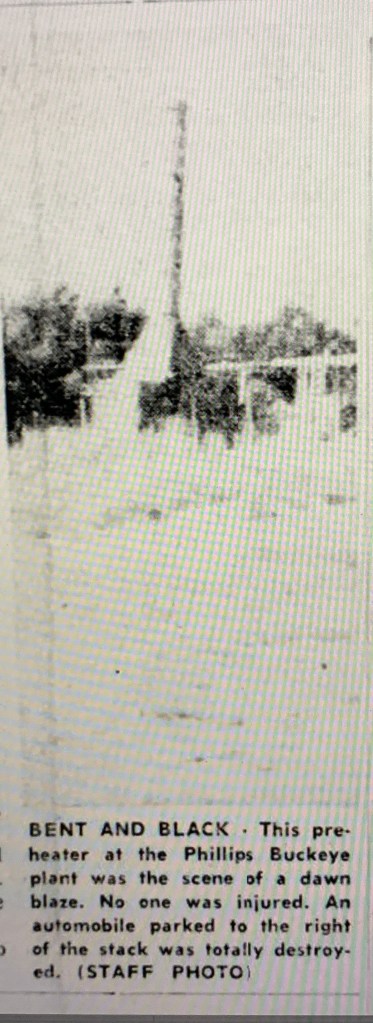
    The Lovington Daily Leader carried this headline in its August 27, 1959 issue, “Intense Blaze Burns Heater at Phillips Buckeye Refinery.” We remember being awakened early that morning and told we needed to evacuate the area because the gasoline plant across the road was on fire.

    Some event had ignited a fire at the Lee Plant that morning. We were living in the house nearest the road and there were six more houses to the north of us. Closer to the plant than our houses were several dozen houses of the plant employees who we assumed were getting the same emergency request.

    Buckeye is eighteen miles from Lovington and further than that from Hobbs, but both fire departments were called out to fight the blaze. Units from Lovington arrived a few minutes followed by elements from Hobbs just a few minutes later. Our parents quickly loaded up some clothing into our cars and drove down a half mile to the Buckeye intersection where the gas station, store and little post office were located. We all watched the fire and smoke until the blaze was safely put out and we were allowed to return to our houses.

    We later learned that a piece of equipment called a pre-heater had caught fire at about 5:30 a.m. and went out about sunrise. The newspaper account said the blaze lit up the sky and could be seen over the horizon all the way to Lovington. The fire departments were able to contain the blaze within about thirty minutes after they arrived. The firefighters braved the extreme heat and danger to spray foam on the flames and extinguish the blaze. Phillips praised the firefighters for their quick work and said if it had not been for their efforts, it could have led to a much more serious situation.

    There were no known injuries and damage to the plant was confined to the pre-heater and surrounding equipment. There may have been more vehicles that were damaged, but we remember at least one passenger car having been melted down to a shell and hauled off on a flat bed truck. The photo below is from the August 27, 1959 issue of the Lovington Daily Leader.
  • Fern Sawyer

    “She died in the saddle, surrounded by friends.” said Peter Holt, as quoted in the October 21, 1993 issue of the Lincoln County News, Carrizozo, New Mexico. Most recently Ms. Sawyer had resided in Nogal, Lincoln County, New Mexico.

    Fern Sawyer was born at Buchanan, De Baca County, New Mexico, on May 17, 1917 to Uyless Devoe Sawyer and Dessie Lewis Sawyer and was raised on the family ranch at Crossroads, near Tatum, New Mexico. She passed away at the age of 76 on October 16, 1993 near Blanco, Blanco County, Texas while visiting friends. Earlier in the day, Ms. Sawyer had been riding with friends and herding heifer cattle when she told another rider she was feeling tired, and shortly thereafter, she passed away.

    A funeral service was held the following Tuesday at St. Andrew’s Episcopal Church in Roswell, officiated by Rev. Robert L. Williams. The service was attended by her many friends, including Governor and Mrs. Bruce King. According to a newspaper report in the Roswell Daily Record, the eulogy was given by Mr. Holt and the service included the singing of “Amazing Grace.” After the service, she was interred at Tatum Cemetery, Tatum, Lea County, New Mexico where her mother and father are also buried.

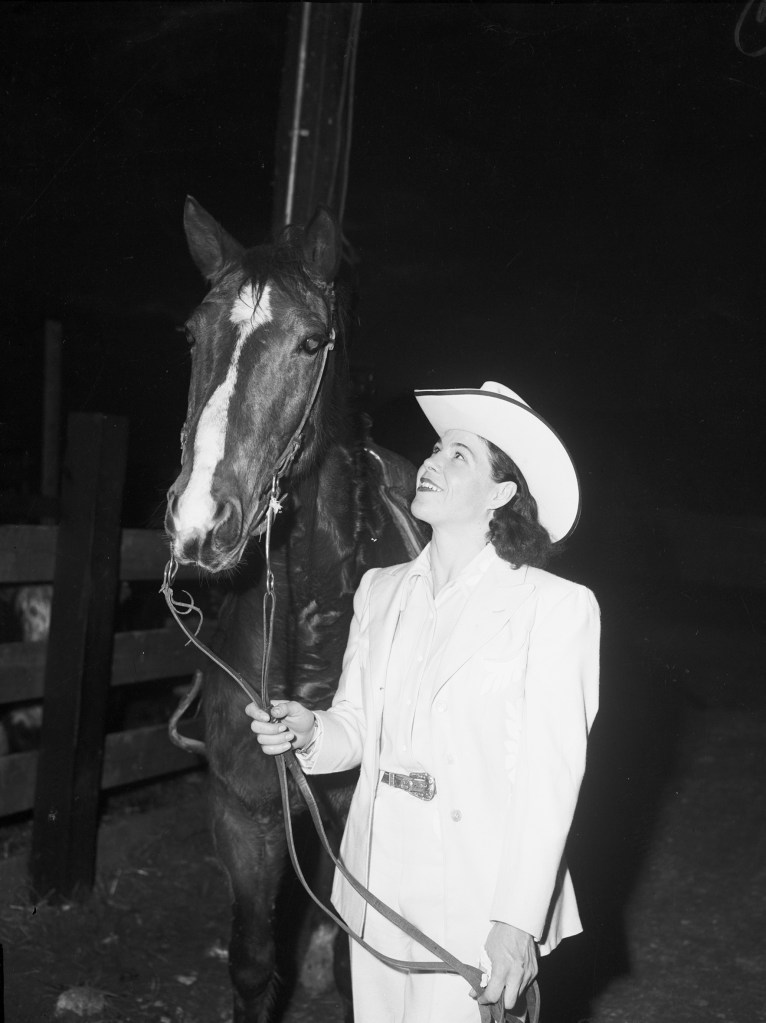
    At an early age, Fern had exhibited her talents in the area of horsemanship and became well known for her abilities. She was encouraged by her parents to work on the ranch and inspired by them to perform as well as any of the men. She began a rodeo career by competing in events previously confined to male contestants. Her many accomplishments include winning the cutting horse championship at the 1945 Southwestern Exhibition and Fat Stock Show in Fort Worth, Texas. She won the Cutting Horse competition aboard her horse “Belen.” In the competition, she eliminated Grady Blue on “Tom Cat” and R. W. McClure on “Smokey” who were second and third place finishers. She is shown below looking up at Belen.

    Image credit: University of Texas at Arlington, Digital Collection, Special Collections Identifier: AR406-6-27

    Fern’s honors include being inducted into the National Cowgirl Hall of Fame, the National Cowboy Hall of Fame and the National Cutting Horse Hall of Fame. She won the All-Around World Champion Cowgirl title in 1938 and the Cutting Horse World Champion title in 1947.

  • Knowles

    Benjamin Lewis “Ben” Knowles came to the area about 1903 or 1904 from Mills County, Texas and claimed land. In and around it grew up a settlement that is believed to be the second oldest (after Monument) in the area that later became Lea County in 1917. Knowles was in his late 60s when he came to New Mexico and his wife Mary Hulda was a few years younger. Mrs. Knowles died in 1907 and Mrs. Knowles survived her until 1925 when he died on a trip to visit relatives in central Texas. The town was not more than about five miles west of the Texas border. According to “Place Names of New Mexico” it went by the name Oasis, at least for a while. At its peak is believed to have had as many as 500 residents. It had at one time several stores, a bank, hotel, newspaper office, wagon yard and other businesses.

    Knowles had its own post office from 1903 to 1944. Once oil was discovered in Hobbs in the late 1920s the residents began to drift away in favor of Hobbs and New Hobbs to the south and Lovington to the north. There was some mention of a fire in the town at some point. Whatever the reasons, none of the original buildings are thought to still survive.

  • Humble City

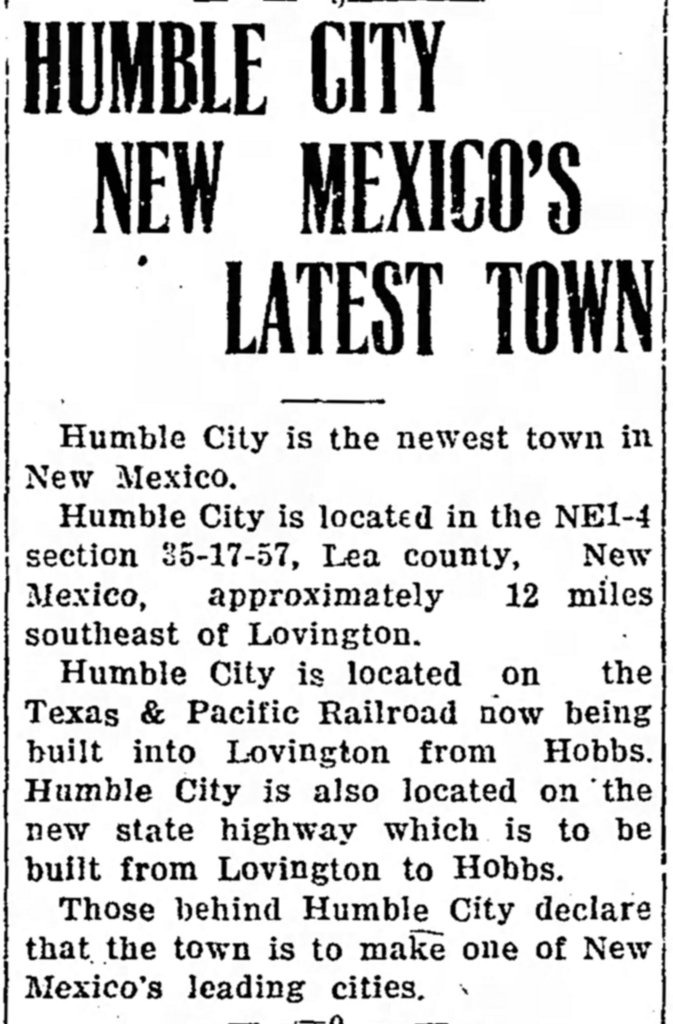
    The community of Humble City is located about five miles northwest of the edge of Hobbs on Highway 18 at the intersection with West Alabama Street. It took its name from the Humble Oil and Refining Company. Humble Oil was founded in 1911 in Harris County, Texas and also gave its name to the town of Humble, Texas, northeast of Houston.

    Standard Oil of New Jersey acquired a one half interest in Humble in 1919 and the brand completely disappeared in 1959 after Standard Oil bought the other half in a merger that gave rise to Exxon (now Exxon Mobil).

    Humble oil company did a good bit of exploration in the early days of the Hobbs oilfield. Humble City was founded about 1930 and had a post office for about 46 years.

    Roswell Daily Record, May 31, 1930

    Humble City did not blossom as much as the article had predicted, but it is still on the map.

  • Caprock

    The community of Caprock is located just inside the northwestern border of the county. It takes its name for the geological formation that is found in southeastern New Mexico where to the east, the surface is flat while to the west it drops off rapidly. West of Caprock, the surface descends to the Pecos river. Caprock is located just under 25 miles northwest of Tatum and 47 miles roughly due east of Roswell on Highway 380.

    Charles E. “Ed” Crossland is credited for having founded the settlement in 1913 and serving as its first postmaster. (1) The 1920 census showed Crossland, his wife Lillian and son Ed, Jr. living there and his profession was listed as farmer. In 1930 Crossland and his family still resided there and his profession was listed as being a teamster for the state highway department while Ed. Jr. listed his as being a wheat farmer. Charles passed away in 1948 in Roswell at the age of 67 and is buried at South Park Cemetery. His wife Lillian survived him over thirty years, remarried and died in California. Ed Crossland Jr. remained in the Roswell area where he lived with his family.


    “The cap, or hard layer, underlying the Llano Estacado is a major geological feature known as the Caprock. It is not a rock layer in the usual sense of the term but is more technically a “hard-pan” layer that developed a few feet below the ground as highly mineral subsoil particles cemented themselves together to form a rock-like layer that resists erosion. Although the name Caprock technically applies only to the formation itself, the expression is often loosely used to mean the whole Llano Estacado. The Caprock escarpment was formed by erosion about one million to two million years ago.” (Excerpt from https://www.tshaonline.org/handbook/entries/caprock)


    (1) Julyan, Robert, “The Place Names of New Mexico,” University of New Mexico Press, 1998.

  • A. J. Crawford

    Abel Justus Crawford was a pioneer to the area, having lived in or near Lea County for almost 70 years when he passed away in 1969. Mr. Crawford was born November 10, 1867 in Mount Giliad, Kentucky.

    He recalled his first job, that of picking cherries for 15 cents per day. As a youth, he was an industrious and diligent worker who worked in a variety of jobs, from sanding piano legs to piloting a ferryboat on the Ohio River. When he was 17, he left home to come to the southwest. He took a job herding sheep for a rancher named Sam Brookshire who had a ranch near Abilene, Texas. He later purchased 125 sheep from Mr. Brookshire to begin his own sheep ranch operation in Lea County.

    At around the age of 30, he returned to Kentucky to marry Minnie Campbell, his childhood sweetheart. When the couple returned to the southwest, they settled in Carlsbad where they made their home for the rest of their lives.

    Among his various interests, Crawford owned the Buckeye Sheep Ranch in Lea County. In addition to his ranching activities, he acquired an interest in six banks: El Paso National Bank; Carlsbad National Bank; City Bank and Trust of Kansas City; the Valley National Bank of Phoenix, and the Bank of America in California. He also built or acquired a number of hotels in West Texas and New Mexico including a number that bore the Crawford name in Carlsbad, New Mexico, Midland, Big Spring and Colorado City, Texas.

    When Mr. Crawford died in 1969, he was 101 years old and had lived in southeastern New Mexico for almost seven decades. His wife Minnie had predeceased him in 1961.

  • Buckeye Sheep Ranch

    by David L. Minton, Lea County Historian. Used with permission.

    Today a look at the origin of the name of the area in Our Lea County known as Buckeye.  Today it is known primarily as the oil patch southwest of Lovington, but 130 years ago it and a larger area was known as the Buckeye Sheep Company owned by Abel Justus “A. J.” Crawford.  Have you ever wondered why it was called Buckeye?  Once again, an interesting story emerges from an unlikely source.

    A. J. Crawford was born in Kentucky November 10, 1867.  When he got big enough A.J. went to work in the tobacco fields for $1.25 a week.  He moved with his family to Ripley, Ohio and Ripley was where he attended school and met his future wife, Minnie May Campbell.  A. J. considered Ripley his home town.

    In 1884 A. J. Crawford finds his way to Abilene, Texas and goes to work on a ranch and also begins working at building his own flock of sheep.  In 1890 A. J. Crawford has a flock of 125 head built up and he moves his flock to the ranch he bought in the Monument area.  This trail drive was made on foot.  He named his ranch the Buckeye Sheep Company.

    On July 18, 1898 A. J. and Minnie wed at Ripley, Ohio and they moved to Carlsbad in September of that year. 

    On the 19th day of November 1906 there was a terrible blizzard and 5 of Crawford’s Mexican sheep herders froze to death.  The loss of the men affected Crawford deeply, many years later in a newspaper interview he became teary eyed when talking about the loss.  While burying the dead Crawford decided to sell the ranch and get out of the sheep business for good.  The Buckeye Sheep Co. also lost 4,000 head of its 15,000 sheep to the blizzard. 

    A. J. Crawford sold the Buckeye Sheep Co. to his foreman Seth Alston in 1907.

    Abel Justus “A. J.” Crawford, the man who started out a boy working in Kentucky tobacco fields at $1.25 a week, then a New Mexico sheep man who went on to get into banking, hotels, grocery stores and other ventures died at his home in Carlsbad February 11, 1969 at 101, a multi-millionaire.  Crawford was generous and shared his wealth with individuals as well as the city of Carlsbad while alive and after death.  A. J. and Minnie Crawford are now together in a private mausoleum at Ripley, Ohio.

    So, have you figured out why Buckeye/The Buckeye Sheep Co. are called Buckeye?  The clues are in the story.    Happy Trails!

  • Buckeye

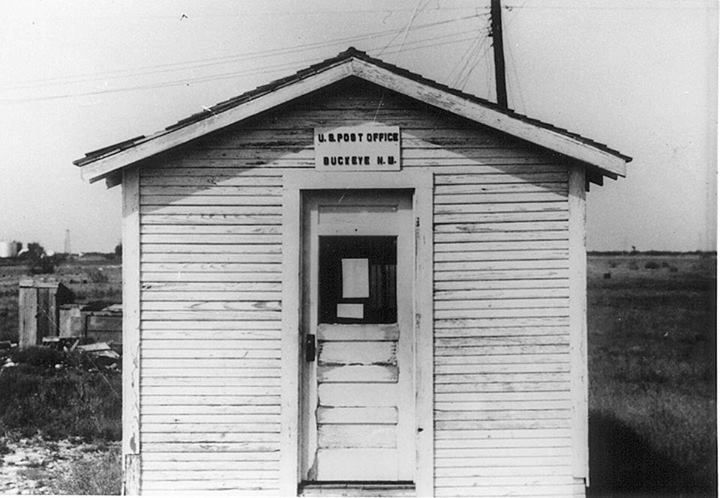
    According to most sources, Buckeye grew up as the oilfield business increased. It was named for the Buckeye Sheep Ranch which was located in the area. At various times, it included a grocery store, as many as two gas stations, a cafe, welding shops, a hardware store and post office. (1)

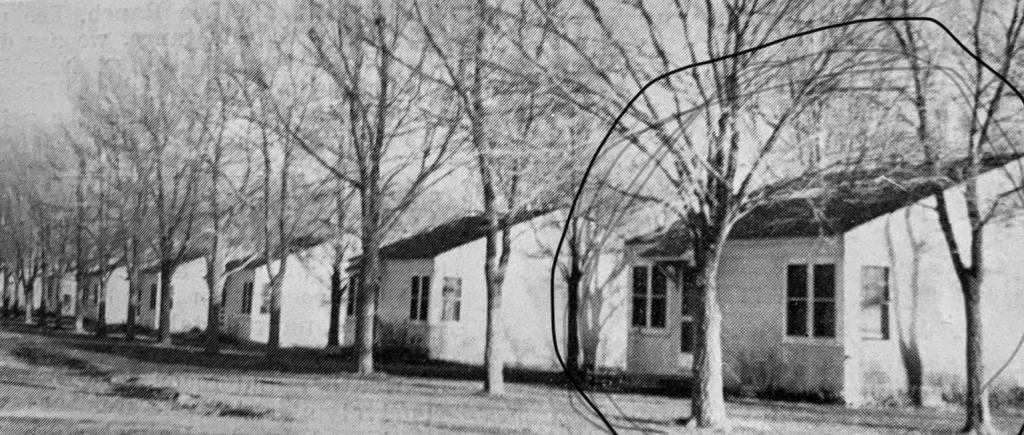
    In addition to the ranches, primarily the Lee, Eidson and Scharbauer ranches, there were a number of production camps including Phillips and Texaco, a large gasoline plant built by Phillips along with housing. The area also included a school at one time, and a Baptist church.

    Below are some images of Buckeye as it probably looked in the 1950s and 1960s.

    Undated Photo of Buckeye
    Undated photo of Buckeye
    Post office built by Jake Walters
    Phillips gasoline plant housing

    (1) Lynn C. Mauldin, Lea County New Mexico, A Pictorial History, The Donning Company, 1997.

  • The Cowden Family

    Four brothers, W. H. “Bill” Cowden, George Cowden, John M. Cowden and Buck Cowden came to the area in the mid 1880s and settled with their wives and children near what became the town of Jal. The men drove their combined cattle while the women drove wagons. Water sources were found by digging wells. Their ranch was called the Mule Shoe Ranch and had its headquarters at what became the Jal town site.

    Their father was William Hamby Cowden (1826-1903). According to federal census records, in 1850, he was twenty-five years old, living in Alabama. By 1860, he was thirty-five years old, living in Palo Pinto, Texas. That same year, he married Caroline Martha Liddon (1832-1879). During the Civil War, he served in Company A of the Frontier Battalion under Captain William C. Clayton. Though it was considered part of the Confederate Army, it essentially served as a local militia, protecting settlers primarily from the native tribes. To the best of our knowledge, it never left the state of Texas. Cowden enlisted in September 1865 for an initial period of six months and during the time of his service, he rose to the rank of sergeant.

    William Hamby Cowden and Caroline Martha Liddon Cowden had a number of children, including Bill, George, John and Buck Cowden. Caroline, known as Carrie, passed away in Palo Pinto in 1879 at the age of 47. The following year, William Hamby Cowden married her sister, Catherine Cobb “Kittie” Liddon Moore who had recently become a widow after the death of her first husband, Robert Young Moore, back in Tennessee in 1876. Kittie and Robert had been married a number of years and had several children including Hattie Lucille Moore, who would become the wife of Ambrose Quincy Cooper of Jal, and Lillie Parham Moore, who would become the wife of John Motherwell Cowden. Though it is not as complicated as it might sound, when Kittie Liddon Moore married William Hamby Cowden, Lillie’s mother became her mother in law. William Hamby Cowden and Kittie do not seem to have lived in New Mexico, but eventually resided in Midland, where they were living when they both passed away.

    Bill, George, John and Buck all were married and lived in the Jal area at least for a while before moving away, but their property was conveyed to Walter C. Cochran and others and eventually became the core of the town of Jal. Hattie Lucille Moore Cooper mentioned in a newspaper article that Walter C. Cochran became her brother in law. Mr. Cochran married yet another sister of Lillie and Hattie Lucille named Nannie Dodson Moore.

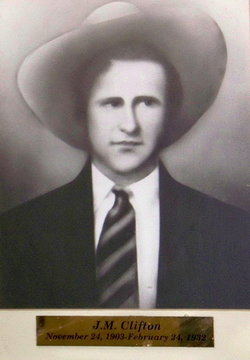
  • Deputy Sheriff J. M. Clifton (1903-1932)

    The Hobbs Flare (Hobbs, NM) of June 19, 1959 carried a column called “News of Yesteryears.” That day, the column quoted an out of print newspaper called the Lovington Tribune from February 26, 1932 and read as follows:

    “Deputy sheriff and two men were killed in a gunfight at Crossroads. The late Bob Beverly was sheriff. J. M. Clifton, stationed at Tatum was searching for robbers of Dean Hardware in Lovington and saw two men in a car at Crossroads. He went to question them, and one drew a gun, shot him in the left arm and stomach. After Clifton was shot, he was able to draw his own gun and kill both men. He then drove to Crossroads where he was taken by plane to Lubbock, Texas, dying enroute. The two men were John O’Dell and Walter Carlock. Odell was from Hobbs and Carlock from Oklahoma. Mr and Mrs. Bob Dow of Lovington were returning home from Clovis and came up on the shooting.

    Afterwards there was recovered from one of the men a watch belonging to M. P. Elsey of Corpus Christi. The news story went on to say the car was stolen.”

    Deputy Clifton had died on February 24. An aircraft had been summoned from Roswell to take him to Lubbock for emergency medical treatment, but the pilot said that the deputy had passed away about forty minutes into the flight near the Texas-New Mexico line. The incident had occurred at the community of Crossroads, about fifteen miles north of Tatum. Deputy Clifton had been badly wounded but an Albuquerque Journal article from the following day had said that he had been able to tell authorities about the incident.

    In the 1932 article, the deceased suspects were listed as Walter Carlocke of Healdon, Oklahoma and John O’Dell of Hobbs who were believed to have robbed the Lea County Hardware store. Quoting Lea County Sheriff Bob Beverly, the article continued to say that Carlocke was wanted for robbing a bank at Waurika, Oklahoma and O’Dell was believed to have been an escapee from an Oklahoma penitentiary.

    Further details included the account of an unnamed rancher who heard the shooting and ran to the location, finding Clifton barely conscious and the two suspects deceased in their car. The rancher said that Clifton had given him a brief account before he was taken to Tatum, placed in an airplane to be rushed to medical treatment in Lubbock. The suspects were apparently not involved in the hardware store robbery, as no items stolen (firearms, ammunition, knives and other articles valued at between $500 and $700) were found in the vehicle. The search continued for the robbers.

    Image credit: findagrave.com

    Officer Clifton was about 28 years old when he died. He was survived by his wife and children and was buried in Tatum Cemetery. Some of the account differs from our telling of the story, which is mostly taken from Lea County newspaper articles from 1932, but this is Deputy Clifton’s page on Officer Down Memorial Page.