Old Lea County, N.M.

Tag: ranching

  • Eugene Price

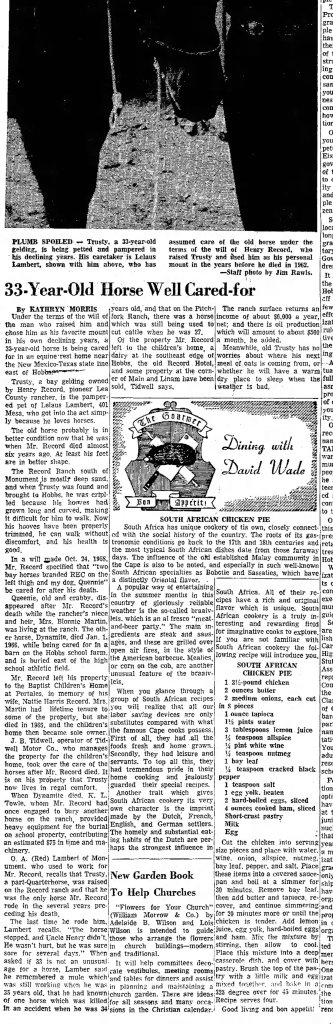
    Gene Price (full name Eugene Hubbert Price) was born on November 19, 1868, in Grayson County, Texas to Theodore Martin Price (1836 – 1927) and Martha Ann Virginia Drisella Hubbert Price (1842 – 1905). Theodore Martin Price was a farmer/rancher/merchant and also a circuit riding Methodist preacher. From his early years, Gene was keenly interested in ranching, beginning in the era of the open range.

    As a young man, he worked on several ranches in the southwest. He named the Quinn Brothers, the Hat Ranch, Pemberton Brothers and the E Ranch in his comments. In 1889, he married the former Lily Kirby Harris Cook in Eolian, Texas. Around 1901, the family homesteaded in New Mexico, at the corner where Yoakum, Gaines, Eddy, and Chaves counties met – roughly 15 miles east of the future site of Lovington.

    Mr. Price built up one of the area’s earliest high-quality registered Hereford herds. For a while, he leased the Highlonesome Ranch, and the family resided in its old headquarters house. As their children reached school age, the family bought a home in Lovington while still working the ranch. Gene served on the Lovington School Board and participated actively in community matters; he generously donated land for a second, larger school building, which served as the town’s only school for many years. He was a long time member of the Methodist Church in Lovington.

    In his later years, he authored “Open Range Ranching on the South Plains in the 1890’s,” a memoir of his early experiences that has become a valuable resource for those interested in the region’s history. Long out of print, the original publication included a reproduction of Gene’s informative hand drawn map of Lea County and the surrounding area.

    Mr. Price passed away on September 5, 1952. Mrs. Price died on October 16. 1962. Both are buried in Lovington Cemetery. In 1988, he was posthumously honored with a Bronze Cowboy award for his numerous contributions to the early traditions and settlement of Lea County.

    Image credit – Hobbs Daily News-Sun, August 13, 1967
  • “Uncle Bill” Oden Talks About the Old Days

    Transcribed from the Pecos Enterprise (Pecos, Texas) – August 19, 1938


    B. A. “Uncle Bill” Oden, Authentic Old-Timer, Gives Historical Sketch of Monument Landmark

    B. A. “Uncle Bill” Oden, Who’s been in the trans-Pecos country since time began, was asked recently by the Hobbs Chamber of Commerce, to give a historical sketch of the famed Rock House in Monument Springs, New Mexico.

    The rock house, subject of a recent story in the Cattleman’s magazine, is one of New Mexico’s oldest land-marks and its origin has been a controversial subject for years.

    Uncle Bill was in the New Mexico country in 1884, and is one of the oldest living early settlers of that section. The story he wrote for the Hobbs Chamber of Commerce and also for the Cattleman’s magazine, is reprinted below:


    According to promise, I am going to give you a true history of the old rock house at Monument Springs. I, a boy of 18, went to what is now the San Simon ranch in 1884. I, being young and everything being new and of interest to a lad of that age in a country as wild as that was, remember things more vividly than things that happened ten years ago.

    Bound for Lincoln!

    I hired to Mr. Divers at San Angelo some time about the middle of June of that year when he was passing though there with about 1250 head of cattle bound for Lincoln County, New Mexico. I worked for him nine years at what is now the San Simon ranch and I, as a cowboy, new all the first settlers of the country. These I will give you in the course of this article.

    From San Angelo we traveled up the North Concho to somewhere above where Sterling City now is. We turned north and crossed the T and P Railroad Company at Iatan Tank about 15 or 20 miles east of Big Spring. There we turned northwest toward the head waters of the Colorado River. There we camped around two months waiting for it to rain before starting across the Plains. Around the middle of August it began to shower and we started and as luck smiled on us, it rained the second night out and we turned the cattle loose and they all got well watered. The next water we got was in small lakes about where there the town of Hobbs now is. We stayed there for a few days and went on to Monument Spring. There we found Jim Harvey and Dick Wilkerson, two buffalo hunters, who had preempted the spring. In other words, they had what was known as squatters right to spring and so much land. They, Harvey and Wilkerson, had hauled the Monument, of rock the soldiers had built on a hill about three-quarters of a mile west, and built the rock house and a small stock correll [corral] near the spring. The little rock house had port holes in the corners for protection from the Indians and when we passed there about the 27th day of August, they slept in the gate of the correll to protect their horses from the Indians. The place where the San Simon ranch is was known by the soldiers and buffalo hunters was Dug Spring. It was only six feet to water but it had to be pumped with horse power. In the spring of 1885 R. F. Kennedy bought Monument Spring from Harvey and Wilkerson, paying them $5,000 for same, and they moved about 1000 head of cattle there from Gonzales County in Texas.

    Ranchers Begin Locating

    In the fall of 1885 E. H. Estes located eight or 10 miles west of there at a well he bought from Louis and Guyat Faulkner and started what was known as the 7Z7 ranch, which is operated for several years. In 1886 there were several ranches started in what is Lea County, New Mexico, and Gaines County, Texas. J. M. Daughtery started what was afterward known as the 84 ranch about 15 or 20 miles south of Monument Spring and also Frank and Ed Crowley located along the line of New Mexico and Texas east of the town of Hobbs.

    Uncle Henry McClentock started the next ranch about 15 miles east of the New Mexico line in Gaines county. South of the 84 ranch was McKenzie Brothers, J. M. and Gene. Farther down the draw toward the southeast corner of New Mexico was Cowden Brothers, later known as the Jal Ranch.

    The W. C. Cochran ranch was where the present town of Jal is, and east of the 84 ranch Bill and Dave Brunson settled. North of Hobbs was the Atwood or Mallet ranch, about five miles south of the present town of Lovington George Causey settled. He was a buffalo hunter and didn’t own any cattle for several years. The above named ranches were started from 1886 to 1888. In 1884 the ranch farthest west was the TJF ranch on the head waters of the Colorado river. With the exception of another old man by the name of Anderson, who had a small bunch of cattle at a weak spring at Cedar Lake in Gaines County, there were no more ranches or cattle between there and the Pecos river. The cattle we had were the first to water at Monument Spring. Harvey and Wilkerson were the only permanent settlers.

    Few Buffalo Hunters Left

    There were a few other old buffalo hunters in the country but they camped around wherever they could find water and killed antelope in the summer, and buffalo and antelope in the winter. They dried the meat, (which they called jerkey) in winter. Those who were there any length of time after I went there were Louis and Guyat Falkner, Rankin More, Judge and Jon Kink Kuykendall and an old man by the name of McConvill, who dug wells for ranchmen for several years. Rankin Moore never owned any interest in the spring, though he might have helped haul the rock. The house was built in the winter of 1883 and 1884, but it wasn’t quite finished when we passed there. The well was dug about 1888 and might have been dug by Jim Andrews as he was working for Mr. Kenney at the time. Rankin Moore settled in Andrews County, Texas, near the line of New Mexico. He dug wells for McKenzie Brothers for twenty cows and calves and ranched them there a few years and sold out to Uncle Billy Daughtery and left the country.

    During the nine years I worked for Mr. Divers, I attended roundups extending from the site of Lubbock to Drockett County and from Black River, New Mexico, to the Live Oak Creek, in Crockett County.

    H. E. Cummins, who lives in Midland now, was hired by Jim Harvey in Colorado in the fall of 1884 to skin buffalo and antelope and cook. He cooked for them all winter and caped part of the winter at the ranch where I worked and owned by Frank Divers. He has the honor of being the last of the buffalo skinners, as the winter of 1884 and 1885 was the last of the buffalo in commercial quantities.

  • Allen Clinton Heard

    A. C. “Daddy” Heard was born in February 23, 1858 in DeWitt County, Texas. His parents were Humphrey Whorley Heard and Louisa Ellenor Foster Heard, and he was one of eight children. When he was an older teenager, he began working cattle for one of his brothers in Texas. He next rode on the cattle trails as a cowboy for about three years before settling for a time in Tom Green County, Texas where he worked for his brother Jasper and Tom Word. He later worked for another rancher near the Pecos and began to build a herd of his own.

    Heard came to Southeastern New Mexico in 1894 around which time he became a co-owner with others in a cattle ranch they purchased out of the old Mallet Ranch and renamed the High Lonesome Ranch. He and others had driven cattle from Texas to what was then Eddy County. At the time, the gramma grass was said to be lush and high. Heard improved his stock by bringing in the first registered Hereford bulls to the area in 1910. His brother and former partner Jasper Newton Heard died in Texas the following year in a ranching accident in which his horse fell on him. The supposition was that both horse and rider died after getting tangled in a rope.

    Heard continued to operate the High Lonesome until around 1927 when it was sold. Heard had earlier moved his family to Carlsbad around 1900. Over the years he served as mayor of Carlsbad, county commissioner of both Eddy and Lea counties at various times, including being one of the first three county commissioners of Lea County when it was formed around 1917.

    Heard was one of the founders of the Presbyterian Church in Lovington. It is also said that he was primarily responsible for seeing to it that a paved road was built from Carlsbad to Lea County. He served as a director of the First National Bank of Carlsbad and was also a State Representative from 1920 to 1924. He was a life member of the New Mexico Cattle Growers’ Association. He and his wife, the former Talovia Elmira Newcomer, had two daughters. Heard was often mentioned in local newspapers for events happening at the ranch and for other activities involving his family. He passed away at the age of 86 on July 6, 1944 in Bernalillo County and is buried there in Albuquerque’s Fairview Memorial Park.


  • John Scharbauer

    John Scharbauer (1854 – 1941) was a long time ranch owner in the area. The family name is a familiar one to people from Lea County. In commemoration of his birthday, a number of his friends got together and honored him, as noted below.


    Loving Cup Inscribed in Gold Given Scharbauer by Friends

    “Going Strong Since 1851 – 83 Years of Service”

    This inscription in raised, gold letters appears on an attractive loving cup which was presented Christmas Day to John Scharbauer by Walter B. Scott as a birthday gift from 15 of his oldtime friends. Scharbauer, cattleman, well known to stock men of West Texas, will be 83 years old Friday. Also on the cup which bears Scharbauer’s name is the wording “A Pioneer, a Patriot, a Splendid Citizen and Loyal Friend.”

    Besides Scott, those who joined in the presentation of the gift were J. Lee Johnson Sr. W. E. Connell, Hugh Rigers, Guy L. Waggoner, T. Z. Hamm, W. O. Shultz, E. B. Spiller, M. C. Ulmer, T. B. Yarbrough, W. C. Stonestreet and Amon G. Carter, all of Fort Worth; Millard Eidson and Dick Lee, Lovington, N. M. and Clarence Scharbauer, Midland.

    Scharbauer, who has an office on the first floor of the Worth Building, still loves the range. He frequently takes horseback rides and can “outride” many men much younger.

    In 1880 he came to West Texas and seven years later moved to Midland. Although Fort Worth is his home, he spends several weeks each year at Midland where he has a ranch and cattle interests and where many of his oldtime friends are located. Born in Indian Fields, N. Y., by the time he had reached 28 he accumulated what he thought was a small fortune, $2,000, and went to Abilene in a covered wagon. There he entered the sheep business.

    His first enterprise in Texas was successful and at one time he was the owner of more than 20,000 sheep.

    In 1890 Connell Brothers and Scharbauer organized a private bank at Midland which was the beginning of the present First National Bank of that city. Several years ago there was a false report circulated in Midland and a “run” on the bank started. Scharbauer and Marvin Ulmer, cashier, chartered an airplane in Fort Worth and took $100,000 in currency to the Midland bank and stacked it on the counter. They invited customers to “come and get it,” but instead, they walked out, leaving their deposits.

    Almost 43 years ago Scharbauer began raising cattle. He decided Herefords were the best breeds for his section and he is a pioneer in the development of that breed around Midland County. His registered herds have gained worldwide attention.

    Clarence Scharbauer, his partner and owner of the hotel that bears his name at Midland, now manages their ranching interests. He is a nephew of John Scharbauer. They have ranch interests in New Mexico, and Midland, Martin, Gaines and Andrews Counties.

    Scharbauer is a director in the First National Banks of Midland and Fort Worth.

    [Source: Fort Worth Star-Telegram (Fort Worth, Texas), 26 Dec 1934.]

  • High Lonesome Ranch

    The High Lonesome Ranch was one of five early ranches in Lea County. Below is a brief recap of how it got its start.

    Two men named Dwight P. Atwood and Roswell A. Neal, along with other investors, had formed the Mallett Cattle Company in the state of Connecticut during 1883 with headquarters near Colorado City, Texas. At one point, their holdings had extended from West Texas on further north and west to into New Mexico, in Lea County, with total holdings of around ninety thousand acres. During the 1890s, due to various factors, the company’s fortunes had declined to the point where it was forced to take bankruptcy in 1893.

    Bankruptcy receivers sold off assets to different individuals and companies. D. P. Earnest, a manager of one of the ranches, acquired some of the property in Howard and Mitchell counties of Texas. Two individuals out of San Antonio named Halff acquired more of the Texas property and incorporated it into their Quien Sabe Ranch. Another buyer in West Texas was Theodore Schuster who operated a livestock business there for a short time, but ultimately sold out to David DeVitt and John Scharbauer around 1895 who set up their own entity and called it the Mallet Ranch. Three people out of Midland, Texas were headed up by Allen C. Heard acquired the Lea County property and named it the High Lonesome Ranch.

    It apparently took its name from the surrounding terrain, which included the highest point of the Llano Estacado between Midland and Roswell. In addition to A. C. Heard (1858 – 1944), other owners are believed to have been John Thomas White (1868 – 1926) and Jesse Heard (1845 – 1911).

    Map attributed to J. W. Runyan, from Hobbs and Lea County by Max A. Clampitt

    We have also occasionally seen the ranch referred to in newspaper articles as “Highlonesome,” without a dash or a space between the two words. We also see some references to a ghost town with the one word name but it is described as a one pump gas station, and exact location of it is currently unknown.

    For more information about the entire Mallet Ranch that High Lonesome came from, see Mallet Ranch.

  • Hat Ranch

    The Hat Ranch dates back to around the mid 1890s when associates Andrew Briggs “Sug” Robertson (1855-1921) and Winfield Scott (1849-1911) began to operate in partnership. Scott is thought to have been the majority owner. Its brand has been described as a half circle over a bar. We have also seen it sketched out looking more like a rectangle over a bar.

    The ranching operation began in Mitchell County in West Texas and expanded into the New Mexico Territory in what was then Eddy County but became Lea County in 1917. The Lea County portion has longer history, of course, dating back far beyond the first Anglo settlers, but Scott is understood to have acquired it from an A. B. “Bill” Anderson and then sold a portion to Robertson.

    In Lea County, it is mostly associated with the Monument area. A number of long time Lea County residents counted working on the Hat Ranch in their resumes.

    At its peak, the Scott-Robertson holdings amounted to 1,000,000 acres and was once a large ranching business, before it began to be sold off to other settlers and homesteaders. The ranch continued to operate in Texas and New Mexico for many years. The ranch appears to have ceased operations as a Lea County entity under the ownership of Robertson and Scott around 1904 to 1906. The Fort Worth Telegram reported a large land sale in its April 3, 1907 issue. In it the real estate firm of Trammel & McCauley of Sweetwater, Texas had brokered the sale of the Texas properties formerly owned by Winfield Scott and A. B. Robertson. It included land in Lynn, Lubbock, Crosby Counties in Texas. Cowboy humorist Will Rogers also is known to have worked on the ranch, however briefly, and most likely around Midland, Texas.

    Scott was well known as an investor in Fort Worth, Texas. When he died in 1911, a large mausoleum was constructed for his family in the historic old Oakwood Cemetery in Fort Worth. Robertson died unexpectedly in Abilene in 1921 and is buried in his home town of Colorado City, Texas.

    Map attributed to J. W. Runyan, from Hobbs and Lea County by Max A. Clampitt
  • The Madera Family and the Pitchfork Ranch

    In the October 13, 1966 issue of the Jal Record, it was reported that the Lea Soil and Water Conservation District Board of Supervisors named Rubert “Bert” Madera as the Outstanding Lea County Conservation Rancher of the year, stating that he was the operator of the Pitchfork Ranch located about twenty miles west of Jal.

    Rubert Madera: Image credt: Jal Record – October 5, 1966

    A grandson of Rufus and Pearl, also named Bert Madera, gave another interview many years later and told a bit more about the history of the ranch. The family had come to Fort Davis in West Texas around 1900. The earliest of the Madera family to live in Lea County were Rufus Frederick and Pearl Augusta Richmond Madera. Rufus had been born in 1881 in Arkansas and raised in Hill County, Texas where his family had operated a farm. Rufus and Pearl had later operated the Chico Ranch in Culbertson County, Texas south of Guadalupe Peak in Texas until they retired in the 1930s, after which they moved to Carlsbad. Rufus passed in 1956 and Pearl followed him in death in 1969.

    Two of their sons, twins Rubert and Ruford and another brother named Malcolm originally leased the Pitchfork Ranch, according to the interview, from a previous owner named Baird. Rubert and his wife Loys originally lived in a dugout on the ranch and raised their family there on the property. They told of dealing with the sometimes harsh weather conditions and (a common practice in the southwest) burning cow chips for warmth. They purchased the ranch in 1946 and later added to it as opportunities presented themselves.

    Bert Madera, the subject of the Jal Record article, said he had started out in the livestock business by purchasing heifer calves at $4 each and later purchased 40 registered Hereford cows in 1945. He practiced conservation by cross fencing, building surface tanks for water, rotating his livestock, digging storage and drinking troughs, broadcast seeding of grasses and doing his best to eliminate mesquite.


    Sources include local newspaper articles and the Summer, 2008 issue of Lea County Traditions, a periodical.

  • A Cattleman’s Will

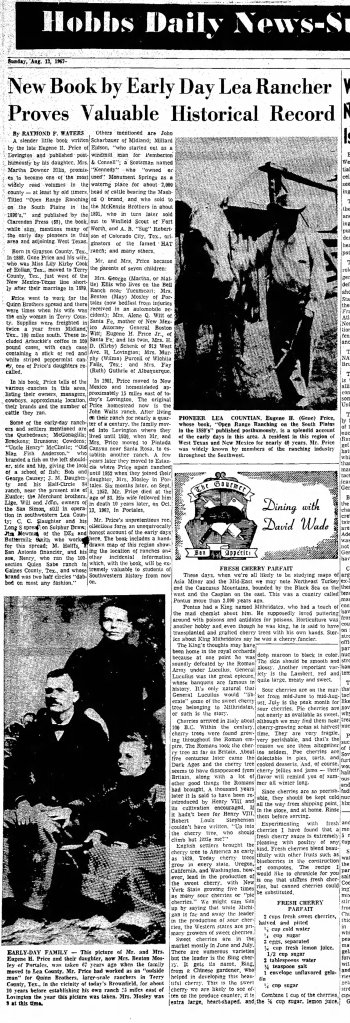
    When Henry S. Record died, he left most of his estate to the New Mexico Baptist Orphanage in Portales. The bequest was in honor and memory of his late wife, Nettie Harris Record who predeceased him. Mr. Record had been a founder of the orphanage and was actively involved in it as he got older.

    At the time of his death, Mr. Record was a member of the New Mexico Cattle Growers Association, a trustee of Hardin-Simmons University, a trustee of the Baptist Orphanage and president of the Open Range Cowboys Association.

    He also provided for his two bay horses and his dog, Queenie. Queenie disappeared in the years after his death, but the two horses lived on for a time. Dynamite died on New Year’s Day, 1966, but the bay gelding named Trusty was still living at the time of the article below from the Hobbs Daily News-Sun on February 4, 1968 at the remarkable age of 33.

    Hobbs Daily News-Sun – 4 Feb 1968
  • Pearl

    The settlement called Pearl was named for Pearl Stark Roberts, wife of Nathan Cornelius Roberts who settled about five miles west of Monument in what was then Eddy County. Pearl Roberts was named postmistress in 1908 and the post office was housed in a room of their small pioneer home on the Roberts Ranch. The post office operated from 1908 to 1928.

    Both Nathan and Pearl were born in Texas. Nathan was born in Killeen, Bell County, Texas on February 24, 1868 to Nathan Thomas Roberts (1831-1909) and Sarah M. Jeffries Roberts (1836-1905). Pearl was born in McCullough County on June 4, 1877 to Presley Summerfield Stark (1840-1929) and Martha Jane Combs Stark (1844-1915). Nathan and Pearl had at least seven children: Vernon C Roberts, Alton Lynn Roberts, Nathan T. Roberts, Stella Rosalie Roberts Peters, James Dean Roberts, Presley Stark Roberts and Alba Pearl Roberts.

    Their property included a terrain feature called Pearl Valley that was described as a wide, shallow depression beginning a few miles west of Monument and running west for several miles. There is still a road named Pearl Valley Road after this feature. Nathan and Pearl moved to the area in 1902 and homesteaded when it became possible. They operated their ranch for many years. Nathan died in 1942 at the age of 74 and Pearl followed him in death in 1965 at the age of 87. Both are buried in Monument Cemetery.

    Image credit – Lea County Traditions, Summer 2010 issue.
  • Samuel Rose Cooper, Early Settler

    Samuel R. Cooper was an early resident of Lea County. He was born near Salina, Kansas in 1874. When he was six years old, his family moved to Erring Springs, in the Chickasaw Nation, Oklahoma Territory, now known as Oklahoma.

    As a young adult around the age of 21, Mr. Cooper left his family and moved west to Mobeetie, Texas in the Panhandle. He worked on several ranches including the XIT ranch. He also recalled hunting prairie chickens and sending them to markets in Kansas City and St. Louis, Missouri. When he was 27, he married the former Jessie May Gray and the young couple moved to a farm near Mobeetie and supplemented his income by cutting wood and transporting it by ox teams. He also hauled and sold cottonseed cake to ranches int he area.

    In 1914, two years after New Mexico became a state, Mr. Cooper sold his Panhandle farm and moved to the area. He homesteaded a half section located roughly ten miles northwest of the area that would give rise to the town of Jal and later added another half section to his homestead holdings. His brothers and father were already residing in New Mexico. Mr. Cooper built a one room house with a dirt floor early on, and lived there for a few years before building a more substantial home. The first three years they were in the area, they had to rely on water which they hauled from Mr. Cooper’s father’s property, but in 1917 they were able to drill their own well and set up a windmill to provide their water supply.

    At that time, a one room schoolhouse served the community children and also provided a place for community gatherings and Sunday School meetings each Sunday morning.

    After some time, the Coopers set up a post office with Mrs. Cooper serving as post mistress. They later established a small mercantile store near their home, supplying it with goods freighted in from Pecos, Texas. The goods were transported by two large wagons in tandem, pulled by a team of twenty burros.

    Oil was discovered in Jal around 1929, and Mr. Cooper recalls that all structures, including barns and chicken houses were converted to housing for oilfield workers. One additional benefit of the oil boom was that Mr. Cooper then was able to get natural gas service to his home where he previously only had wood and kerosene for home use.

    Mr. Cooper passed away in 1958 at the age of 84. He had lived in Lea County for forty-four years. His services were held and the Church of God in Jal, of which he was a charter member. He was buried in the Jal-Cooper Cemetery on land that he donated. His wife Jessie survived him another eighteen years. He and Jessie had eight children, four sons and four daughters, all of whom survived him along with 29 grandchildren and 17 great grandchildren.