Old Lea County, N.M.

Category: oil

  • Fire at the Buckeye Gasoline Plant

    The Lovington Daily Leader carried this headline in its August 27, 1959 issue, “Intense Blaze Burns Heater at Phillips Buckeye Refinery.” We remember being awakened early that morning and told we needed to evacuate the area because the gasoline plant across the road was on fire.

    Some event had ignited a fire at the Lee Plant that morning. We were living in the house nearest the road and there were six more houses to the north of us. Closer to the plant than our houses were several dozen houses of the plant employees who we assumed were getting the same emergency request.

    Buckeye is eighteen miles from Lovington and further than that from Hobbs, but both fire departments were called out to fight the blaze. Units from Lovington arrived a few minutes followed by elements from Hobbs just a few minutes later. Our parents quickly loaded up some clothing into our cars and drove down a half mile to the Buckeye intersection where the gas station, store and little post office were located. We all watched the fire and smoke until the blaze was safely put out and we were allowed to return to our houses.

    We later learned that a piece of equipment called a pre-heater had caught fire at about 5:30 a.m. and went out about sunrise. The newspaper account said the blaze lit up the sky and could be seen over the horizon all the way to Lovington. The fire departments were able to contain the blaze within about thirty minutes after they arrived. The firefighters braved the extreme heat and danger to spray foam on the flames and extinguish the blaze. Phillips praised the firefighters for their quick work and said if it had not been for their efforts, it could have led to a much more serious situation.

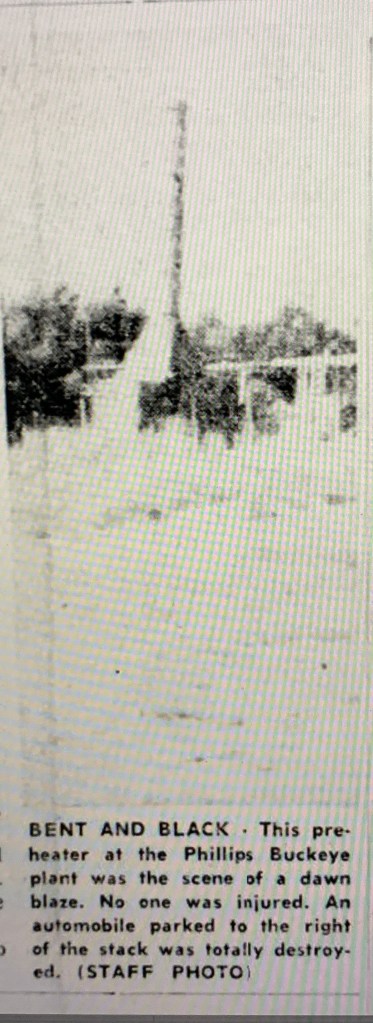
    There were no known injuries and damage to the plant was confined to the pre-heater and surrounding equipment. There may have been more vehicles that were damaged, but we remember at least one passenger car having been melted down to a shell and hauled off on a flat bed truck. The photo below is from the August 27, 1959 issue of the Lovington Daily Leader.
  • Humble City

    The community of Humble City is located about five miles northwest of the edge of Hobbs on Highway 18 at the intersection with West Alabama Street. It took its name from the Humble Oil and Refining Company. Humble Oil was founded in 1911 in Harris County, Texas and also gave its name to the town of Humble, Texas, northeast of Houston.

    Standard Oil of New Jersey acquired a one half interest in Humble in 1919 and the brand completely disappeared in 1959 after Standard Oil bought the other half in a merger that gave rise to Exxon (now Exxon Mobil).

    Humble oil company did a good bit of exploration in the early days of the Hobbs oilfield. Humble City was founded about 1930 and had a post office for about 46 years.

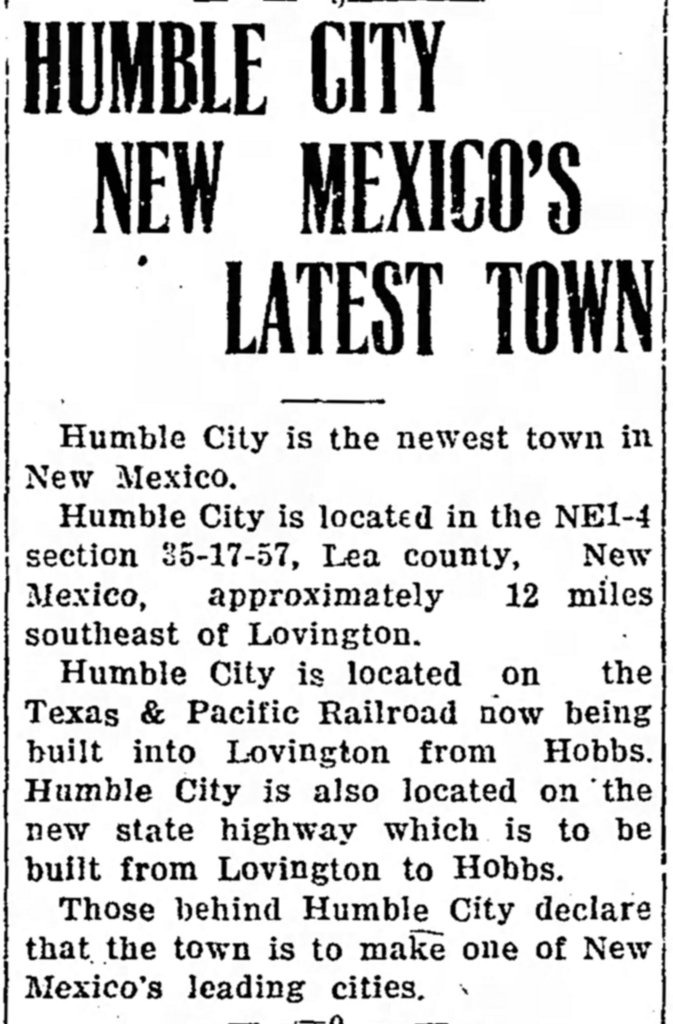
    Roswell Daily Record, May 31, 1930

    Humble City did not blossom as much as the article had predicted, but it is still on the map.

  • Oil Discovery In Hobbs

    The first successful oil well was completed around 1921 and the first successful gas well was completed a year earlier, but the Midwest State No. 1, spudded in 1927 using a standard cable tool rig and found oil on June 13, 1928 at a depth of 4,065 feet is considered to be the well that revealed the huge oil deposits in this area.

    Writers have commented that the flat land surface disguised the formations below the surface. Surface formations may sometimes indicate favorable subsurface formations for petroleum products.

    Midwest Refining Company, which would later become part of Amoco and subsequently British Petroleum, had brought in a successful well near Shiprock some six years earlier in 1922 in what is now called the San Juan Basin. In the Permian Basin, oil was found in nearby Winkler County, Texas in the Scarborough Field. In an oversimplication of all the various split ups and mergers, Midwest had been operating under the name Midwest Refining Company since 1914 after a merger between Midwest Petroleum and Franco Petroleum and Amoco was created in 1911 after the federal government ordered the split up of Standard Oil Company.

    The Midwest State No. 1 was drilled using a steel derrick that came from Amarillo. The engine was rebuilt locally after a fire had occurred when the rig had reached a depth of about 1,500 feet. Exhaust from the Franklin 85 engine created a fire that involved the engine house. The cable tools were fished from the hole, repairs were made and drilling resumed.

    The first signs of oil came at just below 4,000 feet in June and the well was later completed in November, 1928 at a depth of 4,330 feet. The Las Vegas Daily Optic reported on June 15, 1928:

    “The Midwest State No. 1 well, sec 9-19-38, is standing 4000 feet in oil and promises to open a new field, C. B. Barker, attorney for the state land commissioner was advised today. ‘This is on land belonging to the state deaf, dumb and blind schools and may mean a large income for them,’ said Mr. Barker. ‘Another section of common school land adjoins this one.’”

    Early production was measured at 700 barrels of oil per day, but it promised more and greater finds in the Hobbs area. One year later, the Humble Bowers No. 1 was completed. By comparison, its production was estimated to have a potential of 10,000 barrels per day.

    Cable tool drilling is considered to be one of the earliest drilling methods, dating back thousands of years over the world for other applications, such as drilling water wells. Drilling is accomplished by percussion, repeatedly lifting and dropping a string of pipe and tools into the hole. Fluid is pumped into the hole and crushed material is pumped out. Early drilling equipment included the drill bit, the drill stem, drilling jaws, a socket and steel cable. It is still in limited use for other applications but has been replaced by more advanced methods for deeper wells.

    [Sources: American Oil and Gas Historical Society.]

  • Jack Danglade

    Frank Jack Danglade was born November 4, 1898 in Jasper County, Missouri to Frank Henderson Danglade and the former Bertha Mabel McKittrick. He married Jessie June Price in 1920 and the couple had one daughter.

    Danglade and his wife had first moved to Texas in 1924 due to his wife’s poor health. The couple lived in Amarillo, Rising Star and Midland before coming to New Mexico. By about 1930, they had moved to Lea County upon the suggestion of an acquaintance who knew of the oil boom in the area. Jack recounted that a friend had remarked that Hobbs was booming and that Lovington had good possibilities, although at the time it had no paved roads, banks or rail service. He first took a room at the old Commercial Hotel, planning to stay for a short while, and lived in Lovington for the rest of his life. And he did see rail service, banks and paved roads reach Lovington, in time.

    Danglade came first and began to buy oil leases and royalties for others. He then decided to move his wife and young daughter with him. They built a home on South 5th Street in 1931. His wife passed away in 1941. During World War II, he was a civilian employee of the Navy Department in Washington, D.C. Afterward, he returned to the oil business, almost exclusively in Lea County, and was successful at it.

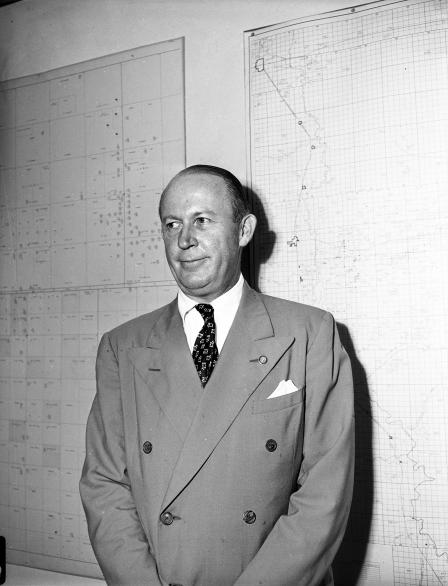
    Courtesy of UTA Libraries Digital Galleries

    He was elected to the New Mexico state senate in in 1952 and won a second term in 1956. He was generally aligned with the Republican Party, but ran as a Democrat to be able to participate in the New Mexico primary elections. During his time in the state senate, he served on a number of committees and sponsored legislation, primarily having to do with state finances.

    Danglade succumbed to cancer on May 24, 1959 while hospitalized in New York and is interred at New Hope Cemetery located in Webb City, Jasper County, Missouri. He was succeeded by Harold Runnels in the state senate after Runnels was appointed to fill Danglade’s unexpired term.

  • Oil Discovery in Jal

    On March 7, 1939, the Jal Flare contained an article that recounted the first oil wells in the area. The first discovery well was a wildcat, the Rhodes #1. Drilled in 1927 by Donley Brothers it produced a gas and sweet oil well that flowed mostly gas and some oil. It was quickly followed by Continental Oil Comapny’s Eaves well, south of town and the Shoals wells. Skelly then struck oil on the Joiner lease.

    This led to a boom and Jal grew in response. Drilling activity declined over the next few years and population declined until there was another boom of sorts beginning in 1936, when Roy Stovall and Culbertson and Irwin brought in a well in the Jal Sand Area. A dry hole by Phillips was followed by this offset well. The article described the pays on the east side of town as being in sand and on the west being in limestone.

    The article concluded by commenting that the discovery of oil was expected to lead to continued growth as surrounding exploratory wells are drilled.

  • Col. C. D. Woolworth Dies

    Col. C. D. Woolworth Dies in San Angelo Friday.

    Prominent Lea County Oil and Cattleman Dies After Illness Of Several Months.

    Col. C. D. Woolworth, widely known politician and prominent cattle and oil man, died Friday night, October 28th at 10:30. He was receiving treatment in the Shannon hospital in San Angelo, Texas at the time of his death. He had previously spent several months at Johns-Hopkins Hospital in Baltimore, Maryland. Col. Woolworth, who formerly was a resident of Lea county and of Jal, had been ill for the past several months. Col. Woolworth was well-known as a philanthropist.

    Funeral services were held at Robert Massey Funeral Home in San Angelo, and were conducted by Rev. Foreman. A large and beautiful floral offering was presented.

    Col. Woolworth was buried in the Fairmont Cemetery in San Angelo.

    He is survived by five sisters, Misses Clara, Litie, Mae , and Elizabeth Woolworth of San Angelo, and Mrs. Watkins of Henderson, Texas; one brother, Dr. Woolworth of Shreveport, Louisiana and an aunt, Mrs. Litie Paxton of San Angelo.

    Those who attended the services from Jal were Mr. and Mrs. Peter Bish, Mr. and Mrs. R. J. Wilson, Messers. Bill Danner, Johnny Stuart, Penn Combest, and M. I. Humphries.

    [Jal Flare, Jal, NM. 3 Nov 1938.]

  • Harold L. Runnels

    Harold Runnels was born May 17, 1924 to Elbert Dewey Runnels (1898-1969) and Stella McCutcheon Runnels (1898-1964) in Dallas, Texas. Dewey, his father, had grown up in a farming family living in nearby Kaufman, Texas. By the 1920 Census, Dewey and Stella had married, Dewey was working for a tractor company and they were living close to downtown Dallas. By 1930, both Harold and his older brother Elbert had been born, completing their small family.

    Harold was a graduate of Dallas Woodrow Wilson High School and attended Cameron State Agricultural College in Lawton, Oklahoma. Prior to World War II, he worked in some capacity for the Federal Bureau of Investigation in Washington, D. C. When the United States entered the war, he enlisted in the Army Air Corps. After the war, he worked for about six years in Magnolia, Arkansas for Magnolia Amusement Company before moving to Lea County, New Mexico in 1951.

    Around 1943, he was married to Dorothy Frances Gilland. The first of their four children was born in 1945. In Lovington, Harold became a partner in Southland Supply Company before forming Runnels Mud Company, which supplied drilling mud to companies drilling oil wells, and the RunCo Acidizing and Fracturing Co., another oilfield service company, both of which he owned and operated until shortly before he died.

    His first venture into politics was having been elected as a Democrat to the New Mexico state Senate in 1960. For the next twenty years, he served his home area either as a state senator or United States Representative. Runnels was first elected to the U. S. House from New Mexico’s newly created Second District in 1970 after serving 10 years in the state Senate, defeating Republican Ed Foreman for the House seat. He first served in the Ninety-second Congress and to the four succeeding Congresses and served from January 3, 1971 until his death at the age of 56 from cancer on August 5, 1980.

    While in Congress, Runnels had served on the House Armed Services Committee and the House Interior and Insular Affairs Committee and was chairman of the Insular Affairs Committee oversight and investigation subcommittee. Because of his background he was considered to be highly knowledgeable in issues dealing with national energy.

    Runnels’ funeral was held in Lovington High School’s Pannell Auditorium with 2,000 people in attendance. Quotes from that day were carried in the August 9, 1980 issue of the Santa Fe New Mexican, as follows:

    District Judge C. Fincher Neal of Hobbs called him “a humble man with humble beginnings.” and added, “In the halls of congress, he was one of the most informed men on the oil and gas industry.” United States Representative Sam Hall of Texas said, “I don’t know of any person who had the love, respect and admiration of the Congress as did Harold Runnels.”

    Reverend Ed Scarborough of Wolfforth, Texas, a former pastor, referred to Runnels as “one of the great men that God has shared with us to lead us in a time of great need.” Following the service, Runnels was interred at Resthaven Memorial Gardens at the edge of town. There, a Navy Ceremonial Guard gave a 21-gun salute and played Taps.

    Runnels was survived by his wife and children and was succeeded as United States Representative by Joe Skeen. His papers relating to his service in Congress were donated to Eastern New Mexico University in Portales, New Mexico.