Old Lea County, N.M.

Tag: newmexico

  • “Uncle Bill” Oden Talks About the Old Days

    Transcribed from the Pecos Enterprise (Pecos, Texas) – August 19, 1938


    B. A. “Uncle Bill” Oden, Authentic Old-Timer, Gives Historical Sketch of Monument Landmark

    B. A. “Uncle Bill” Oden, Who’s been in the trans-Pecos country since time began, was asked recently by the Hobbs Chamber of Commerce, to give a historical sketch of the famed Rock House in Monument Springs, New Mexico.

    The rock house, subject of a recent story in the Cattleman’s magazine, is one of New Mexico’s oldest land-marks and its origin has been a controversial subject for years.

    Uncle Bill was in the New Mexico country in 1884, and is one of the oldest living early settlers of that section. The story he wrote for the Hobbs Chamber of Commerce and also for the Cattleman’s magazine, is reprinted below:


    According to promise, I am going to give you a true history of the old rock house at Monument Springs. I, a boy of 18, went to what is now the San Simon ranch in 1884. I, being young and everything being new and of interest to a lad of that age in a country as wild as that was, remember things more vividly than things that happened ten years ago.

    Bound for Lincoln!

    I hired to Mr. Divers at San Angelo some time about the middle of June of that year when he was passing though there with about 1250 head of cattle bound for Lincoln County, New Mexico. I worked for him nine years at what is now the San Simon ranch and I, as a cowboy, new all the first settlers of the country. These I will give you in the course of this article.

    From San Angelo we traveled up the North Concho to somewhere above where Sterling City now is. We turned north and crossed the T and P Railroad Company at Iatan Tank about 15 or 20 miles east of Big Spring. There we turned northwest toward the head waters of the Colorado River. There we camped around two months waiting for it to rain before starting across the Plains. Around the middle of August it began to shower and we started and as luck smiled on us, it rained the second night out and we turned the cattle loose and they all got well watered. The next water we got was in small lakes about where there the town of Hobbs now is. We stayed there for a few days and went on to Monument Spring. There we found Jim Harvey and Dick Wilkerson, two buffalo hunters, who had preempted the spring. In other words, they had what was known as squatters right to spring and so much land. They, Harvey and Wilkerson, had hauled the Monument, of rock the soldiers had built on a hill about three-quarters of a mile west, and built the rock house and a small stock correll [corral] near the spring. The little rock house had port holes in the corners for protection from the Indians and when we passed there about the 27th day of August, they slept in the gate of the correll to protect their horses from the Indians. The place where the San Simon ranch is was known by the soldiers and buffalo hunters was Dug Spring. It was only six feet to water but it had to be pumped with horse power. In the spring of 1885 R. F. Kennedy bought Monument Spring from Harvey and Wilkerson, paying them $5,000 for same, and they moved about 1000 head of cattle there from Gonzales County in Texas.

    Ranchers Begin Locating

    In the fall of 1885 E. H. Estes located eight or 10 miles west of there at a well he bought from Louis and Guyat Faulkner and started what was known as the 7Z7 ranch, which is operated for several years. In 1886 there were several ranches started in what is Lea County, New Mexico, and Gaines County, Texas. J. M. Daughtery started what was afterward known as the 84 ranch about 15 or 20 miles south of Monument Spring and also Frank and Ed Crowley located along the line of New Mexico and Texas east of the town of Hobbs.

    Uncle Henry McClentock started the next ranch about 15 miles east of the New Mexico line in Gaines county. South of the 84 ranch was McKenzie Brothers, J. M. and Gene. Farther down the draw toward the southeast corner of New Mexico was Cowden Brothers, later known as the Jal Ranch.

    The W. C. Cochran ranch was where the present town of Jal is, and east of the 84 ranch Bill and Dave Brunson settled. North of Hobbs was the Atwood or Mallet ranch, about five miles south of the present town of Lovington George Causey settled. He was a buffalo hunter and didn’t own any cattle for several years. The above named ranches were started from 1886 to 1888. In 1884 the ranch farthest west was the TJF ranch on the head waters of the Colorado river. With the exception of another old man by the name of Anderson, who had a small bunch of cattle at a weak spring at Cedar Lake in Gaines County, there were no more ranches or cattle between there and the Pecos river. The cattle we had were the first to water at Monument Spring. Harvey and Wilkerson were the only permanent settlers.

    Few Buffalo Hunters Left

    There were a few other old buffalo hunters in the country but they camped around wherever they could find water and killed antelope in the summer, and buffalo and antelope in the winter. They dried the meat, (which they called jerkey) in winter. Those who were there any length of time after I went there were Louis and Guyat Falkner, Rankin More, Judge and Jon Kink Kuykendall and an old man by the name of McConvill, who dug wells for ranchmen for several years. Rankin Moore never owned any interest in the spring, though he might have helped haul the rock. The house was built in the winter of 1883 and 1884, but it wasn’t quite finished when we passed there. The well was dug about 1888 and might have been dug by Jim Andrews as he was working for Mr. Kenney at the time. Rankin Moore settled in Andrews County, Texas, near the line of New Mexico. He dug wells for McKenzie Brothers for twenty cows and calves and ranched them there a few years and sold out to Uncle Billy Daughtery and left the country.

    During the nine years I worked for Mr. Divers, I attended roundups extending from the site of Lubbock to Drockett County and from Black River, New Mexico, to the Live Oak Creek, in Crockett County.

    H. E. Cummins, who lives in Midland now, was hired by Jim Harvey in Colorado in the fall of 1884 to skin buffalo and antelope and cook. He cooked for them all winter and caped part of the winter at the ranch where I worked and owned by Frank Divers. He has the honor of being the last of the buffalo skinners, as the winter of 1884 and 1885 was the last of the buffalo in commercial quantities.

  • Clay McGonagill

    Henry Clay McGonagill was born on September 24, 1879 to George M. McGonagill (1841 – 1921) and Narcissa Josephine “Grandma” Haynes McGonagill (1839 – 1935) in Sweet Home, Texas. His family were ranchers and he grew up in West Texas and Southeastern New Mexico as they finally settled in Lea County. It was there that he learned to ride and rope as he lived and worked on the family ranches. Later he did some cowboying for other ranchers.

    For many years, Clay was a championship rodeo contestant and supported himself with his rodeo winnings, primarily in steer roping. In the day, many such rodeos were local affairs and some were known as “fairgroundings.” McGonagill nevertheless developed a wide reputation in the rodeo world competing in the United States, Canada, Mexico and at least one time in South America. Clay moved around over the years, but for a while he operated out of a ranch in Monument.

    He married Annie Laurie Johnston in 1904 and the couple was living in Arizona when Clay was accidentally electrocuted. On October 24, 1921, he was hauling hay on the Papago Indian Reservation near Sacaton, Arizona when he came across a low hanging power line. In trying to clear the roadway to make room for his hay wagon, he came on contact with the power line carrying 11,000 volts of electricity and was instantly killed.

    Clay is buried in the Lovington Cemetery in Lea County along with his parents. He was inducted into the National Rodeo Hall of Fame in 1975.

  • Wacker’s Five and Dime

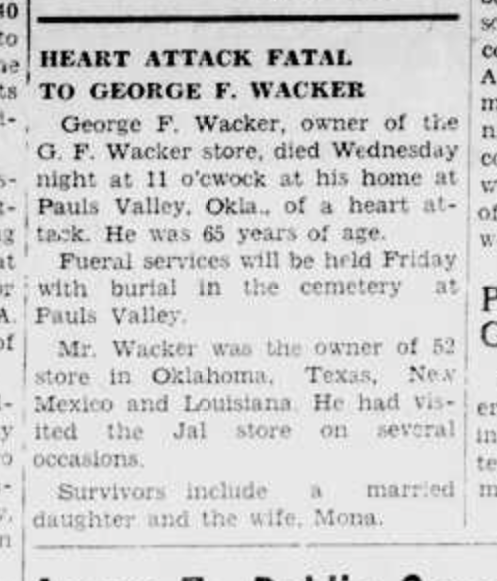
    Wacker’s stores could be found in most of the larger towns in Lea County, usually in the central business district. The stores were named for G. F. Wacker of Oklahoma. He had been working at a dry goods store in Ballinger, Texas and had the vision to start his own store selling low priced goods.

    Wacker resigned his position in Ballinger in 1917 and went back to his home town of Ellinger, Texas where he secured a small loan and bought the inventory of a bankrupt variety store. He opened his first store in Hugo, Oklahoma. This was the start of a chain of retail stores. After the modest success of his first outlet, George Wacker, his brother Hugo Wacker and some other friends opened four more stores in Oklahoma. To this, they set up the company headquarters in Pauls Valley, Oklahoma in the early 1920s. Eventually their holdings included several hundred retail stores. At their peak, Wacker’s consisted of more than 200 stores in at least five states.

    George Wacker died in 1950. The stores continued on for a number of years under successor ownership. Sometimes when companies merge or go out of business, there is more of a trail, but so far we have round nothing on how this business was finally wound up.

    George Wacker’s death notice:

    Jal Record, Jal, New Mexico, 9 Feb 1950
  • Seligman County?

    There has long been a rivalry between Hobbs and Lovington, and in 1931 there was a move to subdivide Lea county into two counties, one retaining the name Lea and another called Seligman. The Albuquerque Journal issue of February 27, 1931 carried an article with these headings “Would Divide County To Honor Arthur – Hobbs and New Hobbs Have Plan for ‘Seligman County,’ Using Court House In Common.”

    The Associated Press article went on to say that the people of Hobbs wanted to preserve the “posterity” of Governor Arthur Seligman by splitting Lea County in half and creating one named for the Governor. A proposal to approve this change was introduced to the New Mexico senate by Senator Taylor Julien. New Hobbs still existed at that time but the older town of Hobbs would serve as the county seat.

    Two weeks later, the Roswell Daily Record issue of March 11, 1931 carried these sarcastic comments: “Seligman county has been killed. There never was any excuse for creation of two counties in Lea county. In fact, there is hardly any excuse for one county. But creating a new county would have meant additional offices and that seems to have been the only excuse for it.”

    Arthur Seligman was governor of New Mexico from 1931 until his death in 1933. He was preceded by Richard C. Dillon and succeeded by Andrew Hockenhull.

  • Pooch Saves Baby

    On January 26 at 3 o’clock, Marilyn Janet Justis, 2, was playing in her yard with Mr. K. B. Walker’s dog, Pooch. A few minutes later she wandered away and fell into an empty cess pool. Pooch howled and danced around the mouth of the hole until he attracted the attention of Marilyn’s mother, Mrs. D. W. Justis.

    With the help of a man who happened to be passing, Mrs. Justis rescued her daughter from the cess pool.

    [Jal Flare, Jal, New Mexico. 6 Feb 1947.]

    [Note: Marilyn Janet Justis was the granddaughter of Charles W. Justis, one of the earliest residents of the area around Jal and usually considered to be the founder of Jal.]

  • Allen Clinton Heard

    A. C. “Daddy” Heard was born in February 23, 1858 in DeWitt County, Texas. His parents were Humphrey Whorley Heard and Louisa Ellenor Foster Heard, and he was one of eight children. When he was an older teenager, he began working cattle for one of his brothers in Texas. He next rode on the cattle trails as a cowboy for about three years before settling for a time in Tom Green County, Texas where he worked for his brother Jasper and Tom Word. He later worked for another rancher near the Pecos and began to build a herd of his own.

    Heard came to Southeastern New Mexico in 1894 around which time he became a co-owner with others in a cattle ranch they purchased out of the old Mallet Ranch and renamed the High Lonesome Ranch. He and others had driven cattle from Texas to what was then Eddy County. At the time, the gramma grass was said to be lush and high. Heard improved his stock by bringing in the first registered Hereford bulls to the area in 1910. His brother and former partner Jasper Newton Heard died in Texas the following year in a ranching accident in which his horse fell on him. The supposition was that both horse and rider died after getting tangled in a rope.

    Heard continued to operate the High Lonesome until around 1927 when it was sold. Heard had earlier moved his family to Carlsbad around 1900. Over the years he served as mayor of Carlsbad, county commissioner of both Eddy and Lea counties at various times, including being one of the first three county commissioners of Lea County when it was formed around 1917.

    Heard was one of the founders of the Presbyterian Church in Lovington. It is also said that he was primarily responsible for seeing to it that a paved road was built from Carlsbad to Lea County. He served as a director of the First National Bank of Carlsbad and was also a State Representative from 1920 to 1924. He was a life member of the New Mexico Cattle Growers’ Association. He and his wife, the former Talovia Elmira Newcomer, had two daughters. Heard was often mentioned in local newspapers for events happening at the ranch and for other activities involving his family. He passed away at the age of 86 on July 6, 1944 in Bernalillo County and is buried there in Albuquerque’s Fairview Memorial Park.


  • John Scharbauer

    John Scharbauer (1854 – 1941) was a long time ranch owner in the area. The family name is a familiar one to people from Lea County. In commemoration of his birthday, a number of his friends got together and honored him, as noted below.


    Loving Cup Inscribed in Gold Given Scharbauer by Friends

    “Going Strong Since 1851 – 83 Years of Service”

    This inscription in raised, gold letters appears on an attractive loving cup which was presented Christmas Day to John Scharbauer by Walter B. Scott as a birthday gift from 15 of his oldtime friends. Scharbauer, cattleman, well known to stock men of West Texas, will be 83 years old Friday. Also on the cup which bears Scharbauer’s name is the wording “A Pioneer, a Patriot, a Splendid Citizen and Loyal Friend.”

    Besides Scott, those who joined in the presentation of the gift were J. Lee Johnson Sr. W. E. Connell, Hugh Rigers, Guy L. Waggoner, T. Z. Hamm, W. O. Shultz, E. B. Spiller, M. C. Ulmer, T. B. Yarbrough, W. C. Stonestreet and Amon G. Carter, all of Fort Worth; Millard Eidson and Dick Lee, Lovington, N. M. and Clarence Scharbauer, Midland.

    Scharbauer, who has an office on the first floor of the Worth Building, still loves the range. He frequently takes horseback rides and can “outride” many men much younger.

    In 1880 he came to West Texas and seven years later moved to Midland. Although Fort Worth is his home, he spends several weeks each year at Midland where he has a ranch and cattle interests and where many of his oldtime friends are located. Born in Indian Fields, N. Y., by the time he had reached 28 he accumulated what he thought was a small fortune, $2,000, and went to Abilene in a covered wagon. There he entered the sheep business.

    His first enterprise in Texas was successful and at one time he was the owner of more than 20,000 sheep.

    In 1890 Connell Brothers and Scharbauer organized a private bank at Midland which was the beginning of the present First National Bank of that city. Several years ago there was a false report circulated in Midland and a “run” on the bank started. Scharbauer and Marvin Ulmer, cashier, chartered an airplane in Fort Worth and took $100,000 in currency to the Midland bank and stacked it on the counter. They invited customers to “come and get it,” but instead, they walked out, leaving their deposits.

    Almost 43 years ago Scharbauer began raising cattle. He decided Herefords were the best breeds for his section and he is a pioneer in the development of that breed around Midland County. His registered herds have gained worldwide attention.

    Clarence Scharbauer, his partner and owner of the hotel that bears his name at Midland, now manages their ranching interests. He is a nephew of John Scharbauer. They have ranch interests in New Mexico, and Midland, Martin, Gaines and Andrews Counties.

    Scharbauer is a director in the First National Banks of Midland and Fort Worth.

    [Source: Fort Worth Star-Telegram (Fort Worth, Texas), 26 Dec 1934.]

  • High Lonesome Ranch

    The High Lonesome Ranch was one of five early ranches in Lea County. Below is a brief recap of how it got its start.

    Two men named Dwight P. Atwood and Roswell A. Neal, along with other investors, had formed the Mallett Cattle Company in the state of Connecticut during 1883 with headquarters near Colorado City, Texas. At one point, their holdings had extended from West Texas on further north and west to into New Mexico, in Lea County, with total holdings of around ninety thousand acres. During the 1890s, due to various factors, the company’s fortunes had declined to the point where it was forced to take bankruptcy in 1893.

    Bankruptcy receivers sold off assets to different individuals and companies. D. P. Earnest, a manager of one of the ranches, acquired some of the property in Howard and Mitchell counties of Texas. Two individuals out of San Antonio named Halff acquired more of the Texas property and incorporated it into their Quien Sabe Ranch. Another buyer in West Texas was Theodore Schuster who operated a livestock business there for a short time, but ultimately sold out to David DeVitt and John Scharbauer around 1895 who set up their own entity and called it the Mallet Ranch. Three people out of Midland, Texas were headed up by Allen C. Heard acquired the Lea County property and named it the High Lonesome Ranch.

    It apparently took its name from the surrounding terrain, which included the highest point of the Llano Estacado between Midland and Roswell. In addition to A. C. Heard (1858 – 1944), other owners are believed to have been John Thomas White (1868 – 1926) and Jesse Heard (1845 – 1911).

    Map attributed to J. W. Runyan, from Hobbs and Lea County by Max A. Clampitt

    We have also occasionally seen the ranch referred to in newspaper articles as “Highlonesome,” without a dash or a space between the two words. We also see some references to a ghost town with the one word name but it is described as a one pump gas station, and exact location of it is currently unknown.

    For more information about the entire Mallet Ranch that High Lonesome came from, see Mallet Ranch.

  • William Middleton Nelson “Bob” Beverly

    Bob was born May 5, 1872 in Ringgold, Georgia to John Purnell Beverly (1831 – 1884) and Missouri Alice Israel Beverly (1845 – 1879). Bob’s father J. P. had worked as a farmer in Georgia and was doing so when Bob was born. Soon thereafter, J. P.’s family and the Israel family moved to a place near Kimball in central Texas where a settlement was beginning to take hold on the Brazos River. Alice died in 1879 in Bosque County, Texas at the same time Bob’s sister Anna Addie Beverly was born and Alice was buried there. Afterward, J. P. moved back to Ringgold, Georgia where he and the five children remained until his death in 1884, living with Bob’s grandparents, William and Elizabeth Beverly. The family story is that soon after his father’s death, Bob came back to Texas on horseback by himself, while still a teenager.

    In 1895, Bob married Nancy Ona Elizabeth Rammage with whom he had two children. She died in the Chickasaw Nation (now Oklahoma) in 1899 and by 1900, Bob was living in Johnson County with the two children in the household of Arthur and Henrietta “Etta” Israel, his aunt and uncle. Bob later remarried.

    In Bob’s long career, he had worked on a farm, served as sheriff of Midland County, Texas (1908 – 1912), served as a brand inspector for the Texas and Southwestern Cattle Raiser’s Association. He was a special ranger for the Texas Rangers for a short time prior to 1920. By around 1920, Bob was operating a ranch in Nara Vista, Quay County, New Mexico and by 1930, he had relocated to a ranch in Lea County, where he would remain. He ranched and served as sheriff of Lea County for a number of years. Bob was a charter member of the Open Range Cowboy Association, which was made up of those individuals who had worked in the cattle business before the range was divided by fencing.

    Bob was known to be an excellent writer and over the years penned at least one book “Hobo of the Rangeland” and many other articles. One news writer commented of the book, “Bob has written the book to raise money to send his blind five year old grandson to some school where he may have opportunities for an education.” He also wrote letters to the editors of various newspapers. He is mentioned many times in the news, some of which are noted below.

    In early 1931, Albuquerque Journal carried an article under the headline “War On Slot Machines in Hobbs and Other Lea County Towns; 33 Confiscated; Three Men Jailed.” The article described a raid in Hobbs where 33 nickel and quarter slot machines were seized. As word spread of the raid, slot machines in Lovington, Tatum and other parts of the county disappeared. Beverly was quoted as saying that one of his deputies had been warned to stay out of Hobbs or be jailed himself. The gambling operation had come with the oil boom, and Beverly carried out the raid anyway with deputies Jack Seay, Bert Ivey and L. C. Mills.

    An article in the Clovis News-Journal from 1940 has Beverly, no longer sheriff, warning residents of a mail fraud called the “Spanish Swindle,” Quoting from an actual letter he had been given by a potential victim, he described the swindle which was characterized by the hoaxer’s claims of needing money to free a female relative who is behind bars in a foreign country. The hoaxer needed help in accessing a tantalizing amount cash held in United States banks. If the victim helped, he would receive one-third of the funds, “at no risk.” Other variations had the hoaxer needing funds to pay for a bankruptcy trial or some other calamity.

    In an article from the Roswell Daily Record in 1932, Beverly gave his account of the shootout in which deputy J. M. Clifton was mortally wounded after a gun battle in which suspected robbers named Carlock and O’Dell were killed by Clifton. In another article from the Clovis News-Journal in 1932, an account is given in which Beverly and a deputy went to Tatum and apprehended a suspected Oklahoma underworld figure by the name of Stanley Hedrick who helped them locate his associate named Pebsworth. The pair had escaped from a Roosevelt County shooting while driving a 1930 Ford Tudor. Pebsworth had been wounded and the suspects were turned over to Roosevelt County officers.

    A 1938 article in the Albuquerque Journal mentions Beverly in an account of the annual XIT Ranch Reunion. Beverly was elected to serve as an officer of the reunion.

    Our favorite article comes from the February 16, 1941 issue of the Clovis News-Journal on the occasion of the death of an old cowboy friend, James Irvin “Buster” Degraffenried. Beverly wrote of his friend:

    “He saw unbroken trails. His footsteps marked the paths, blazed to follow, in the routes over the old west. He knew the west when barbed wire did not fence its acres. When life was safer, from the Comanche warrior, and outlaw, than today when so many Ford cars are running at you.

    He saw the buffalo crowded from the range by the longhorns, and saw the longhorns disappear from the range by the stocking of blooded stock.

    His early youth and manhood were spent on the prairies, before towns, and cities came to dot them with mileposts of progress. He drove through to a success in a red blooded period, when only courage could survive and initiative could win.

    He caught a vision in his youth, that remained with him to the close of a long and useful life.

    Now he is headed West once more, foot in the stirrup, seat in the saddle, driving his herd over another long and unknown trail. As we sit in our chairs, surrounded by modern civilization and mourn his passing, I wonder if there is yet left others in the world like Buster, who loved the solitude of the plains, the silence of the canyons, the ozone of the mountains.

    So he died in El Paso. Perfectly fitting for an old puncher, of his kind, out on the border, looking ever for a land fitted with cows.

    Farewell old friend. None will mourn your passing more than your old friend, Bob.

    BOB BEVERLY,

    Lovington, N. M.”

    Bob passed away in 1958 in El Paso.

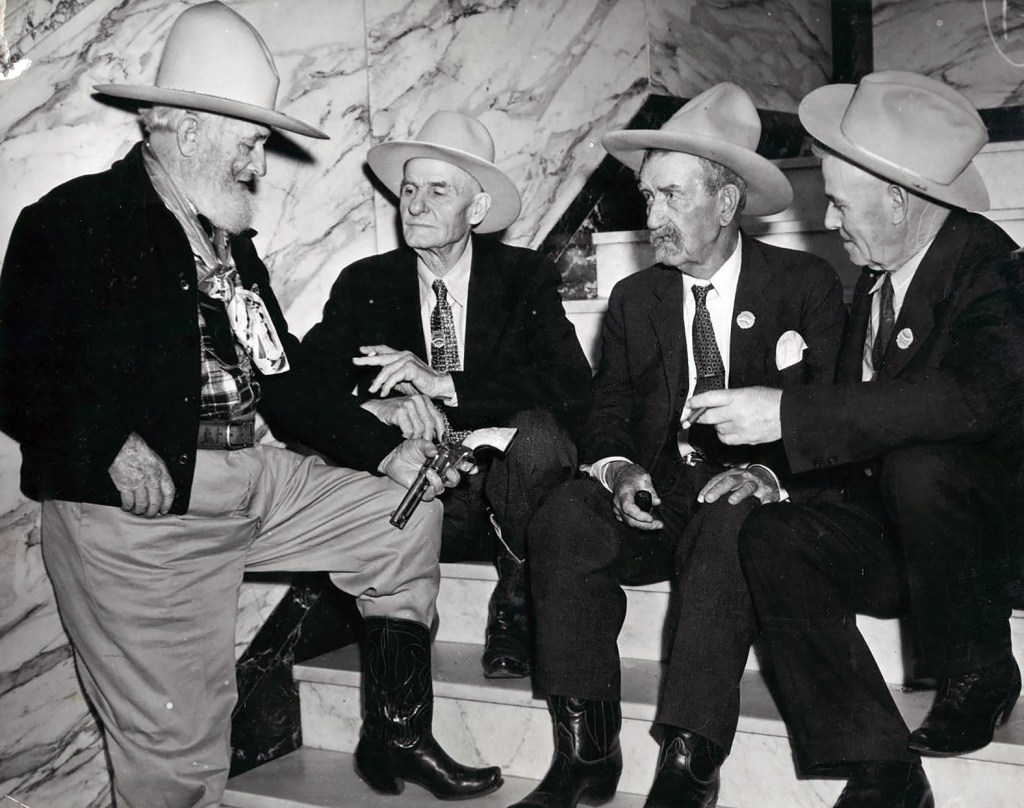
    Left to right, John R. Hughes, Ellison Carroll, A. P. (Ab) Blocker, and Bob Beverly wearing cowboy hats and smoking cigars on the steps in the lobby of the Westbrook Hotel in Fort Worth at the 1939 Texas & Southwestern Cattle Raisers Association convention. Image credit: Cattle Raisers Museum in Fort Worth

    Clipping:

    The Collinsville News, Collinsville, Oklahoma · Thursday, February 16, 1939

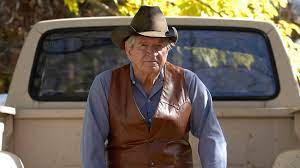
  • Max Evans

    Max Allen Evans was born August 29, 1924 to Walter Burnace (W. B) Evans (1900-1979) and Hazel Glenn Swafford Evans (1904-1994) in Ropesville, Hockley County in Texas. Max was one of two children and had a younger sister named Glenda Rhue. Max grew up in the Panhandle of Texas and southeastern New Mexico and drew on his varied experiences and his knowledge of the culture to write over four dozen books, several of which were made into feature films.

    Max grew up in Humble City and remembered doing errands and making delivery rounds on horseback as far as Lovington and smaller communities. His family moved there in the late 1920s. His father was farming and is said to have drilled one of the first irrigation wells for farming in the area. He grew potatoes, watermelons, strawberries and other vegetables. His father is said to have organized the township of Humble City. W. B. also organized a small school district and built a two room school house there, which Max attended though the third or fourth grade. W. B. also set up the first post office and Max’s mother Hazel served as Humble City’s first postmistress.

    Max remembered living through the Great Depression there in Humble City and the difficulties his and other families experienced just getting through it and keeping their families fed. The Evans lived in Humble City for seven years in all.

    Max tried his hand at ranching up in Union County in far northeastern New Mexico. He joined the United States Army in World War II and is said to have participated in the D Day landing on Omaha Beach in Normandy, France. After his return from the war, he did some painting before he turned full time to writing. Max married and lived several more places, including Taos, before settling in Albuquerque around 1967.

    This is a partial list of his fiction books:

    •   Southwest Wind (1958)
    •    Long John Dunn of Taos (1959)
    •    The Hi Lo Country (1962)
    •    The Rounders (1965)
    •    Shadow of Thunder (1969)
    •    My Pardner (1972)
    •    Bobby Jack Smith, You Dirty Coward! (1974)
    •    One-Eyed Sky (1974)
    •    The White Shadow (1977)
    •    The Mountain of Gold (1983)
    •    The Great Wedding (1983)
    •    Bluefeather Fellini (1993)
    •    Faraway Blue (1999)
    •    Now and Forever (2003)
    •    War and Music (2009)
    •    The King of Taos (2020)

    This is a partial list of his nonfiction books:

    • Sam Peckinpah, Master of Violence (1972)
    • This Chosen Place (1997)
    • Albuquerque (2000)
    • Madam Millie (2002)
    • Hi Lo Country: Under the One-Eyed Sky (2004)
    • Making a Hand (2005)
    • For the Love of a Horse (2007)
    • Goin’ Crazy with Sam Peckinpah and All Our Friends (2014)

    Three of Evans’ works were made into feature films including The Rounders, The Wheel and The Hi-Lo Country. The Rounders was also made into a television series. Seventeen episodes were filmed in 1966 and 1967. Max was also cast as an actor in the Peckinpah film, The Ballad of Cable Hogue. His book, Sam Peckinpah, Master of Violence is about the making of that film.

    For a number of years, a rodeo and celebration was held in Hobbs and was known as the High Lonesome Stampede (or Estampeda). The 1967 celebration was the ninth of its kind and one day was dedicated as “Max Evans Day” in which Max agreed to serve as parade marshall for the rodeo parade that opened up the three day affair.

    Max passed in 2020. His honors include a commendation from City of Los Angeles. He was named honorary member of board of chancellors, University of Texas. He received the Saddleman Award, Western Writers of America, 1990. In 2015, he was honored with the Edgar Lee Hewett Award in recognition of his lifetime of service to the people of New Mexico. Max also received the New Mexico Governor’s Award for Excellence in the Arts and the Spur Award for Best Short Nonfiction. He continued to write up to the year that he passed away.

    Image credit: variety.com