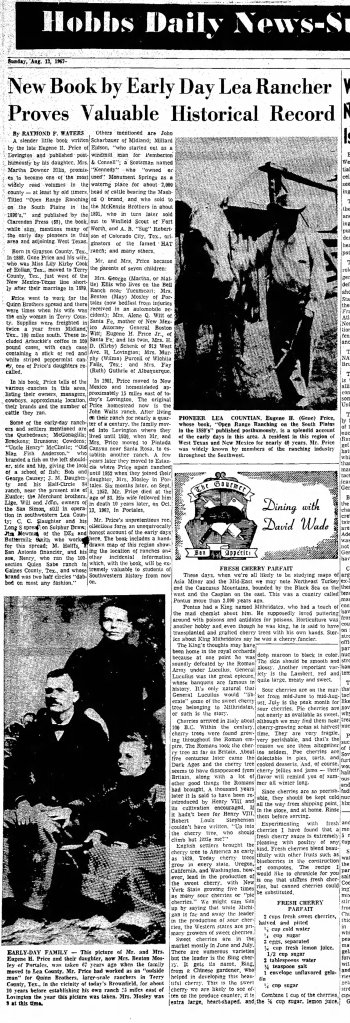
Gene Price (full name Eugene Hubbert Price) was born on November 19, 1868, in Grayson County, Texas to Theodore Martin Price (1836 – 1927) and Martha Ann Virginia Drisella Hubbert Price (1842 – 1905). Theodore Martin Price was a farmer/rancher/merchant and also a circuit riding Methodist preacher. From his early years, Gene was keenly interested in ranching, beginning in the era of the open range.
As a young man, he worked on several ranches in the southwest. He named the Quinn Brothers, the Hat Ranch, Pemberton Brothers and the E Ranch in his comments. In 1889, he married the former Lily Kirby Harris Cook in Eolian, Texas. Around 1901, the family homesteaded in New Mexico, at the corner where Yoakum, Gaines, Eddy, and Chaves counties met – roughly 15 miles east of the future site of Lovington.
Mr. Price built up one of the area’s earliest high-quality registered Hereford herds. For a while, he leased the Highlonesome Ranch, and the family resided in its old headquarters house. As their children reached school age, the family bought a home in Lovington while still working the ranch. Gene served on the Lovington School Board and participated actively in community matters; he generously donated land for a second, larger school building, which served as the town’s only school for many years. He was a long time member of the Methodist Church in Lovington.
In his later years, he authored “Open Range Ranching on the South Plains in the 1890’s,” a memoir of his early experiences that has become a valuable resource for those interested in the region’s history. Long out of print, the original publication included a reproduction of Gene’s informative hand drawn map of Lea County and the surrounding area.
Mr. Price passed away on September 5, 1952. Mrs. Price died on October 16. 1962. Both are buried in Lovington Cemetery. In 1988, he was posthumously honored with a Bronze Cowboy award for his numerous contributions to the early traditions and settlement of Lea County.
Image credit – Hobbs Daily News-Sun, August 13, 1967
Source: “Then and Now – Lea County Families,” Lea County Genealogical Society, Walsworth Publishing Company, 1979.
Tom Conway interviewed Robert L. “Preacher” Jones for an article in the above mentioned book. In the interview, Rev. Jones was said to be the first person of African American descent to move to Lovington, arriving in 1931 and staying a short time. He had previously lived in Hobbs, moving there from North Texas where he said he had grown up on the “Wagner” (probably a reference to the Waggoner) Ranch near Vernon, Texas.
The interview stated that he had moved to Hobbs, attracted by the oil boom, where he did some carpentry work. After that, he left the area for a while, returning in 1933 to Lovington where he bought property on a high place to the east of town.
The article stated that one David Martin was the second person of African American descent to come to Lovington around 1935. Mr. Martin bought some of Rev. Jones’ land where he built a home and lived until the 1950s. While in Lovington, Mr. Martin, reportedly disabled, worked shining shoes at Simpson’s barber shop. He is said to have later moved to Hobbs where he worked for the Postal Service.
Rev. Jones was a pentecostal minister and a carpenter and remained in Lovington the rest of his life. The article stated that he had built some seventeen churches and many homes. Rev. Jones is said to have named the neighborhood Rock Hill. Rev. Jones also was the first garbage collector for the neighborhood. He would drive around and pick up garbage in his pickup truck.
In addition to Jones and Martin, the article also mentions other early residents: the Cottons, Andover Williams, Olene Fillmore. The article also mentions B. W. “Overcoat” Williams as being an early resident.
Rev. Robert L. Jones died in 1986 and is buried in Lovington Cemetery along with his wife, Annie.
[This article about Sister Mary Fides was transcribed from the Hobbs Flare issue of March 1, 1984. It was written by Patricia Breyman.]
This week’s old timer is 80 years old, is devoted, compassionate, courageous, loving, caring — all of these plus dedication personified. However, what this reporter also quickly recognized in her beautiful face is happiness, contentment, laugh lines from a marvelous sense of humor, warmth. tenderness, eyes alive and alight with expectation, and a readiness for helpful escapades that has about worn out her guardian angel!
She is sister Mary Fides, Dominican Order, serving St. Helena’s Catholic Church in Hobbs in a full-time and very active position as Director of Religious Education.
She was born as Agnes Cecelia Gough on June 22. 1903 to George Joseph Gough and Ophelia (Pickard) Gough. Her father was from Kentucky and her mother from southern Illinois. They met at a small Baptist College in Illinois, married. and Agnes Cecelia was born into a mixed marriage home – half Catholic and half Baptist. It later became an all Catholic marriage and home. They lived in Uniontown, Kentucky.
CATHOLIC/YANKEE
The family moved from Uniontown to Oceola, Arkansas, smack in the middle of the Bible-belt and into a southern stronghold. Young Cecelia found herself as she put it, with two strikes against her she was Catholic and a “damnyankee” to boot.
She was timid and shy but at seven, assured her mother she knew the way to the home of an aunt and uncle in Oceola and was perfectly capable of walking there alone. She didn’t get far from home when she realized she was hopelessly lost. Lost to such an extent she could not find the home of the relatives nor could she find her own home again. She finally gathered her courage, marched up to the front door of the nearest home, and asked for help. It was the Methodist parsonage and the minister’s daughter walked her around and up and down streets until she recognized her own home. She said she always had respect for people of other faiths and the memory of that event only strengthened that respect.
Agnes Cecelia attended public schools until she was a junior in high school. Her mother was afraid she would become “wild” so she sent her to St. Agnes Academy in Memphis, about 60 miles away. The good sister was quick to assure she definitely was not “wild” and has no idea what criteria her mother used to arrive at that fear.
SISTERHOOD REJECTED
She said the last thing on her mind was to enter religious training in any form, much less to become a nun. When asked by friends and family if she considered that as an avocation, her stock answer was ”No, I am not about to wear all those clothes.”
She said “the Lord finally had enough of her foolishness and moved her to the decision to enter training.” Soon after she finished high school, she entered the Mother House at Bardstown, Kentucky to train as a Sister of Dominican Order.
Dominican Sisterhood was founded as a teaching order in 1822. Dominican priests working in the area, started a school for boys (in those days, boys and girls were educated from separate accommodations. They quickly saw the need for sisters to teach the girls. An appeal was soon made from the pulpit on a Sunday morning and eight young ladies answered the call.
The father of one of the eight gave a parcel of land with a log cabin on it as the beginning of the Dominican Sisterhood, with the priests training the eight original young ladies. The first years were a hard struggle but they grew into an order with a magnificent Mother House that covers many acres and they are now one of the most active orders.
When Agnes Cecelia entered the Mother House in January of 1923 to begin training, the Mistress who accepted her had the list of names for the twelve young ladies in that class. Since Agnes Cecelia was first to arrive, she was given her choice of names. She chose Diana, but the Mistress said that had been spoken for; second choice was Mary Thomas, again that had been spoken for by one of the young ladies, because Mary was her mother’s name and Thomas was her father’s name; finally. Agnes Cecelia said, just give me Mary Fides, no one else would choose that anyway. She learned that Fides is Latin for Faith and has been happy with that choice since.
BEGINS TEACHING
After a year and a half, she was sent to the missions and taught at Matoon, Illinois. She spent her longest time – ten years – at St. Catharine of Siena in Memphis, Tennessee.
In between her years of teaching, Sister Fides found time to earn a bachelor degree and two masters. She attended De Paul University at Chicago and got her first degree, a B.S., in Chemistry in 1935. After teaching that subject for some time, she became interested in mathematics, went back to De Paul, built up her prerequisites, and got a masters in mathematics in 1940. She was asked later if she had any interest in home economics, and thought that would be an interesting field. She returned to school, this time to the University Of Wisconsin and got a masters in Home Economies in 1949.
Prior to the Vatican Council II in 1969, Sisters in the Dominican Order (and most other orders as well) were sent where their church felt they were needed – they had no choice.
After Vatican Council II, the late Pope John was said to have thrown open the window and declared the church needed fresh air. To begin this process, he asked the Orders to update themselves.
From that edict, came a gradual modernization “by degrees” of their habit and finally, the greatest change of all, permitting the Sisters to choose their field, the location, and to make their own contracts.
After the 1969 decision to leave regular teaching for religious education. Sister Fides went to Notre Dame Seminary at New Orleans, Louisiana for several summers to prepare herself for yet another branch of her profession.
NEBRASKA
Her first self-contracted job was at the Diocese of Grand Island, Nebraska where she had the entire western half of the State of Nebraska. While there, she got her first drivers license.
In 1973, she left Nebraska for the Diocese of Little Rock, Arkansas and her territory was the entire state of Arkansas. She visited 50 different parishes, some of them several times, where her primary work was in the field or teacher training in church, not in school. She was in Little Rock for three years and loved her work, but realized she was spreading herself thin. She decided to work for one Church so she could devote more time to her new profession. She chose West Memphis, Arkansas and went to work at St. Michael’s where she spent six happy years and made some dear friends. She visits there and Grand Island for vacations when she gets the chance.
In 1979, at the age of 76, she was all set for retirement because she crippled from arthritis and two minor falls. She had resigned from St. Michael’s where the congregation was furious with the pastor for accepting her resignation – the poor man asked them what was he to do other than accept it? Father John, now pastor at St. Helena’s, persuaded her to come to Carlsbad to the religious center and she agreed to if it was not teaching. She had served more than 40 years in that capacity and said times had changed so she did not want to enter that field again. Too, she accepted, because she thought this climate might help her arthritic knee.
HOBBS
She visited Hobbs several times while working at Carlsbad and when the opportunity came to work at St. Helena’s in religious education, she accepted. However. She’s retiring, again, come June of this year, and I am sure it will be with deep regret that this resignation is accepted.
She said religious education is very different from teaching in Catholic schools but that it is very satisfying work. She is responsible for retreats, discussion groups, preparations for confirmations, baptismal preparations, conducting classes on Sundays for approximately 230 children of Kindergarten through sixth grades. a variety of programs for junior and senior high school age, and the 5:30 Sunday Mass which is designated “youth mass.”
She teaches a sexual education class – careful never to the word “sex” as opposed to “sexual” and bases every statement on scripture. She seems to enjoy the reaction her appearance always brings when she enters this classroom – a nun and one who is 80 years old teaching sexual education!! She laughs to herself, not just for the fun of it, but in conjunction with her classes. She uses a book which she wrote. “My Sexuality – A gift of God” in these classes and feels it is helping some to combat the ideas these children and youth are getting from their peers, from television, and from the streets. She is distressed that they are missing the moral implications and stresses love in all that she teaches. She said they need dwell on the different kinds of love – love Of God, love of parents, love of friends, and romantic love.
This serene lady has many happy memories of her years of teaching and in religious education, among them taking a group of children to Little Rock to visit the Cathedral of St. Andrew where their Bishop, who knew the children were coming, spent extra time explaining each vestment and sacrament to the children. Later he met with them and gave Sister Fides money to treat them to lunch at McDonalds. He said they might have happy memories of the day if he, Bishop McDonald, sent them to McDonalds for lunch!
She still has contact with many of her former students and parishioners – one, Philip Wray from St. Michael’s had called the day of this interview to report success in his first real job.
CHURCH FAMILY
She said only recently, she was thinking how alone she was with most of her family gone, when she looked around at the huge church family she has and realized she was not alone and never would be.
She celebrated her golden jubilee in 1976 when friends sent her on a trip to Paris, Vienna, Belgium, Italy, Isle of Capri, and highlighted by a group audience with Pope Paul. She has traveled to Mexico City more recently for a pilgrimage and mass at the Shrine of Our Lady of Guadalupe celebrating the new diocese of New Mexico, headed by Bishop Ricardo Ramirez.
She reads incessantly, enjoys crafts such as crochet, making banners, and ojo de dios; she is doing for others – such as the wild trip at Christmas to drive the vehicle of another Sister to Tennessee and then fly home. Before long, the terrible winter blizzard conditions overtook them, she had three very close calls, but with God’s help (and that poor frazzled “guardian angel” watching over her) they arrived safely.
She relatively good health now except for a broken wrist she got the day before Thanksgiving, and it is still in a cast. For several years she was crippled to the point of having great difficulty in getting around until she came to Hobbs and Dr. Maldanado operated on her knee. He inserted a plastic one, and now walks without even a cane.
In facing her retirement, she says her one dream for religious education is training on an ungraded basis. She hates leaving without accomplishing this but hopes others will carry on the programs to that goal.
This serene lady’s only concession to “old age” (and even the mention of the word in conjunction with this active person seems sacrilegious) is sleeping late. She said she arose at 5 o’clock each morning for almost all her life but now sleeps “late.” Late to her is 7 o’clock at which time she arises, goes to her office for prayers, then Mass, and another day at work.
Dr. Terrell served as a medical doctor for many years in Lea County. In 1941, he purchased the Shuler Hospital from Dr. A.C. Shuler after Dr. Shuler announced that he was relocating to Carlsbad to join the Womack Clinic.
The building where the medical practice and hospital was located was going to be renamed the Terrell Hospital. It had been built in 1931 and was once of the first brick buildings to be built in Hobbs. It could accommodate six patients.
An article in the Hobbs Daily News-Sun on February 16, 1941 recounted that Dr. and Mrs. Terrell had lived in Hobbs for the past eleven years and that the former owner, Dr. Shuler had lived in Hobbs for five years. The article continued that no changes were anticipated in the operation of the hospital following the change of ownership.
Dr. Price was the son of Albert Pinkney Terrell (1852 – 1914) and Bennora Trabue Terrell (1861 – 1942). He was born to the couple in Kentucky on December 16, 1884. Allen P. Terrell was living with his parents and four siblings in Missouri in the 1900 census. By 1910, he was about twenty-five years old, single and was working as a physician in Dallas, Texas. He was living with his parents and two siblings. Dr. Terrell served in the field artillery during World War I at the rank of major. By 1920, Dr. Terrell appears to have been living in Wichita Falls, Texas, was single at the time and was practicing as a physician. He relocated to Hobbs, Lea County, New Mexico in 1929.
Dr. Terrell was last married to Maude Hawkins Terrell (1888 – 1967). Mrs. Terrell was a nurse by profession and during the time in which they owned the Terrell Hospital in Hobbs worked and helped to manage the facility.
Dr. Terrell passed away in 1947 while still living in Hobbs, New Mexico. Mrs. Terrell survived him by another twenty years and both are buried in Riverside Cemetery near downtown Wichita Falls, Texas.
Howard Hamilton (1885 – 1963) was the son of William B. Hamilton and Josephine Missouri Melton Hamilton. He was born in Paint Rock, Concho County, Texas on May 22, 1885. Berenice (or Bernice) Garrett (1891 – 1988) was also born in Texas. She was the daughter of John Thomas Garrett (1868 – 1928) and Carrie Ella McMillan Garrett (1873 – 1916).
Mrs. Garrett was interviewed by the Hobbs Flare in 1979. She recalled moving to Lea County in 1902 with her family when she was twenty-one years old. They lived in a dugout until they could build a house. She and Howard were married in 1925.
Howard was interviewed by the Hobbs Flare in 1959 as he recalled the first drift fence built in the area. A drift fence is usually thought of today as any long continuous fence designed to keep cattle or horses from straying. In Lea County, the drift fences were the first type of fencing used to confine cattle to a certain area, to keep them from drifting away. Prior to the use of drift fences, the area was what was called open range. Mr. Hendrix referred to the fence as being the first drift fence between Amarillo, Texas and Carlsbad.
Mr. Hamilton passed away in 1963 and Mrs. Hamilton survived him until 1988. Both are buried in the Lovington Cemetery.
The headline in the Hobbs Daily Flare issue of January 27, 1961 read “Death Takes Pair of Old-Timers From Lea Scene.” It related the recent passing of John W. Green and Archie Dow Wood. A. D. Wood was 79 years of age and lived south of Lovington on the Arkansas Junction Road. It added that he moved to Lea County as a boy, started his own ranch and also said that he had served as a deputy sheriff for fifteen years during the oil boom. Survivors included his wife and son as well as numerous grandchildren and great grandchildren.
Archie Dow Wood was the son of George Washington Wood and Jessie Lucinda Cauble Wood. He grew up in Texas and Oklahoma before coming to New Mexico when he was fourteen years old working on ranches for others until he “filed on a government claim” of his own. After Lea County was formed, he worked as a deputy sheriff from about 1922 to 1933 and served as a New Mexico cattle inspector for nearly forty years. He retained a title as special deputy of Lea and other counties for many years as well.
A. D. was one of the organizers of the Open Range Cowboys Association. They started meeting informally in the early 1930s and were more formally organized around 1940. He was known as a great story teller and enjoyed relating the early days of the area even before Lea County was formed.
He was first married to Jessie Pearl Markley and secondly to Mary Beth Wilf. A. D. passed in 1961 and was interred at Lovington Cemetery. Mary Beth survived him until 1986. She is also interred at Lovington Cemetery.
Transcribed from the Pecos Enterprise (Pecos, Texas) – August 19, 1938
B. A. “Uncle Bill” Oden, Authentic Old-Timer, Gives Historical Sketch of Monument Landmark
B. A. “Uncle Bill” Oden, Who’s been in the trans-Pecos country since time began, was asked recently by the Hobbs Chamber of Commerce, to give a historical sketch of the famed Rock House in Monument Springs, New Mexico.
The rock house, subject of a recent story in the Cattleman’s magazine, is one of New Mexico’s oldest land-marks and its origin has been a controversial subject for years.
Uncle Bill was in the New Mexico country in 1884, and is one of the oldest living early settlers of that section. The story he wrote for the Hobbs Chamber of Commerce and also for the Cattleman’s magazine, is reprinted below:
According to promise, I am going to give you a true history of the old rock house at Monument Springs. I, a boy of 18, went to what is now the San Simon ranch in 1884. I, being young and everything being new and of interest to a lad of that age in a country as wild as that was, remember things more vividly than things that happened ten years ago.
Bound for Lincoln!
I hired to Mr. Divers at San Angelo some time about the middle of June of that year when he was passing though there with about 1250 head of cattle bound for Lincoln County, New Mexico. I worked for him nine years at what is now the San Simon ranch and I, as a cowboy, new all the first settlers of the country. These I will give you in the course of this article.
From San Angelo we traveled up the North Concho to somewhere above where Sterling City now is. We turned north and crossed the T and P Railroad Company at Iatan Tank about 15 or 20 miles east of Big Spring. There we turned northwest toward the head waters of the Colorado River. There we camped around two months waiting for it to rain before starting across the Plains. Around the middle of August it began to shower and we started and as luck smiled on us, it rained the second night out and we turned the cattle loose and they all got well watered. The next water we got was in small lakes about where there the town of Hobbs now is. We stayed there for a few days and went on to Monument Spring. There we found Jim Harvey and Dick Wilkerson, two buffalo hunters, who had preempted the spring. In other words, they had what was known as squatters right to spring and so much land. They, Harvey and Wilkerson, had hauled the Monument, of rock the soldiers had built on a hill about three-quarters of a mile west, and built the rock house and a small stock correll [corral] near the spring. The little rock house had port holes in the corners for protection from the Indians and when we passed there about the 27th day of August, they slept in the gate of the correll to protect their horses from the Indians. The place where the San Simon ranch is was known by the soldiers and buffalo hunters was Dug Spring. It was only six feet to water but it had to be pumped with horse power. In the spring of 1885 R. F. Kennedy bought Monument Spring from Harvey and Wilkerson, paying them $5,000 for same, and they moved about 1000 head of cattle there from Gonzales County in Texas.
Ranchers Begin Locating
In the fall of 1885 E. H. Estes located eight or 10 miles west of there at a well he bought from Louis and Guyat Faulkner and started what was known as the 7Z7 ranch, which is operated for several years. In 1886 there were several ranches started in what is Lea County, New Mexico, and Gaines County, Texas. J. M. Daughtery started what was afterward known as the 84 ranch about 15 or 20 miles south of Monument Spring and also Frank and Ed Crowley located along the line of New Mexico and Texas east of the town of Hobbs.
Uncle Henry McClentock started the next ranch about 15 miles east of the New Mexico line in Gaines county. South of the 84 ranch was McKenzie Brothers, J. M. and Gene. Farther down the draw toward the southeast corner of New Mexico was Cowden Brothers, later known as the Jal Ranch.
The W. C. Cochran ranch was where the present town of Jal is, and east of the 84 ranch Bill and Dave Brunson settled. North of Hobbs was the Atwood or Mallet ranch, about five miles south of the present town of Lovington George Causey settled. He was a buffalo hunter and didn’t own any cattle for several years. The above named ranches were started from 1886 to 1888. In 1884 the ranch farthest west was the TJF ranch on the head waters of the Colorado river. With the exception of another old man by the name of Anderson, who had a small bunch of cattle at a weak spring at Cedar Lake in Gaines County, there were no more ranches or cattle between there and the Pecos river. The cattle we had were the first to water at Monument Spring. Harvey and Wilkerson were the only permanent settlers.
Few Buffalo Hunters Left
There were a few other old buffalo hunters in the country but they camped around wherever they could find water and killed antelope in the summer, and buffalo and antelope in the winter. They dried the meat, (which they called jerkey) in winter. Those who were there any length of time after I went there were Louis and Guyat Falkner, Rankin More, Judge and Jon Kink Kuykendall and an old man by the name of McConvill, who dug wells for ranchmen for several years. Rankin Moore never owned any interest in the spring, though he might have helped haul the rock. The house was built in the winter of 1883 and 1884, but it wasn’t quite finished when we passed there. The well was dug about 1888 and might have been dug by Jim Andrews as he was working for Mr. Kenney at the time. Rankin Moore settled in Andrews County, Texas, near the line of New Mexico. He dug wells for McKenzie Brothers for twenty cows and calves and ranched them there a few years and sold out to Uncle Billy Daughtery and left the country.
During the nine years I worked for Mr. Divers, I attended roundups extending from the site of Lubbock to Drockett County and from Black River, New Mexico, to the Live Oak Creek, in Crockett County.
H. E. Cummins, who lives in Midland now, was hired by Jim Harvey in Colorado in the fall of 1884 to skin buffalo and antelope and cook. He cooked for them all winter and caped part of the winter at the ranch where I worked and owned by Frank Divers. He has the honor of being the last of the buffalo skinners, as the winter of 1884 and 1885 was the last of the buffalo in commercial quantities.
A. C. “Daddy” Heard was born in February 23, 1858 in DeWitt County, Texas. His parents were Humphrey Whorley Heard and Louisa Ellenor Foster Heard, and he was one of eight children. When he was an older teenager, he began working cattle for one of his brothers in Texas. He next rode on the cattle trails as a cowboy for about three years before settling for a time in Tom Green County, Texas where he worked for his brother Jasper and Tom Word. He later worked for another rancher near the Pecos and began to build a herd of his own.
Heard came to Southeastern New Mexico in 1894 around which time he became a co-owner with others in a cattle ranch they purchased out of the old Mallet Ranch and renamed the High Lonesome Ranch. He and others had driven cattle from Texas to what was then Eddy County. At the time, the gramma grass was said to be lush and high. Heard improved his stock by bringing in the first registered Hereford bulls to the area in 1910. His brother and former partner Jasper Newton Heard died in Texas the following year in a ranching accident in which his horse fell on him. The supposition was that both horse and rider died after getting tangled in a rope.
Heard continued to operate the High Lonesome until around 1927 when it was sold. Heard had earlier moved his family to Carlsbad around 1900. Over the years he served as mayor of Carlsbad, county commissioner of both Eddy and Lea counties at various times, including being one of the first three county commissioners of Lea County when it was formed around 1917.
Heard was one of the founders of the Presbyterian Church in Lovington. It is also said that he was primarily responsible for seeing to it that a paved road was built from Carlsbad to Lea County. He served as a director of the First National Bank of Carlsbad and was also a State Representative from 1920 to 1924. He was a life member of the New Mexico Cattle Growers’ Association. He and his wife, the former Talovia Elmira Newcomer, had two daughters. Heard was often mentioned in local newspapers for events happening at the ranch and for other activities involving his family. He passed away at the age of 86 on July 6, 1944 in Bernalillo County and is buried there in Albuquerque’s Fairview Memorial Park.
John Scharbauer (1854 – 1941) was a long time ranch owner in the area. The family name is a familiar one to people from Lea County. In commemoration of his birthday, a number of his friends got together and honored him, as noted below.
Loving Cup Inscribed in Gold Given Scharbauer by Friends
“Going Strong Since 1851 – 83 Years of Service”
This inscription in raised, gold letters appears on an attractive loving cup which was presented Christmas Day to John Scharbauer by Walter B. Scott as a birthday gift from 15 of his oldtime friends. Scharbauer, cattleman, well known to stock men of West Texas, will be 83 years old Friday. Also on the cup which bears Scharbauer’s name is the wording “A Pioneer, a Patriot, a Splendid Citizen and Loyal Friend.”
Besides Scott, those who joined in the presentation of the gift were J. Lee Johnson Sr. W. E. Connell, Hugh Rigers, Guy L. Waggoner, T. Z. Hamm, W. O. Shultz, E. B. Spiller, M. C. Ulmer, T. B. Yarbrough, W. C. Stonestreet and Amon G. Carter, all of Fort Worth; Millard Eidson and Dick Lee, Lovington, N. M. and Clarence Scharbauer, Midland.
Scharbauer, who has an office on the first floor of the Worth Building, still loves the range. He frequently takes horseback rides and can “outride” many men much younger.
In 1880 he came to West Texas and seven years later moved to Midland. Although Fort Worth is his home, he spends several weeks each year at Midland where he has a ranch and cattle interests and where many of his oldtime friends are located. Born in Indian Fields, N. Y., by the time he had reached 28 he accumulated what he thought was a small fortune, $2,000, and went to Abilene in a covered wagon. There he entered the sheep business.
His first enterprise in Texas was successful and at one time he was the owner of more than 20,000 sheep.
In 1890 Connell Brothers and Scharbauer organized a private bank at Midland which was the beginning of the present First National Bank of that city. Several years ago there was a false report circulated in Midland and a “run” on the bank started. Scharbauer and Marvin Ulmer, cashier, chartered an airplane in Fort Worth and took $100,000 in currency to the Midland bank and stacked it on the counter. They invited customers to “come and get it,” but instead, they walked out, leaving their deposits.
Almost 43 years ago Scharbauer began raising cattle. He decided Herefords were the best breeds for his section and he is a pioneer in the development of that breed around Midland County. His registered herds have gained worldwide attention.
Clarence Scharbauer, his partner and owner of the hotel that bears his name at Midland, now manages their ranching interests. He is a nephew of John Scharbauer. They have ranch interests in New Mexico, and Midland, Martin, Gaines and Andrews Counties.
Scharbauer is a director in the First National Banks of Midland and Fort Worth.
[Source: Fort Worth Star-Telegram (Fort Worth, Texas), 26 Dec 1934.]
Bob was born May 5, 1872 in Ringgold, Georgia to John Purnell Beverly (1831 – 1884) and Missouri Alice Israel Beverly (1845 – 1879). Bob’s father J. P. had worked as a farmer in Georgia and was doing so when Bob was born. Soon thereafter, J. P.’s family and the Israel family moved to a place near Kimball in central Texas where a settlement was beginning to take hold on the Brazos River. Alice died in 1879 in Bosque County, Texas at the same time Bob’s sister Anna Addie Beverly was born and Alice was buried there. Afterward, J. P. moved back to Ringgold, Georgia where he and the five children remained until his death in 1884, living with Bob’s grandparents, William and Elizabeth Beverly. The family story is that soon after his father’s death, Bob came back to Texas on horseback by himself, while still a teenager.
In 1895, Bob married Nancy Ona Elizabeth Rammage with whom he had two children. She died in the Chickasaw Nation (now Oklahoma) in 1899 and by 1900, Bob was living in Johnson County with the two children in the household of Arthur and Henrietta “Etta” Israel, his aunt and uncle. Bob later remarried.
In Bob’s long career, he had worked on a farm, served as sheriff of Midland County, Texas (1908 – 1912), served as a brand inspector for the Texas and Southwestern Cattle Raiser’s Association. He was a special ranger for the Texas Rangers for a short time prior to 1920. By around 1920, Bob was operating a ranch in Nara Vista, Quay County, New Mexico and by 1930, he had relocated to a ranch in Lea County, where he would remain. He ranched and served as sheriff of Lea County for a number of years. Bob was a charter member of the Open Range Cowboy Association, which was made up of those individuals who had worked in the cattle business before the range was divided by fencing.
Bob was known to be an excellent writer and over the years penned at least one book “Hobo of the Rangeland” and many other articles. One news writer commented of the book, “Bob has written the book to raise money to send his blind five year old grandson to some school where he may have opportunities for an education.” He also wrote letters to the editors of various newspapers. He is mentioned many times in the news, some of which are noted below.
In early 1931, Albuquerque Journal carried an article under the headline “War On Slot Machines in Hobbs and Other Lea County Towns; 33 Confiscated; Three Men Jailed.” The article described a raid in Hobbs where 33 nickel and quarter slot machines were seized. As word spread of the raid, slot machines in Lovington, Tatum and other parts of the county disappeared. Beverly was quoted as saying that one of his deputies had been warned to stay out of Hobbs or be jailed himself. The gambling operation had come with the oil boom, and Beverly carried out the raid anyway with deputies Jack Seay, Bert Ivey and L. C. Mills.
An article in the Clovis News-Journal from 1940 has Beverly, no longer sheriff, warning residents of a mail fraud called the “Spanish Swindle,” Quoting from an actual letter he had been given by a potential victim, he described the swindle which was characterized by the hoaxer’s claims of needing money to free a female relative who is behind bars in a foreign country. The hoaxer needed help in accessing a tantalizing amount cash held in United States banks. If the victim helped, he would receive one-third of the funds, “at no risk.” Other variations had the hoaxer needing funds to pay for a bankruptcy trial or some other calamity.
In an article from the Roswell Daily Record in 1932, Beverly gave his account of the shootout in which deputy J. M. Clifton was mortally wounded after a gun battle in which suspected robbers named Carlock and O’Dell were killed by Clifton. In another article from the Clovis News-Journal in 1932, an account is given in which Beverly and a deputy went to Tatum and apprehended a suspected Oklahoma underworld figure by the name of Stanley Hedrick who helped them locate his associate named Pebsworth. The pair had escaped from a Roosevelt County shooting while driving a 1930 Ford Tudor. Pebsworth had been wounded and the suspects were turned over to Roosevelt County officers.
A 1938 article in the Albuquerque Journal mentions Beverly in an account of the annual XIT Ranch Reunion. Beverly was elected to serve as an officer of the reunion.
Our favorite article comes from the February 16, 1941 issue of the Clovis News-Journal on the occasion of the death of an old cowboy friend, James Irvin “Buster” Degraffenried. Beverly wrote of his friend:
“He saw unbroken trails. His footsteps marked the paths, blazed to follow, in the routes over the old west. He knew the west when barbed wire did not fence its acres. When life was safer, from the Comanche warrior, and outlaw, than today when so many Ford cars are running at you.
He saw the buffalo crowded from the range by the longhorns, and saw the longhorns disappear from the range by the stocking of blooded stock.
His early youth and manhood were spent on the prairies, before towns, and cities came to dot them with mileposts of progress. He drove through to a success in a red blooded period, when only courage could survive and initiative could win.
He caught a vision in his youth, that remained with him to the close of a long and useful life.
Now he is headed West once more, foot in the stirrup, seat in the saddle, driving his herd over another long and unknown trail. As we sit in our chairs, surrounded by modern civilization and mourn his passing, I wonder if there is yet left others in the world like Buster, who loved the solitude of the plains, the silence of the canyons, the ozone of the mountains.
So he died in El Paso. Perfectly fitting for an old puncher, of his kind, out on the border, looking ever for a land fitted with cows.
Farewell old friend. None will mourn your passing more than your old friend, Bob.
BOB BEVERLY,
Lovington, N. M.”
Bob passed away in 1958 in El Paso.
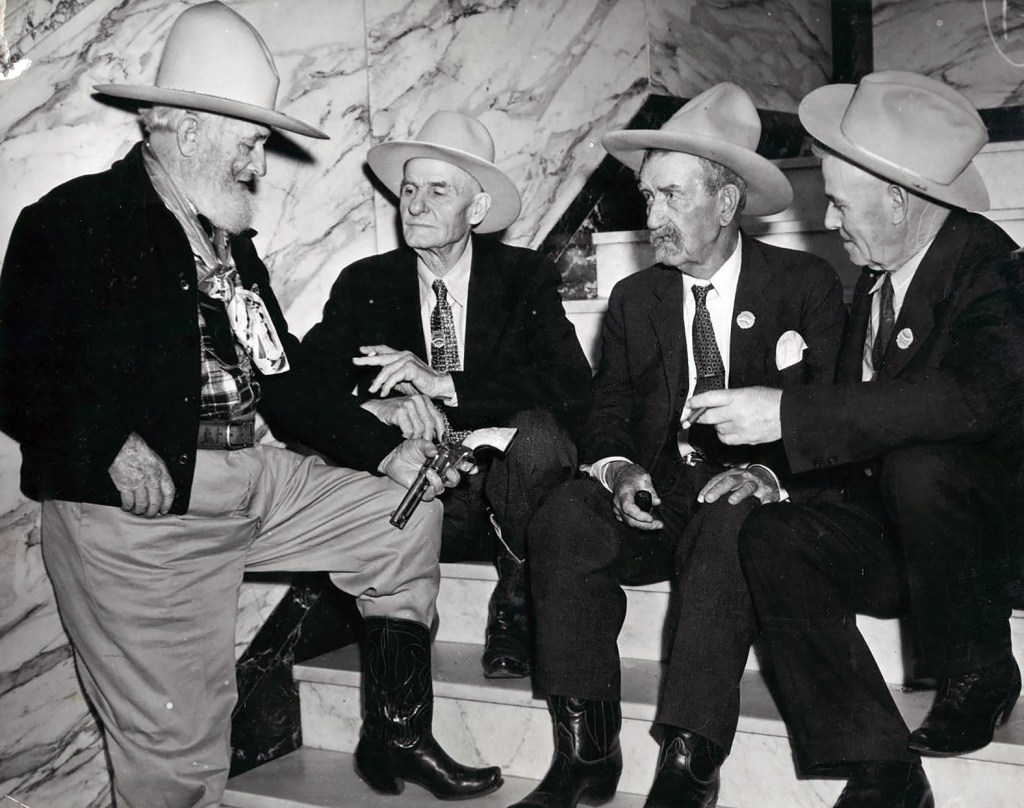
Left to right, John R. Hughes, Ellison Carroll, A. P. (Ab) Blocker, and Bob Beverly wearing cowboy hats and smoking cigars on the steps in the lobby of the Westbrook Hotel in Fort Worth at the 1939 Texas & Southwestern Cattle Raisers Association convention. Image credit: Cattle Raisers Museum in Fort Worth
Clipping:
The Collinsville News, Collinsville, Oklahoma · Thursday, February 16, 1939


 Old Lea County, N.M.