Old Lea County, N.M.

Author: Texoso

  • Howard Hendrix Hamilton and Bernice Garrett Hamilton

    Howard Hamilton (1885 – 1963) was the son of William B. Hamilton and Josephine Missouri Melton Hamilton. He was born in Paint Rock, Concho County, Texas on May 22, 1885. Berenice (or Bernice) Garrett (1891 – 1988) was also born in Texas. She was the daughter of John Thomas Garrett (1868 – 1928) and Carrie Ella McMillan Garrett (1873 – 1916).

    Mrs. Garrett was interviewed by the Hobbs Flare in 1979. She recalled moving to Lea County in 1902 with her family when she was twenty-one years old. They lived in a dugout until they could build a house. She and Howard were married in 1925.

    Howard was interviewed by the Hobbs Flare in 1959 as he recalled the first drift fence built in the area. A drift fence is usually thought of today as any long continuous fence designed to keep cattle or horses from straying. In Lea County, the drift fences were the first type of fencing used to confine cattle to a certain area, to keep them from drifting away. Prior to the use of drift fences, the area was what was called open range. Mr. Hendrix referred to the fence as being the first drift fence between Amarillo, Texas and Carlsbad.

    Mr. Hamilton passed away in 1963 and Mrs. Hamilton survived him until 1988. Both are buried in the Lovington Cemetery.

  • Jal Becomes a City, 1950

    Governor’s Proclamation

    [Transcribed from the Jal Record, Jal, New Mexico, 27 Apr 1950.]

    This proclamation, made, issued and published this 24th day of March, in the year of our Lord one thousand nine hundred and fifty, by the undersigned, Thomas J. Mabry, governor of the State of New Mexico, that:

    Whereas, on 6th day or February, 1950, the incorporated town of Jal, Lea County, New Mexico, by resolution duly enacted expressed the desire through its board of trustees, to apply to the governor of the state or New Mexico to make, issue and publish a proclamation of the fact that the said town desires and is entitled to become a city as provided by section 14-317 and 14-318 New Mexico statutes annotated 1941 compilation, and

    Whereas, the mayor of said town of Jal was designated by the said board of trustees to act as chairman for the purpose of making a sworn statement showing the facts and matters required by law to be stated in such application, and

    Whereas, the said chairman, by sworn statement and with the unanimous approval of the said board of trustees and with the attestation of the town clerk, did state and show following facts, to-wit:

    l. That the name of the proposed city is the City of Jal.

    2. That the boundaries of the proposed city and the lands to included therein as shown by the attached plat are as follows:

    Jal townsite: Section 17, 18, 19, 20, 29 and 30, township 25th south, range 37 east, Lea county, New Mexico.

    Beginning at the southeast corner of Jal townsite said said point being the southeast corner of said section 29, thence west along the south boundary of said section 29 and 30 a distance or 8940.0 feet to the southwest corner of said townsite, thence north to a distance of 9355.9 feet, thence north 19 degrees and 46 minutes east a distance of 688.5 feet to the northwest corner of said townsite, thence south 89 degrees and 52 minutes east along the north boundary of said section 18 a distance of 1321,2 feet to the common corner between said section 17 and 18 and section 7 and 8, said township and range, thence north 89 degrees and 37 minutes east along the north boundary of said section 17 a distance of 5280.0 feet to the northeast corner of said section 17 and the northeast corner of said townsite, thence south 0 degrees and 02 minutes east along the east boundary of said 17, 20 and 29 a distance of 15840.0 feet to the point of beginning, containing 3075.44 acres, more or less.

    3. That the center of said proposed city as heretofore established by the Board of trustees of the town of Jal is as follows:

    Commencing at the point where the NE corner of the SE 1/4 of section 19, and the NW corner of the SE 1/4, section 20, township 25 south, range 37 east N. M. P. M, coincide for a point of beginning, which point is the center of the proposed city of Jal.

    4. That the boundaries of said proposed city do not exceed one and one half miles from the center of the proposed city as set forth above.

    That the estimated assessed valuation of all property within the limits of said proposed city as shown the official record of Lea county is $595,203.00.

    6. That the population of the proposed city is in excess of 2000.

    7. That the town of Jal is entitled to become and desires to become a city.

    NOW, therefore, in accordance with the laws in this case made and provided, and the power vested in me as governor of the state of New Mexico, the said town of Jal be, and is hereby proclaimed to be a city, to be designated as the City of Jal, with all the powers, privileges, duties and the liabilities of the cities in the State of New Mexico, and that the lands, areas and territory hereinabove described be, and the same are hereby declared be within the corporate limits and jurisdiction of the said city of Jal, and that this proclamation shall be conclusive evidence of all the facts herein contained and recited.

    In witness whereof I have hereunto affixed by official signature on the day and year this proclamation first above written.

    Thomas J. Mabry, Governor of the State of New Mexico

    Attest: Alicia Romero, Secretary of State
  • Archie Dow Wood

    The headline in the Hobbs Daily Flare issue of January 27, 1961 read “Death Takes Pair of Old-Timers From Lea Scene.” It related the recent passing of John W. Green and Archie Dow Wood. A. D. Wood was 79 years of age and lived south of Lovington on the Arkansas Junction Road. It added that he moved to Lea County as a boy, started his own ranch and also said that he had served as a deputy sheriff for fifteen years during the oil boom. Survivors included his wife and son as well as numerous grandchildren and great grandchildren.

    Archie Dow Wood was the son of George Washington Wood and Jessie Lucinda Cauble Wood. He grew up in Texas and Oklahoma before coming to New Mexico when he was fourteen years old working on ranches for others until he “filed on a government claim” of his own. After Lea County was formed, he worked as a deputy sheriff from about 1922 to 1933 and served as a New Mexico cattle inspector for nearly forty years. He retained a title as special deputy of Lea and other counties for many years as well.

    A. D. was one of the organizers of the Open Range Cowboys Association. They started meeting informally in the early 1930s and were more formally organized around 1940. He was known as a great story teller and enjoyed relating the early days of the area even before Lea County was formed.

    He was first married to Jessie Pearl Markley and secondly to Mary Beth Wilf. A. D. passed in 1961 and was interred at Lovington Cemetery. Mary Beth survived him until 1986. She is also interred at Lovington Cemetery.

  • “Uncle Bill” Oden Talks About the Old Days

    Transcribed from the Pecos Enterprise (Pecos, Texas) – August 19, 1938


    B. A. “Uncle Bill” Oden, Authentic Old-Timer, Gives Historical Sketch of Monument Landmark

    B. A. “Uncle Bill” Oden, Who’s been in the trans-Pecos country since time began, was asked recently by the Hobbs Chamber of Commerce, to give a historical sketch of the famed Rock House in Monument Springs, New Mexico.

    The rock house, subject of a recent story in the Cattleman’s magazine, is one of New Mexico’s oldest land-marks and its origin has been a controversial subject for years.

    Uncle Bill was in the New Mexico country in 1884, and is one of the oldest living early settlers of that section. The story he wrote for the Hobbs Chamber of Commerce and also for the Cattleman’s magazine, is reprinted below:


    According to promise, I am going to give you a true history of the old rock house at Monument Springs. I, a boy of 18, went to what is now the San Simon ranch in 1884. I, being young and everything being new and of interest to a lad of that age in a country as wild as that was, remember things more vividly than things that happened ten years ago.

    Bound for Lincoln!

    I hired to Mr. Divers at San Angelo some time about the middle of June of that year when he was passing though there with about 1250 head of cattle bound for Lincoln County, New Mexico. I worked for him nine years at what is now the San Simon ranch and I, as a cowboy, new all the first settlers of the country. These I will give you in the course of this article.

    From San Angelo we traveled up the North Concho to somewhere above where Sterling City now is. We turned north and crossed the T and P Railroad Company at Iatan Tank about 15 or 20 miles east of Big Spring. There we turned northwest toward the head waters of the Colorado River. There we camped around two months waiting for it to rain before starting across the Plains. Around the middle of August it began to shower and we started and as luck smiled on us, it rained the second night out and we turned the cattle loose and they all got well watered. The next water we got was in small lakes about where there the town of Hobbs now is. We stayed there for a few days and went on to Monument Spring. There we found Jim Harvey and Dick Wilkerson, two buffalo hunters, who had preempted the spring. In other words, they had what was known as squatters right to spring and so much land. They, Harvey and Wilkerson, had hauled the Monument, of rock the soldiers had built on a hill about three-quarters of a mile west, and built the rock house and a small stock correll [corral] near the spring. The little rock house had port holes in the corners for protection from the Indians and when we passed there about the 27th day of August, they slept in the gate of the correll to protect their horses from the Indians. The place where the San Simon ranch is was known by the soldiers and buffalo hunters was Dug Spring. It was only six feet to water but it had to be pumped with horse power. In the spring of 1885 R. F. Kennedy bought Monument Spring from Harvey and Wilkerson, paying them $5,000 for same, and they moved about 1000 head of cattle there from Gonzales County in Texas.

    Ranchers Begin Locating

    In the fall of 1885 E. H. Estes located eight or 10 miles west of there at a well he bought from Louis and Guyat Faulkner and started what was known as the 7Z7 ranch, which is operated for several years. In 1886 there were several ranches started in what is Lea County, New Mexico, and Gaines County, Texas. J. M. Daughtery started what was afterward known as the 84 ranch about 15 or 20 miles south of Monument Spring and also Frank and Ed Crowley located along the line of New Mexico and Texas east of the town of Hobbs.

    Uncle Henry McClentock started the next ranch about 15 miles east of the New Mexico line in Gaines county. South of the 84 ranch was McKenzie Brothers, J. M. and Gene. Farther down the draw toward the southeast corner of New Mexico was Cowden Brothers, later known as the Jal Ranch.

    The W. C. Cochran ranch was where the present town of Jal is, and east of the 84 ranch Bill and Dave Brunson settled. North of Hobbs was the Atwood or Mallet ranch, about five miles south of the present town of Lovington George Causey settled. He was a buffalo hunter and didn’t own any cattle for several years. The above named ranches were started from 1886 to 1888. In 1884 the ranch farthest west was the TJF ranch on the head waters of the Colorado river. With the exception of another old man by the name of Anderson, who had a small bunch of cattle at a weak spring at Cedar Lake in Gaines County, there were no more ranches or cattle between there and the Pecos river. The cattle we had were the first to water at Monument Spring. Harvey and Wilkerson were the only permanent settlers.

    Few Buffalo Hunters Left

    There were a few other old buffalo hunters in the country but they camped around wherever they could find water and killed antelope in the summer, and buffalo and antelope in the winter. They dried the meat, (which they called jerkey) in winter. Those who were there any length of time after I went there were Louis and Guyat Falkner, Rankin More, Judge and Jon Kink Kuykendall and an old man by the name of McConvill, who dug wells for ranchmen for several years. Rankin Moore never owned any interest in the spring, though he might have helped haul the rock. The house was built in the winter of 1883 and 1884, but it wasn’t quite finished when we passed there. The well was dug about 1888 and might have been dug by Jim Andrews as he was working for Mr. Kenney at the time. Rankin Moore settled in Andrews County, Texas, near the line of New Mexico. He dug wells for McKenzie Brothers for twenty cows and calves and ranched them there a few years and sold out to Uncle Billy Daughtery and left the country.

    During the nine years I worked for Mr. Divers, I attended roundups extending from the site of Lubbock to Drockett County and from Black River, New Mexico, to the Live Oak Creek, in Crockett County.

    H. E. Cummins, who lives in Midland now, was hired by Jim Harvey in Colorado in the fall of 1884 to skin buffalo and antelope and cook. He cooked for them all winter and caped part of the winter at the ranch where I worked and owned by Frank Divers. He has the honor of being the last of the buffalo skinners, as the winter of 1884 and 1885 was the last of the buffalo in commercial quantities.


  • Clay McGonagill

    Henry Clay McGonagill was born on September 24, 1879 to George M. McGonagill (1841 – 1921) and Narcissa Josephine “Grandma” Haynes McGonagill (1839 – 1935) in Sweet Home, Texas. His family were ranchers and he grew up in West Texas and Southeastern New Mexico as they finally settled in Lea County. It was there that he learned to ride and rope as he lived and worked on the family ranches. Later he did some cowboying for other ranchers.

    For many years, Clay was a championship rodeo contestant and supported himself with his rodeo winnings, primarily in steer roping. In the day, many such rodeos were local affairs and some were known as “fairgroundings.” McGonagill nevertheless developed a wide reputation in the rodeo world competing in the United States, Canada, Mexico and at least one time in South America. Clay moved around over the years, but for a while he operated out of a ranch in Monument.

    He married Annie Laurie Johnston in 1904 and the couple was living in Arizona when Clay was accidentally electrocuted. On October 24, 1921, he was hauling hay on the Papago Indian Reservation near Sacaton, Arizona when he came across a low hanging power line. In trying to clear the roadway to make room for his hay wagon, he came on contact with the power line carrying 11,000 volts of electricity and was instantly killed.

    Clay is buried in the Lovington Cemetery in Lea County along with his parents. He was inducted into the National Rodeo Hall of Fame in 1975.

  • Wacker’s Five and Dime

    Wacker’s stores could be found in most of the larger towns in Lea County, usually in the central business district. The stores were named for G. F. Wacker of Oklahoma. He had been working at a dry goods store in Ballinger, Texas and had the vision to start his own store selling low priced goods.

    Wacker resigned his position in Ballinger in 1917 and went back to his home town of Ellinger, Texas where he secured a small loan and bought the inventory of a bankrupt variety store. He opened his first store in Hugo, Oklahoma. This was the start of a chain of retail stores. After the modest success of his first outlet, George Wacker, his brother Hugo Wacker and some other friends opened four more stores in Oklahoma. To this, they set up the company headquarters in Pauls Valley, Oklahoma in the early 1920s. Eventually their holdings included several hundred retail stores. At their peak, Wacker’s consisted of more than 200 stores in at least five states.

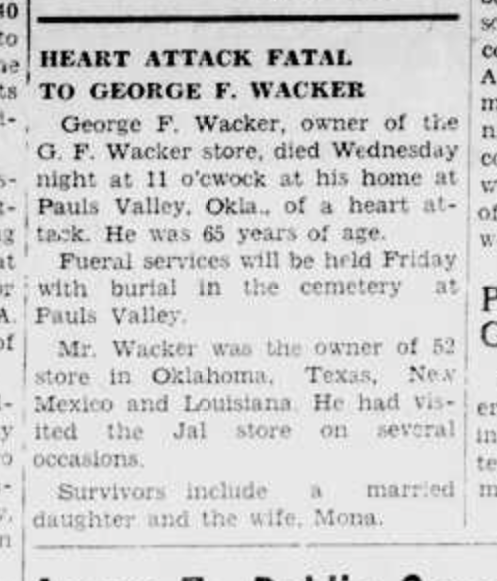
    George Wacker died in 1950. The stores continued on for a number of years under successor ownership. Sometimes when companies merge or go out of business, there is more of a trail, but so far we have round nothing on how this business was finally wound up.

    George Wacker’s death notice:

    Jal Record, Jal, New Mexico, 9 Feb 1950
  • Seligman County?

    There has long been a rivalry between Hobbs and Lovington, and in 1931 there was a move to subdivide Lea county into two counties, one retaining the name Lea and another called Seligman. The Albuquerque Journal issue of February 27, 1931 carried an article with these headings “Would Divide County To Honor Arthur – Hobbs and New Hobbs Have Plan for ‘Seligman County,’ Using Court House In Common.”

    The Associated Press article went on to say that the people of Hobbs wanted to preserve the “posterity” of Governor Arthur Seligman by splitting Lea County in half and creating one named for the Governor. A proposal to approve this change was introduced to the New Mexico senate by Senator Taylor Julien. New Hobbs still existed at that time but the older town of Hobbs would serve as the county seat.

    Two weeks later, the Roswell Daily Record issue of March 11, 1931 carried these sarcastic comments: “Seligman county has been killed. There never was any excuse for creation of two counties in Lea county. In fact, there is hardly any excuse for one county. But creating a new county would have meant additional offices and that seems to have been the only excuse for it.”

    Arthur Seligman was governor of New Mexico from 1931 until his death in 1933. He was preceded by Richard C. Dillon and succeeded by Andrew Hockenhull.

  • Pooch Saves Baby

    On January 26 at 3 o’clock, Marilyn Janet Justis, 2, was playing in her yard with Mr. K. B. Walker’s dog, Pooch. A few minutes later she wandered away and fell into an empty cess pool. Pooch howled and danced around the mouth of the hole until he attracted the attention of Marilyn’s mother, Mrs. D. W. Justis.

    With the help of a man who happened to be passing, Mrs. Justis rescued her daughter from the cess pool.

    [Jal Flare, Jal, New Mexico. 6 Feb 1947.]

    [Note: Marilyn Janet Justis was the granddaughter of Charles W. Justis, one of the earliest residents of the area around Jal and usually considered to be the founder of Jal.]

  • Allen Clinton Heard

    A. C. “Daddy” Heard was born in February 23, 1858 in DeWitt County, Texas. His parents were Humphrey Whorley Heard and Louisa Ellenor Foster Heard, and he was one of eight children. When he was an older teenager, he began working cattle for one of his brothers in Texas. He next rode on the cattle trails as a cowboy for about three years before settling for a time in Tom Green County, Texas where he worked for his brother Jasper and Tom Word. He later worked for another rancher near the Pecos and began to build a herd of his own.

    Heard came to Southeastern New Mexico in 1894 around which time he became a co-owner with others in a cattle ranch they purchased out of the old Mallet Ranch and renamed the High Lonesome Ranch. He and others had driven cattle from Texas to what was then Eddy County. At the time, the gramma grass was said to be lush and high. Heard improved his stock by bringing in the first registered Hereford bulls to the area in 1910. His brother and former partner Jasper Newton Heard died in Texas the following year in a ranching accident in which his horse fell on him. The supposition was that both horse and rider died after getting tangled in a rope.

    Heard continued to operate the High Lonesome until around 1927 when it was sold. Heard had earlier moved his family to Carlsbad around 1900. Over the years he served as mayor of Carlsbad, county commissioner of both Eddy and Lea counties at various times, including being one of the first three county commissioners of Lea County when it was formed around 1917.

    Heard was one of the founders of the Presbyterian Church in Lovington. It is also said that he was primarily responsible for seeing to it that a paved road was built from Carlsbad to Lea County. He served as a director of the First National Bank of Carlsbad and was also a State Representative from 1920 to 1924. He was a life member of the New Mexico Cattle Growers’ Association. He and his wife, the former Talovia Elmira Newcomer, had two daughters. Heard was often mentioned in local newspapers for events happening at the ranch and for other activities involving his family. He passed away at the age of 86 on July 6, 1944 in Bernalillo County and is buried there in Albuquerque’s Fairview Memorial Park.


  • John Scharbauer

    John Scharbauer (1854 – 1941) was a long time ranch owner in the area. The family name is a familiar one to people from Lea County. In commemoration of his birthday, a number of his friends got together and honored him, as noted below.


    Loving Cup Inscribed in Gold Given Scharbauer by Friends

    “Going Strong Since 1851 – 83 Years of Service”

    This inscription in raised, gold letters appears on an attractive loving cup which was presented Christmas Day to John Scharbauer by Walter B. Scott as a birthday gift from 15 of his oldtime friends. Scharbauer, cattleman, well known to stock men of West Texas, will be 83 years old Friday. Also on the cup which bears Scharbauer’s name is the wording “A Pioneer, a Patriot, a Splendid Citizen and Loyal Friend.”

    Besides Scott, those who joined in the presentation of the gift were J. Lee Johnson Sr. W. E. Connell, Hugh Rigers, Guy L. Waggoner, T. Z. Hamm, W. O. Shultz, E. B. Spiller, M. C. Ulmer, T. B. Yarbrough, W. C. Stonestreet and Amon G. Carter, all of Fort Worth; Millard Eidson and Dick Lee, Lovington, N. M. and Clarence Scharbauer, Midland.

    Scharbauer, who has an office on the first floor of the Worth Building, still loves the range. He frequently takes horseback rides and can “outride” many men much younger.

    In 1880 he came to West Texas and seven years later moved to Midland. Although Fort Worth is his home, he spends several weeks each year at Midland where he has a ranch and cattle interests and where many of his oldtime friends are located. Born in Indian Fields, N. Y., by the time he had reached 28 he accumulated what he thought was a small fortune, $2,000, and went to Abilene in a covered wagon. There he entered the sheep business.

    His first enterprise in Texas was successful and at one time he was the owner of more than 20,000 sheep.

    In 1890 Connell Brothers and Scharbauer organized a private bank at Midland which was the beginning of the present First National Bank of that city. Several years ago there was a false report circulated in Midland and a “run” on the bank started. Scharbauer and Marvin Ulmer, cashier, chartered an airplane in Fort Worth and took $100,000 in currency to the Midland bank and stacked it on the counter. They invited customers to “come and get it,” but instead, they walked out, leaving their deposits.

    Almost 43 years ago Scharbauer began raising cattle. He decided Herefords were the best breeds for his section and he is a pioneer in the development of that breed around Midland County. His registered herds have gained worldwide attention.

    Clarence Scharbauer, his partner and owner of the hotel that bears his name at Midland, now manages their ranching interests. He is a nephew of John Scharbauer. They have ranch interests in New Mexico, and Midland, Martin, Gaines and Andrews Counties.

    Scharbauer is a director in the First National Banks of Midland and Fort Worth.

    [Source: Fort Worth Star-Telegram (Fort Worth, Texas), 26 Dec 1934.]