Old Lea County, N.M.

Category: history

  • Power’s Motel in Lovington

    Early settlers, Dick and Mary Power, owned a motel south of downtown Lovington and it served the area for many decades. Mary was the former Mary Eaves whose family had come to what became Lea County in 1909 and Dick arrived in 1914. She was the daughter of Paschal Simeon and Mary Susan Brown Eaves. Dick’s full name was Earnest H. Power. He was the son of Augustus Earnest and Edna Latham Power. Before he and Mary ran the hotel, Dick once owned and operated a cafe named Dick’s Cafe that was located downtown

    The address of the motel was 215 E. Avenue B. The grounds had some beautiful elm and pecan trees which were formerly part of the Eaves family’s orchard. The oldest units were 27 rooms built in 1947 and 12 more units were added in 1953. The old motel was demolished many years ago and a City office building now sits on the former site.

    Dick passed in 1974 and Mary followed him in death in 1982. Both are buried in Lovington Cemetery.

    The Power’s Motel Lovington, NM in 1940 – Image credit: cardcow.com
  • The Loose Balloon

    On May 6, 1978, an advertising balloon became detached from the ground at a motor vehicle dealership in Hobbs. A doctor and an employee of the dealership noticed that it was coming untethered and got in touch with Lea County pilot Zip Franklin who first flew after the loose balloon and finally brought it down after shooting it with a .22 and finally with a shotgun. It came down outside Levelland, Texas and when it did, the dealership employee who had been trailing it in his pickup became trapped in the fabric of the collapsed balloon. Franklin and the doctor administered aid until medical assistance arrived. The dealership employee had to be hospitalized but all three survived.

    Franklin said that the balloon reached heights of 15,000 feet above sea level and estimated that at its peak, the balloon was as large as a house.

    (Thanks to R.O.F. for telling us this story.)

  • Founding of Tatum

    [Transcribed from the 60th Anniversary Collector’s Edition of the Lea County Fair and Rodeo program for the event held August 5-12, 1995]

    Tatum, the crossroads on the high plains, began with the arrival of James Green Tatum August 9, 1909. Mr. Tatum along with his wife Mattie and daughter Martha James made the trip from San Antonio to Roswell and traveled by wagon and team across the Pecos River to reach his 320 acre homestead on the Llano Estacado.

    James Tatum had been in the mercantile business and hoped to take advantage of the need for supplies that existed in the area. Numerous settlers had begun to come into the area and this made an ideal site for a general store. The Tatum General Mercantile Company was born and an application for a post office soon followed. Three names were submitted to the Washington Postal Department – Tatum, Martha James and Bilderback (another early settler that came in 1910). The Tatum Post Office permit was granted in 1909 and Mrs. Mattie Tatum was the first postmaster.

    In the operation of his store, Mr. Tatum had to make long freight hauling trips to Roswell or Elida. At times these trips would take two weeks. Meanwhile it was up to Mrs. Tatum to deliver and pick up mail besides running the general store.

    By 1912 the Tatum School District had been formed. Dr. Charles Bridges, O. M. Daniel, and E. J. Fox traveled to Roswell to establish the school. Because funds were desperately needed for the building, box suppers and rodeos were held to raise the money. $400.00 was raised to pay for the building materials that were hauled from Elida in wagons. The school patrons donated their labor and James Tatum donated the two acres for that first white two-story schoolhouse. The first term began in 1912 with Miss Belle Norton as the teacher. The students included Anita Bridges, Willie, Mattie, and Earl Daniel, Robert and Lowell Fox, Dana Howard, Joseph James, Lambert Eaton, Lydia and Earl Seals and Mary London.

    Tatum’s first doctor arrived in 1911. Dr. D. C. Bridges arrived with his wife who was in frail health and he filed on a homestead claim. Dr. Ruff arrived the following year to set up his practice.

    Many of the smaller outlying schools consolidated with the Tatum District including Warren, Ranger Lake, McDonald, King, Bagley, Collum, Caprock, Mescalero, High Top, Gladiola, Crossroads and Pitchfork. By 1920 a new eight room school was built. In the early days of the school, church services were also held there. Reverend J. W. Allen held the first service for the Methodist Church.

    By 1912, J. W. (Mood) Smith and his family had established the first drug store while W. H. Anderson put in the first hardware store in 1914. The Tatum State Bank was organized in 1916 by W. H. Anderson, M. R. Anderson, Jim Anderson, Ott Anderson, and George Bilderback. The Plains Democrat was published by J. U. Williams in 1917 and Tatum had a newspaper. Tatum could boast a hotel opened by C. P. Byles in 1915 and a blacksmith shop in 1913 with J. J. Seals as owner.

    Tom Howard James brought the first telephone system to the Tatum Community in 1912. The party-line central switchboard style was located in the Tom Bess home and Georgia Bess and her daughter Jewell were the operators. Phone lines ran along the tops of fence wire and were attached to the fence posts.

    Tatum Power and Light was established in the early 1920s bringing electricity to the area. A diesel plant with two engines generated about fifty kilowatts of power and you were never certain about the reliability of the system. If you could hear the hum of the engine you could get electricity, otherwise you were out of luck!

    From its pioneer beginning as the center of the LIttlefield Cattle Company’s Four Lakes Ranch, Tatum has become a modern and close-knit community whose economy still depends on good ranch land and abundant water.

  • Beverly Thomas “Tootie” Schnaubert

    “Tootie” Schnaubert was born January 29, 1917 to Stephen Arthur Schnaubert and Ella M. Adams Schnaubert in Rankin, Texas. Both parents died in December, 1918 when he was not quite two years old, their causes of death unstated. Tootie and his two siblings, Leon and Stephen, went to live with their grandparents, Arthur and Mentie Schnaubert in Upton County, Texas. By 1930, the combined family was living in Carlsbad, New Mexico where Arthur was working as an electrician for Carlsbad Light and Power Company.

    Tootie married Peggy Jo Parks in 1939 and the couple would remain married until Peggy’s death in 1987. Tootie registered for the draft in 1940 naming his grandfather Arthur Francis as his next of kin and his employer as Homer Bryan of Carlsbad. He was 23 years old.

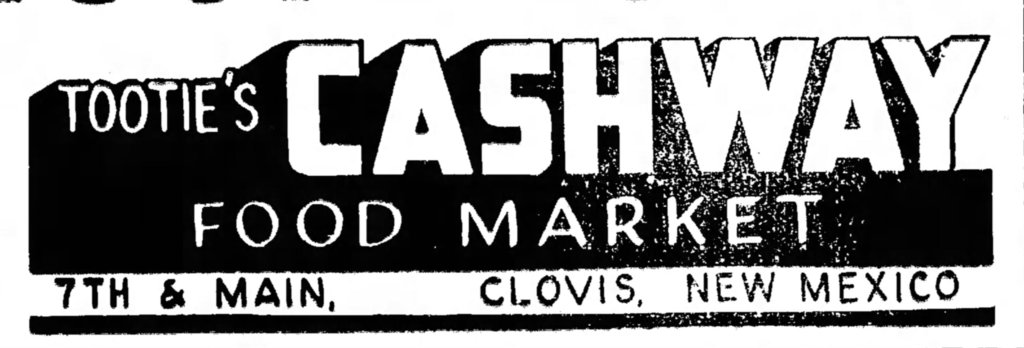
    Around 1950, Tootie opened up his first retail grocery stores in Hobbs and called them Tootie’s Cashway. A 1952 article in the Lovington Leader announced the remodeling of their Hobbs store giving it the largest floor space of a grocery store in Hobbs. It offered not Green Stamps but Pacific Stamps.

    It was not uncommon for the grocery to take out full page ads in local newspapers. The company also ran commercials on local radio stations. The melody was taken from an old Al Jolson song “Toot, Toot, Tootsie, Goodbye” and singer sang these lyrics. “Toot, Toot, Tootie’s Cashway. Ladies hear what we say…”

    Clovis News Journal Sun, August 30, 1959

    The company expanded to have multiple stores in places like Hobbs, Lovington and Clovis. It was not unusual to see Tootie’s image on the ads. Tootie eventually retired. Over the years, the company employed many people. An internet search of obituaries would mention that different individuals had worked in some capacity for Tootie’s Cashway.

    Peggy Jo passed away in 1987 and Tootie followed him in death in 1997. Both are buried in Memory Gardens in Hobbs, New Mexico.

  • A Lightning Story

    In the book, “Then and Now – Lea County Families, Vol. 1,” Fred B. Cooper (1915-1996) relates a family story of a lightning strike to his family home on September 27, 1910. The family was sleeping in their home in the Panhandle of Texas when a big electrical storm came up.

    Fred writes, “The lightning struck their clothesline wire, one end of which was tied to the house. Lightning followed the line to the house, making its way inside, splitting the lumber and throwing splinters in ever(y) direction over the room. The lightning then passed over a bed where James was lying and jumped to another bed in the same room, setting it afire, then passing near where his wife was sitting, then out the door. The fire was extinguished; another bolt struck a barrel of water at the well.” (1)

    The Coopers moved to Jal in 1914 and the above anecdote was part of Fred’s contribution to the book regarding the Samuel Rose Cooper family.


    (1) Lea County Genealogical Society, “Then and Now – Lea County Families, Vol. 1,” Walsworth Publishing Company, 1979.

  • The James B. Love Family

    James Benjamin “Jim” Love was the younger brother of Robert Florence Love. Both were sons of John Dillard Love and Mary Jane Austin Love. Jim was born on September 25, 1873 in Palo Pinto, Stephens County, Texas. By the time he was about seventeen, he began working on ranches in West Texas and on into New Mexico. (1) Jim’s father John D. Love died in 1889 at the age of 76. His mother survived John for about seventeen years and died at the age of 69.

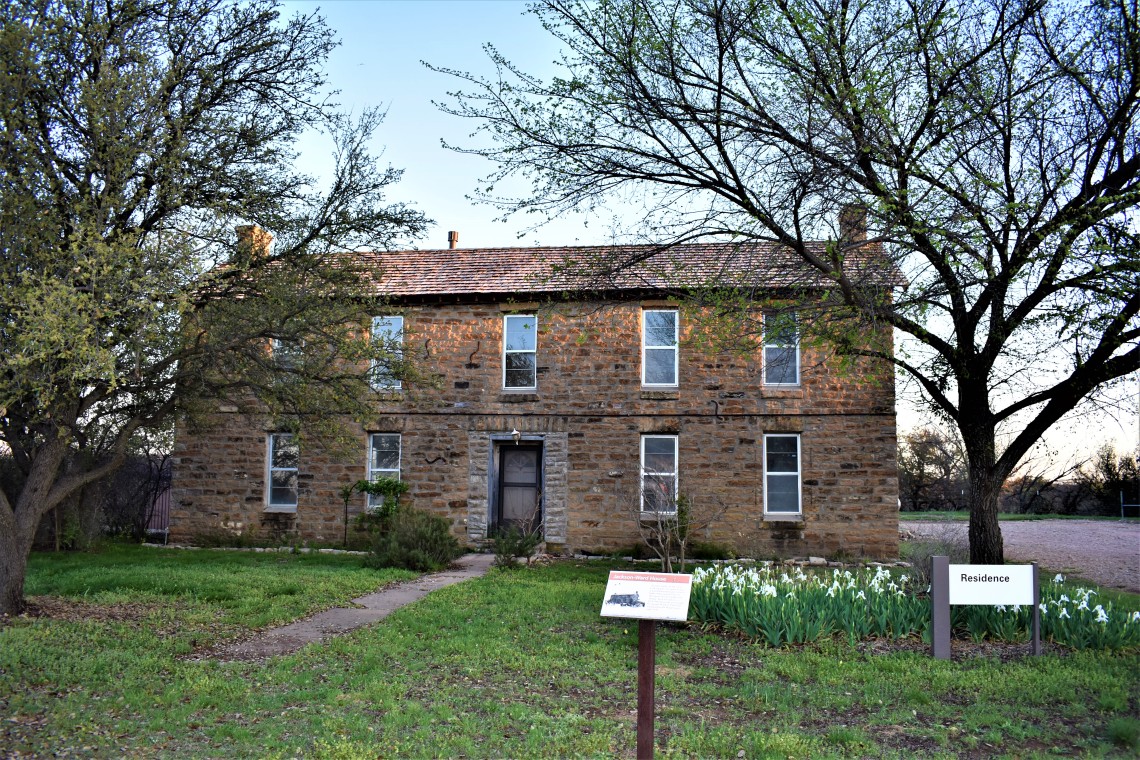
    Jim had met Mary Myrtleene “Myrtle” Ward who was living in Fort Griffin, north of Albany, Texas. Myrtle had been born in a rock house in old Fort Griffin, the town, according to her daughter Anemone Binkley’s account. There is only one remaining intact structure where Fort Griffin was located. It is called the Jackson-Ward house and is still standing, at last report. This is probably the house that Mrs. Binkley was referring to.


    Their first child, a daughter named Emma Leona was born the following year in Turkey, Texas. Another daughter, Ruth Alma, was born two years later in 1906. Soon afterward, the young family moved to southeastern New Mexico, then still a territory and settling first in the general area of Knowles. By about 1908, they were living in what would become the town of Lovington, named after the two brothers.(1)

    Jim operated the first mercantile store in Lovington on property he had acquired around what would eventually become the town square. To their family, five more children were born: Velma (1908), Jordan Ward (1910), Mary Kathleen (1910), Myrtle Jim (1914) and Anemone (1918).

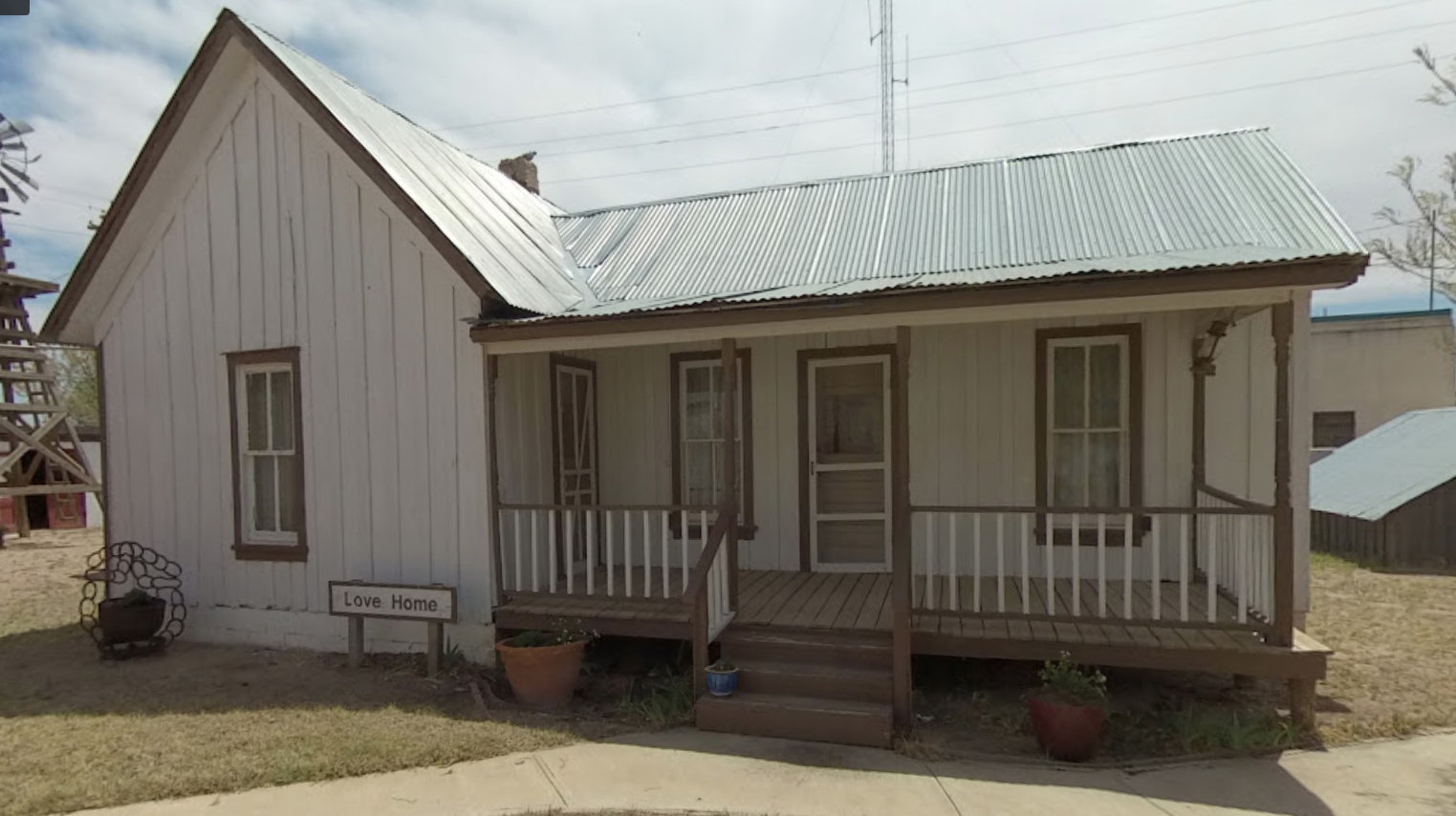
    Jim Love died in 1945. Myrtle survived him about 26 years until she passed in 1971. The home they lived in, pictured below, was originally located at 109 S. Eddy Street. In the spring of 1975, the children of Jim and Myrtle Love donated the home to the Lea County Museum. At that time, most of the children were still living, with the exception of Jordan, who had passed away in the previous year. The residence was later moved about two blocks to a location behind the Lea County Museum on Love Street, on the courthouse square. The home was renovated and furnished as it would have been in the past.


    (1) Lea County Genealogical Society, “Then and Now – Lea County Families, Vol. 1,” Walsworth Publishing Company, 1979.

  • Samuel Rose Cooper, Early Settler

    Samuel R. Cooper was an early resident of Lea County. He was born near Salina, Kansas in 1874. When he was six years old, his family moved to Erring Springs, in the Chickasaw Nation, Oklahoma Territory, now known as Oklahoma.

    As a young adult around the age of 21, Mr. Cooper left his family and moved west to Mobeetie, Texas in the Panhandle. He worked on several ranches including the XIT ranch. He also recalled hunting prairie chickens and sending them to markets in Kansas City and St. Louis, Missouri. When he was 27, he married the former Jessie May Gray and the young couple moved to a farm near Mobeetie and supplemented his income by cutting wood and transporting it by ox teams. He also hauled and sold cottonseed cake to ranches int he area.

    In 1914, two years after New Mexico became a state, Mr. Cooper sold his Panhandle farm and moved to the area. He homesteaded a half section located roughly ten miles northwest of the area that would give rise to the town of Jal and later added another half section to his homestead holdings. His brothers and father were already residing in New Mexico. Mr. Cooper built a one room house with a dirt floor early on, and lived there for a few years before building a more substantial home. The first three years they were in the area, they had to rely on water which they hauled from Mr. Cooper’s father’s property, but in 1917 they were able to drill their own well and set up a windmill to provide their water supply.

    At that time, a one room schoolhouse served the community children and also provided a place for community gatherings and Sunday School meetings each Sunday morning.

    After some time, the Coopers set up a post office with Mrs. Cooper serving as post mistress. They later established a small mercantile store near their home, supplying it with goods freighted in from Pecos, Texas. The goods were transported by two large wagons in tandem, pulled by a team of twenty burros.

    Oil was discovered in Jal around 1929, and Mr. Cooper recalls that all structures, including barns and chicken houses were converted to housing for oilfield workers. One additional benefit of the oil boom was that Mr. Cooper then was able to get natural gas service to his home where he previously only had wood and kerosene for home use.

    Mr. Cooper passed away in 1958 at the age of 84. He had lived in Lea County for forty-four years. His services were held and the Church of God in Jal, of which he was a charter member. He was buried in the Jal-Cooper Cemetery on land that he donated. His wife Jessie survived him another eighteen years. He and Jessie had eight children, four sons and four daughters, all of whom survived him along with 29 grandchildren and 17 great grandchildren.

  • Mescalero Ridge

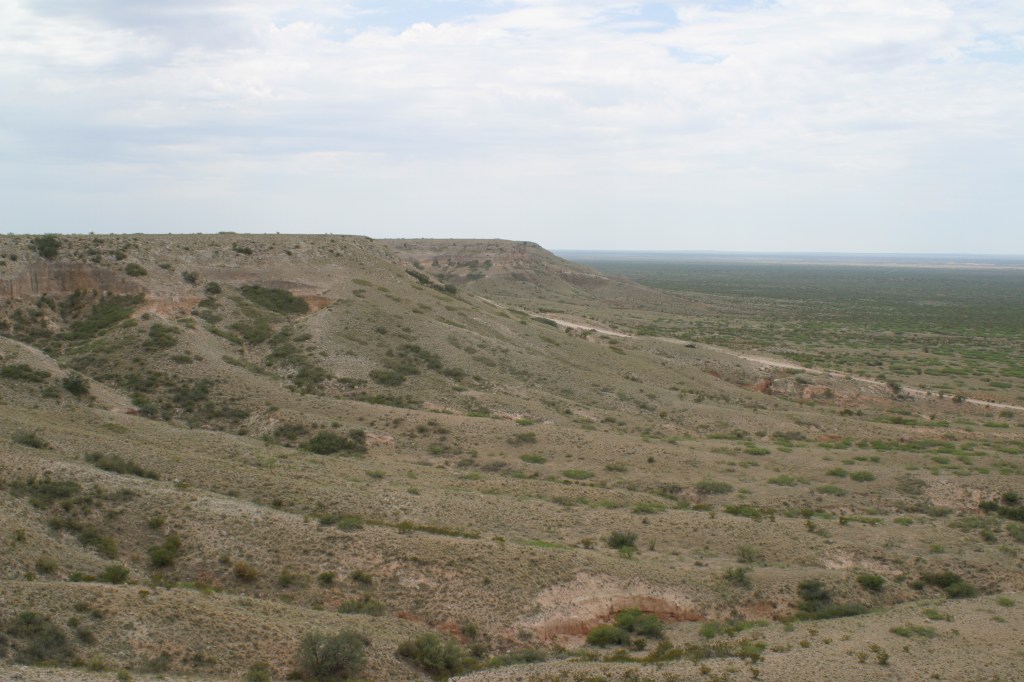
    Mescalero Ridge is a name given to the geological feature that is part of the larger Caprock Escarpment. It begins in eastern Chaves County in New Mexico and runs for fifty miles roughly parallel to the county line of Lea County. Its name comes from the Mescalero Apache tribe who once resided and hunted in this general area. It is likely the most distinguishing landmark of the Lea County area.(1)

    Image believed to be in the public domain.

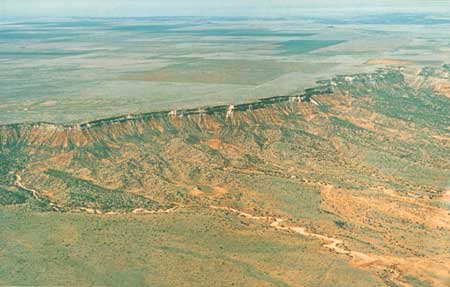
    For illustrative purposes, below is an image of the same escarpment system located further north in the state.

    Elevated view of the Mescalero Escarpment in Quay County near Tucumcari. Image credit: nps.gov

    (1) Julyan, Robert, “The Place Names of New Mexico,” University of New Mexico Press, 1998.

  • Arkansas Junction

    Arkansas Junction is a name given to the intersection of New Mexico highway 483 and US 62-180 (the Hobbs-Carlsbad highway). The location never really rose to the level of a settlement or community, like some others in the county, but most of the time has had businesses there, such as a gas station and a cafe. The Arkansas Junction Road is a name given to New Mexico highway 483 that runs due south from Lovington to the intersection. The actual origin of the name Arkansas Junction is unknown and is lost to history.

  • The Joseph Hall Graham Family

    Joseph Hall Graham was born May 18, 1848 to Spencer Corp Graham and Nancy Venters Graham in Denton County, Texas. Both of his parents died in the mid to late 1860s. Joseph married Marianne (or Marian) Elizabeth Johnson of Tarrant County, Texas in 1879. The census in 1880 shows them to be living in Young County and they were raising cattle. Their family consisted of the two of them and three of Joseph’s younger siblings, all in their twenties. They also began their own family that same year with the birth of their first child, a daughter named Alice. By 1900, the census showed that all seven of their children lived with them at home in Midland, Texas and Joseph was a rancher.
    Around that time, Joseph bought the Allen ranch in what was then Eddy County, later to become Lea County. The ranch was called the Rock House Ranch, which had previously been owned by the Causey brothers. The Causeys had built a rock house in 1883 located about 15 miles south of Lovington to the east of Arkansas Junction Road. The house was built from native stone in the area and the ranch took its name from it. The Causeys had another ranch house about 5 miles south of Lovington and northwest of there that predated the Graham house by a few years. It had a similar look to the Graham rock house. The northern most house is believed to be the oldest standing structure in Lea County. Joseph Graham ran a cattle and horse ranch out of the Rock House Ranch location for many years and was a founding member of the “Plains Pool” which was a group of ranchers who banded together to run cattle in the land between the Pecos River and one fence close to the old Eddy and Chaves county line before other settlers and land owners began fencing off their property.
    The Joseph Hall family were witnesses to the early days of Lea County from the open range days to the fencing and subdivision of the land, the development of settlements and towns, the discovery of oil in the county, and many other landmark events. Some of their children moved away, but several remained in the area. Those that remained included Jody (Joseph Jefferson Graham), Spencer and Rebecca.
    Joseph Hall Graham died in 1931 at the age of 83. Marian Elizabeth survived him about another 17 years until her death in 1948. Both are buried in Lovington Cemetery.